



Leather Saddle Toy
These leather saddle toy pieces are tactile Victorian and Edwardian wooden rocking horses and pull along toys built to last generations.
Leather Saddle Toy
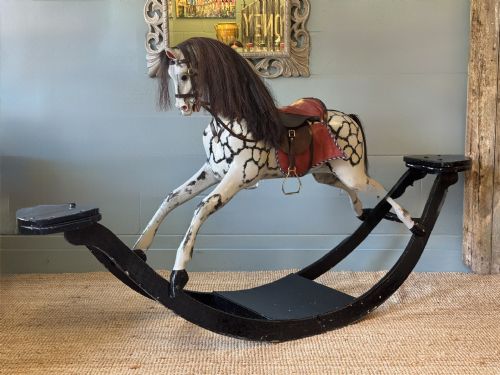
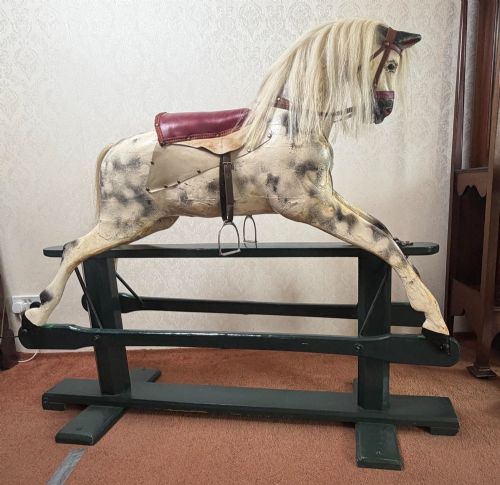
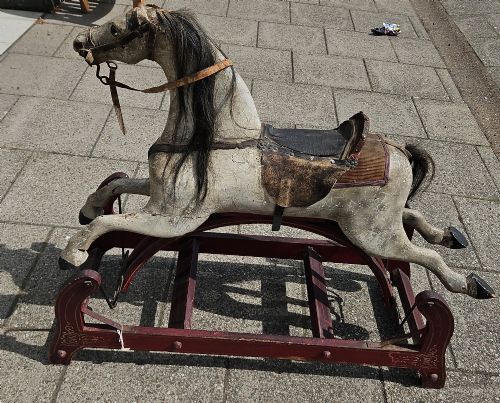
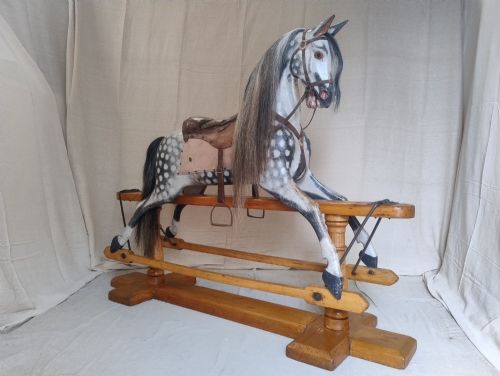
The versions you will most frequently meet on this page are large carved wooden rocking horses mounted on original rockers. They combine carved pine bodies, horsehair manes and tails, and fitted leather saddles designed for nursery use.
Alongside grand rocking horses, the evidence includes smaller child's pull along horse formats. These pieces range from compact Victorian examples up to extra large twentieth century variants from established makers.
How they were made
Makers constructed these figures using carved wood and pine foundations, shaping the equine forms by hand before applying painted finishes and dapple details. Metal, iron, and steel components provided internal reinforcement and sturdy hardware for the swinging rocker frames.
Biological and natural materials completed the tactile realism of the toys, utilising genuine horsehair for manes and tails. Real leather formed the fitted saddles and tack, while glass eyes added a lifelike gaze to the carved wooden heads.
Leather Saddle Toy Retail Price Guide 2026
Typical asking prices for leather saddle toy among the pieces listed under this phrase on Sellingantiques today, from the lower quarter to the upper quarter. They describe what is for sale here now, not the wider market.
Listings feature items spanning the Victorian era through to the 1940s, utilising carved wood, horsehair, pine, and leather.
What varies in quality
Quality rests upon the depth of the carving and the original integrity of the painted surface, particularly where dapple patterns survive with minimal intervention. Scale and proportion also dictate standing, with larger examples from documented makers commanding greater presence.
The survival of original components such as the wooden rockers, glass eyes, horsehair, and fitted leather saddle elevates an example significantly. Pieces retaining their original structural ironwork and uncompromised pine frames represent the pinnacle of the maker's art.
G & J Lines of London·F.H. Ayres·Collinson
The Leather Saddle Toy Glossary
- Rocking Horse
- A large toy horse mounted on curved wooden rockers or safety stands designed for children to ride. These objects form the majority of surviving antique horse toys.
- Pull Along Horse
- A smaller toy horse mounted on a platform with wheels or runners so a child could pull it along the floor. These pieces date from the late nineteenth century.
- Horsehair
- Natural hair harvested from the mane and tail of horses, used by makers to give antique toys a realistic texture and appearance. It is secured firmly into the carved wooden head.
- Pine
- A softwood utilised extensively by carvers for the main body blocks of antique rocking horses because it accepts detailed chisel work and holds paint well.
- Dappled
- A painted finish mimicking the mottled coat pattern of certain horses, applied by hand in grey or dark spots over a lighter base colour on antique toys.
Leather Saddle Toy: Frequently Asked Questions
How do I date an antique rocking horse?
Dating relies upon examining the construction methods of the carved wooden body, the style of the paint finish, and the type of ironwork used on the rockers. Earlier nineteenth century examples often feature heavier pine blocks and simpler stances compared to later twentieth century variants.
Makers' stamps, where present on the wooden safety frames or under the belly, provide a direct reference. Comparing the construction of the leather saddle and glass eyes also helps narrow the decade of manufacture.
Were these toys meant for daily use?
These wooden horses were constructed as robust playthings for Victorian and Edwardian nurseries, built to withstand active childhood use. The combination of solid pine, iron hardware, and durable leather saddles meant they could endure decades of vigorous rocking.
Today, their sturdy construction allows them to survive as decorative display items rather than active toys. Their solid materials ensure they remain stable interior focal points.
How do I care for the leather saddle?
The leather components benefit from a stable environment away from direct heat sources and excessive moisture to prevent the material from drying out. Gentle dusting keeps the surface clean without disturbing the aged patina.
Avoid harsh chemical cleaners on both the leather and the painted wooden body. Preserving the original materials requires minimal, careful maintenance rather than heavy restoration.
What is the difference between a rocking horse and a pull along?
Rocking horses are large, stationary toys mounted on curved wooden rockers designed for a child to sit astride and rock back and forth. They form the grand centrepieces of the toy categories seen here.
Pull along horses are significantly smaller toys equipped for floor movement, allowing a child to lead the horse across a room. They represent a more portable format from the same period.