




Large Hunting Scene
These large hunting scene works capture vigorous rural pursuits, offering bold period character and grand scale for an ambitious wall.
Large Hunting Scene
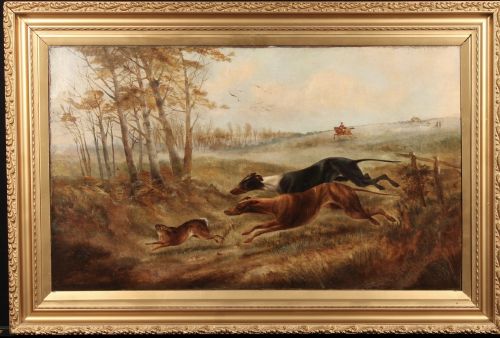
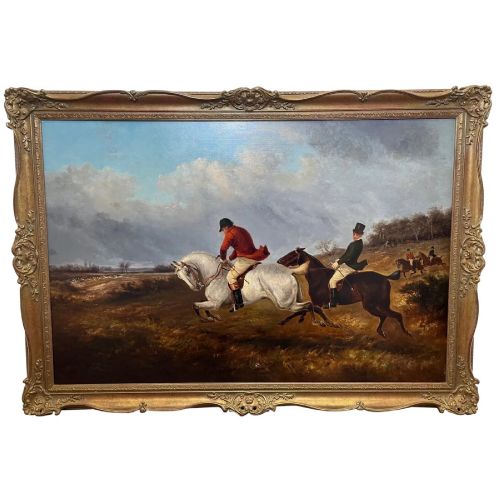
When searching for a large hunting scene, a buyer examines substantial oil paintings, tapestries, and carved panels depicting mounted riders, hounds, and quarry across country landscapes. These works span the Georgian and Victorian eras up to the early twentieth century, reflecting enduring sporting traditions.
The selections available here lean heavily toward expansive nineteenth-century oil paintings on canvas alongside framed tapestries and wall hangings. These larger formats suit principal reception rooms and halls where historical sporting subjects create a commanding focal point.
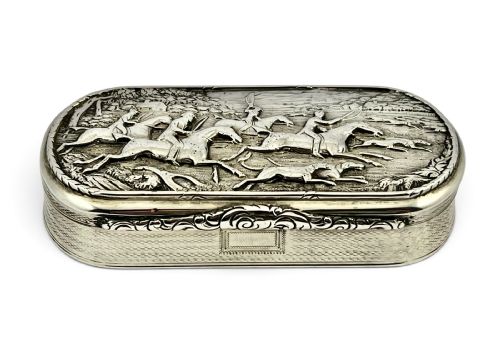
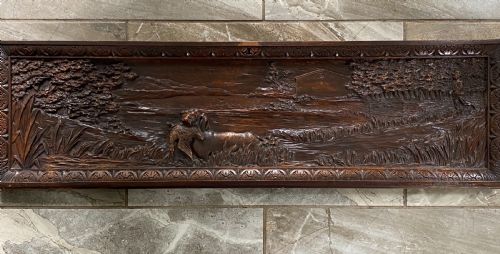
Beyond paintings and textiles, the category includes functional silver table boxes and carved wood panels. Each object reflects the rich iconography of nineteenth-century realism and Victorian sporting art.
Materials and construction
Canvases utilise oil paint applied with varying brushwork to render figures, horses, and hounds in detailed rural landscapes. Gilt wood and standard wood provide heavy frames and architectural elements such as carved overdoor panels.
Large Hunting Scene Retail Price Guide 2026
Typical asking prices for large hunting scene among the pieces listed under this phrase on Sellingantiques today, from the lower quarter to the upper quarter. They describe what is for sale here now, not the wider market.
Watch closely as fierce hounds chase elusive foxes across your wall, ensuring the local wildlife remains safely trapped in nineteenth-century paint.
Assessing quality
Quality rests upon the precision of execution in the figures, horses, and hound anatomy, particularly within oil paintings and carved wood panels. Masterful handling of light and perspective across a large landscape separates superior pieces from standard workshop output.
The preservation of the original canvas, wool weave, or carved surface dictates the long-term integrity of the work. Richness of detail in engraved silver elements and crispness in woven textiles further distinguish finer examples.
George Armfield·Thomas Smythe·Sir Edwin Henry Landseer·Henri Schouten
The Large Hunting Scene Glossary
- Oil on Canvas
- Pigments bound in a drying oil applied to a stretched fabric surface. This medium allows for deep tonal gradations and rich textures in large landscape works.
- Tapestry
- A form of textile art woven by hand on a vertical loom, using coloured threads to build complex pictorial designs.
- Black Forest Carving
- Woodwork originating from the mountainous region of central Europe, typically characterised by deep relief carvings of animals and natural motifs.
- Engraving
- The practice of incising a design onto a hard surface, such as metal or glass, to create detailed linear imagery.
- Snuff Box
- A small hinged container designed to hold powdered tobacco, often fashioned from precious metals with decorative chased lids.
Large Hunting Scene: Frequently Asked Questions
Where should I hang a large oil painting?
These expansive canvases require substantial wall space, making them well-suited for principal reception rooms, dining halls, or above large mantelpieces.
Ensure the hanging location avoids direct sunlight and moisture to protect the canvas and traditional frame.
How do I care for a textile wall hanging?
Wall tapestries and textiles need gentle handling and protection from direct sunlight to prevent the wool fibres from fading and weakening over time.
Light dusting with a soft brush helps maintain the surface without disturbing the woven structure.
What is the difference between an oil painting and an engraving?
An oil painting uses applied pigments on canvas to build rich colour and depth, whereas an engraving relies on incised lines on a plate or glass surface.
Engravings offer precise, monochrome or treated linear detail, while paintings present full chromatic rural scenes.
How do I identify a Victorian sporting work?
Victorian sporting pieces frequently depict detailed scenes of horse riding, hare coursing, and fox hunting with realistic anatomical rendering of dogs and horses.
They often bear signatures or stylistic traits consistent with nineteenth-century realism and popular rural iconography of the period.