




Japanese Wood Toggle
These japanese wood toggle pieces are tactile carved toggles from the nineteenth century, prized for fastening traditional garments.
Japanese Wood Toggle
A japanese wood toggle is a small carved fastener used historically to secure pouches and medicine boxes to traditional kimono sashes. The examples seen here belong predominantly to the nineteenth century, spanning the Edo and Meiji periods.
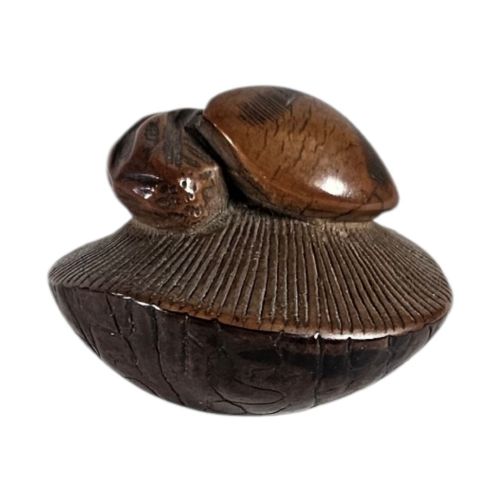
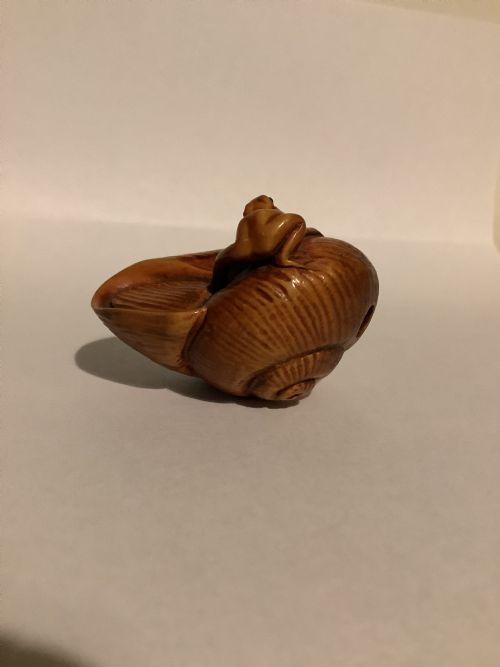
Most pieces take the form of a netsuke or a kagamibuta, carved closely from boxwood or other dense woods. Common subject matter ranges from natural forms like snails, mushrooms, toads, frogs, and nuts to figures such as wise men on horses and young boys on rams.
Makers often incorporated inlaid horn, copper alloy, and champleve cloisonne enamel into manju and kagamibuta formats. Each object serves as a miniature sculpture, designed to be handled and admired for its intricate detail.
Materials and Construction
Carvers utilised boxwood and various exotic woods for their grain and density, allowing for sharp, enduring relief work. These woods responded well to hand tools, yielding smooth surfaces that developed a rich patina through handling.
Certain manju and kagamibuta incorporate copper alloy elements alongside champleve cloisonne enamel. Inlaid horn also appears, providing textural contrast against the carved wooden body of the toggle.
Current listings feature boxwood, inlaid horn, copper alloy, and vitreous enamel across nineteenth-century Edo and Meiji period forms.
Assessing Quality
Quality rests upon the sensitivity of the carving and the fidelity of the naturalistic form. Finer pieces demonstrate precise undercutting and a lively sense of movement, whether portraying a snail upon a mushroom or a cluster of nuts.
Material selection and the integration of contrasting elements like inlaid horn or enamel elevate the complexity of a piece. The presence of a signature often denotes work by a named artisan, distinguishing standard production from superior artistry.
Masayuki
The Japanese Wood Toggle Glossary
- Netsuke
- A miniature carved toggle used in traditional Japanese dress to secure suspended pouches. These pieces function as both practical toggles and intricate works of art.
- Kagamibuta
- A round, bowl-shaped netsuke featuring a metal disc fitted into the top like a mirror lid. The metal centre often displays champleve cloisonne enamel.
- Manju
- A flat, circular netsuke shaped like a traditional steamed bun. They are frequently carved in relief or paired with metal insets.
- Champleve
- An enamelling technique where troughs are dug into a metal surface and filled with enamel paste before firing. This method creates colourful decorative patterns on metal plates.
- Boxwood
- A dense, pale wood favoured by carvers for its fine grain and resistance to splitting. It takes intricate detail exceptionally well.
Japanese Wood Toggle: Frequently Asked Questions
What is a japanese wood toggle used for?
These objects served as practical toggles, known as netsuke, slotted behind the obi sash to anchor hanging containers. Their weight and shape kept pouches secure during daily movement.
Over time, they evolved from utilitarian fasteners into highly collectable miniature sculptures appreciated for their clever design and tactile qualities.
How do I date a japanese wood toggle?
Dating relies primarily on stylistic markers, materials, and historical periods such as the Edo or Meiji eras. Nineteenth-century examples often display specific naturalistic subjects and tool marks characteristic of that epoch.
Signatures and specific material combinations, like champleve enamel on copper alloy, also help narrow down the decade of production.
Are these toggles carved by hand?
Yes, historical pieces from the nineteenth century were executed entirely by hand using specialised small chisels and knives. Carvers worked boxwood and other timbers to achieve high levels of anatomical and botanical detail.
Tool marks and individual stylistic variations confirm the hand-carved nature of each miniature sculpture.
How should I care for a wooden toggle?
Wood toggles require stable indoor humidity and protection from direct sunlight to prevent the timber from drying out or splitting. Occasional gentle handling helps maintain the natural patina developed over generations.
Avoid using liquid cleaners or polishes, as these can damage inlaid horn and enamel sections.