

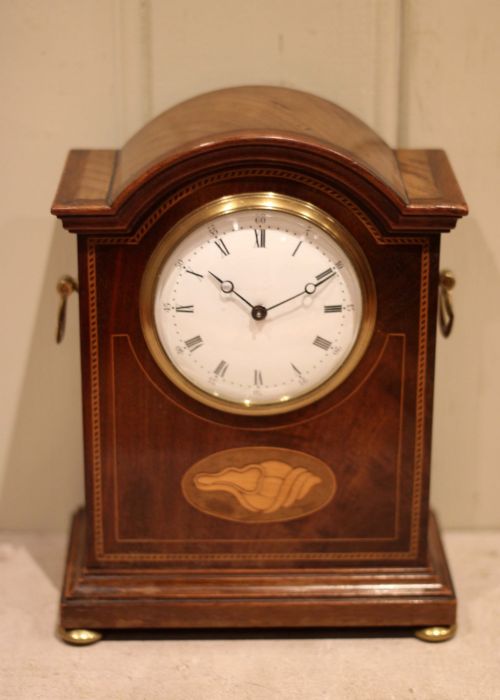
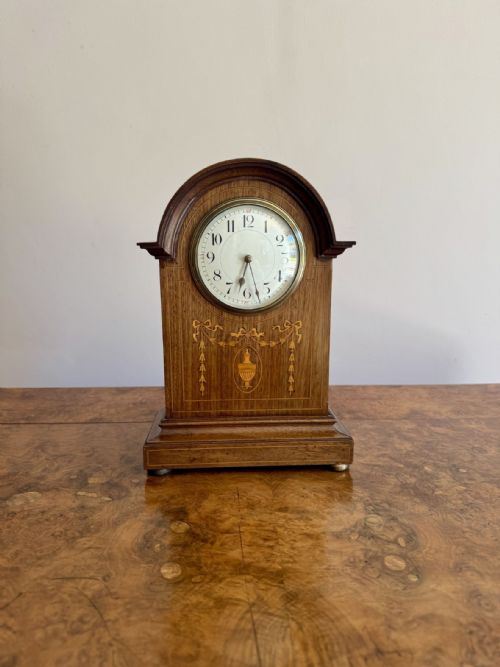


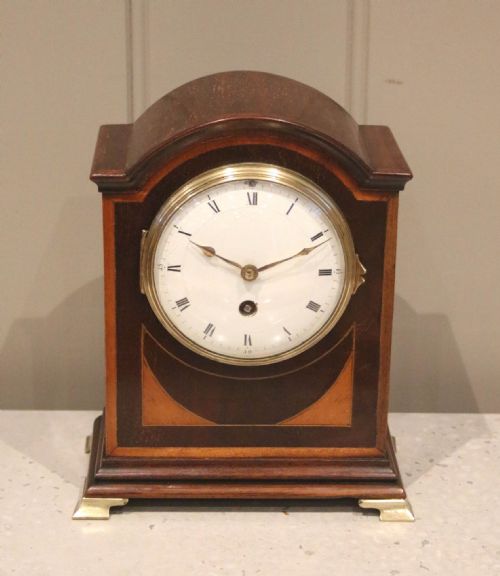


Inlaid Wood Shelf Clock
An inlaid wood shelf clock brings mechanical precision and fine cabinetmaking together in a compact form designed for domestic use.
Inlaid Wood Shelf Clock
When searching for an inlaid wood shelf clock, you encounter timepieces designed to sit on mantelpieces, brackets, and desks rather than stand on the floor. These pieces range from compact Edwardian balloon shapes to architectural Victorian and Regency examples.
The most common versions on this page are Edwardian mahogany mantel clocks featuring delicate stringing or satinwood inlay, alongside French rosewood cases and earlier Georgian bracket clocks.
Makers and regional styles vary widely, spanning English workshop production, French 19th Century design, and German movement manufacture housed in timber cases.
Materials and Construction
Cases rely on dense timbers such as mahogany and rosewood, chosen for their stability and rich grain. Cabinetmakers embellished these surfaces using contrasting veneers like boxwood and satinwood, creating geometric banding or figurative marquetry.
Metal components including brass bezels, dials, and carrying handles complement the woodwork. Movements utilise brass gear trains, enamel dials, and sometimes glass panels to protect the escapement.
Dial faces feature painted numerals, brass chapter rings, or visible enamel cartouche plaques, driven by either simple timepiece movements or striking mechanisms.
Inlaid Wood Shelf Clock Retail Price Guide 2026
Typical asking prices for inlaid wood shelf clock among the pieces listed under this phrase on Sellingantiques today, from the lower quarter to the upper quarter. They describe what is for sale here now, not the wider market.
Some French officers' clocks travelled across borders in fitted leather cases, ready to keep time on campaign.
Assessing Quality and Execution
Quality reveals itself in the precision of the cabinetwork, where wood inlay sits completely flush with the surrounding veneer and timber grain aligns purposefully across the case. Finer pieces demonstrate crisp carving and well-proportioned architectural forms, such as pagoda tops or break arches.
The internal mechanics dictate the standard of the piece, with signed movements by established makers indicating superior horological production. Heavier brass castings forbezels and reliable bell or gong striking trains separate high-grade examples from standard commercial production.
Barrett London·Paul Garnier·Henry Marc·Walker and Hall·Junghans·Seikosha Seiko
The Inlaid Wood Shelf Clock Glossary
- Inlay
- A technique where pieces of contrasting wood, such as boxwood or satinwood, are inserted into recessed cavities in the primary case timber. This creates decorative patterns and borders flush with the surface.
- Bracket Clock
- A portable mechanical clock traditionally designed to sit upon a matching wall bracket or a furniture surface. Many examples feature arched wooden cases and brass carrying handles.
- Fusee
- A conical pulley connected to the mainspring by a chain or cord, designed to equalize the diminishing power of the spring as it unwinds. This mechanism ensures consistent timekeeping throughout the power reserve.
- Marquetry
- Elaborate veneer work forming pictorial or decorative designs using various tinted woods and other materials. It differs from simple inlay by covering the entire primary surface.
- Timepiece
- A clock that measures and indicates the time without including any striking or chiming mechanism. These movements require simpler gear trains than striking clocks.
Inlaid Wood Shelf Clock: Frequently Asked Questions
What is a shelf clock?
A shelf clock is a portable timepiece designed to sit flat on a mantelpiece, sideboard, or bracket without needing wall mounting or floor space.
These clocks combine domestic utility with decorative cabinetwork, serving as functional focal points in a room.
How do I wind an 8 day clock?
An 8 day clock requires winding approximately once a week using a matching key inserted into the winding holes on the dial face.
Careful turning engages the mainspring barrel until resistance indicates the spring is fully wound.
What is the difference between a timepiece and a striking clock?
A timepiece only keeps and shows the time, containing a gear train solely for the escapement and hands.
A striking clock includes additional gear trains and hammers to ring bells or gongs on the hour and half-hour.
How do I identify an Edwardian inlaid clock?
Edwardian inlaid clocks typically date from around 1900 to 1910, featuring mahogany cases with delicate boxwood stringing or satinwood shell motifs.
Case shapes often include balloon silhouettes, arched tops, and inlaid brass feet.