

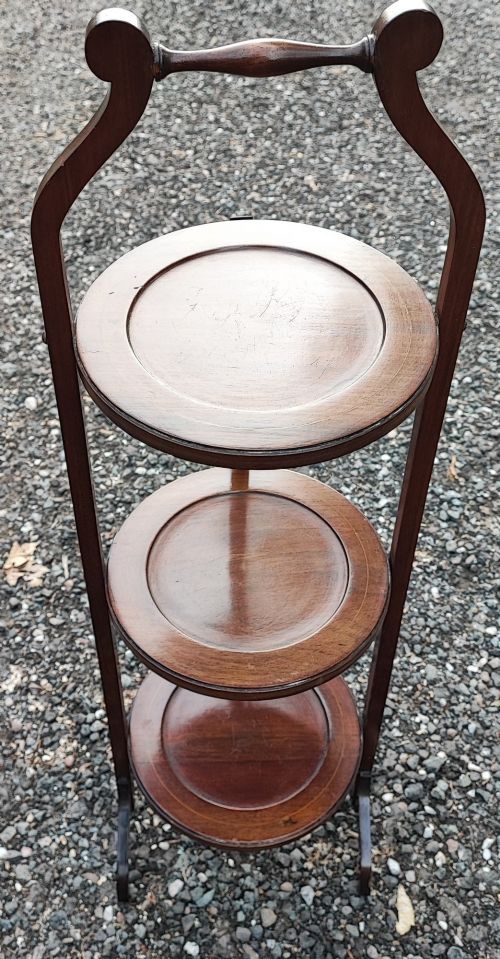


Inlaid Cake Stand
An inlaid cake stand brings tiered elegance to a room, offering functional display space crafted in rich mahogany with delicate contrasting lines.
Inlaid Cake Stand
An inlaid cake stand is primarily a tiered wooden display piece designed for domestic utility and social display. Buyers seeking this search phrase encounter multi-level furnishings intended to hold small items or cakes.
The versions met most frequently on this page belong to the Edwardian period and the early twentieth century, alongside Victorian examples. These pieces typically take the form of three-tier folding stands, etageres, or side tables constructed from mahogany.
Makers of these items utilised circular and oval top configurations arranged in tiers supported by upright frames. Many incorporate folding mechanisms that allow the tiers to collapse neatly when not in use.
Materials and construction
Cabinetmakers built these pieces using solid and veneered mahogany as the primary timber. This hardwood provided both structural stability and a dark reddish-brown ground suitable for decorative embellishment.
Contrasting woods such as satinwood and boxwood were shaped into fine lines and motifs through precise inlay techniques. Craftsmen set these pale materials flush into the darker mahogany surfaces to create geometric or classical borders.
Inlaid Cake Stand Retail Price Guide 2026
Typical asking prices for inlaid cake stand among the pieces listed under this phrase on Sellingantiques today, from the lower quarter to the upper quarter. They describe what is for sale here now, not the wider market.
Listings for this phrase span multiple decades, incorporating Victorian and Edwardian periods alongside Sheraton Revival styling.
Assessing quality
Quality in these pieces rests upon the crispness of the cabinetwork and the precision of the contrasting inlay. Sharply executed boxwood and satinwood lines set cleanly into the mahogany distinguish finer workshop output from simpler production.
The sophistication of the form also separates standard examples from more ambitious variants. Pieces featuring multi-tier folding mechanisms, oval shelves, or etagere styling demonstrate greater design consideration than basic circular stands.
The Inlaid Cake Stand Glossary
- Inlay
- A decorative technique where pieces of contrasting wood like satinwood or boxwood are inserted into recesses cut into the primary timber. This method creates flat patterns and borders across the surface of the stand.
- Edwardian
- A period spanning the reign of King Edward VII, characterised by lighter furniture designs often revisiting earlier Georgian aesthetics. Pieces from this era frequently employ mahogany and refined inlay work.
- Etagere
- A set of open shelves supported by columns or pillars, used for displaying small objects. In these listings, the term describes tiered stands with circular or oval shelves.
- Sheraton Revival
- A late nineteenth and early twentieth century style drawing inspiration from the furniture designs of Thomas Sheraton. It relies on satinwood inlay, mahogany, and slender proportions.
- Tiered stand
- Furniture constructed with multiple horizontal surfaces arranged vertically above one another. This form maximises display capacity while maintaining a compact footprint on the floor.
Inlaid Cake Stand: Frequently Asked Questions
What is an inlaid cake stand used for?
These tiered pieces were traditionally employed in domestic settings for presenting cakes and afternoon tea items to guests. Today, collectors utilise them as display shelves for small decorative objects or plants.
The vertical multi-level structure allows owners to exhibit several items simultaneously while occupying minimal floor space in a drawing room or hallway.
How do I identify an Edwardian cake stand?
Edwardian examples typically date from the early twentieth century and frequently feature mahogany construction enhanced with satinwood or boxwood inlay. They often incorporate three tiers and sometimes include folding mechanisms.
Comparing the lightness of the timber and the refinement of the decorative borders helps distinguish these pieces from heavier Victorian furniture.
Are these stands easy to store?
Many of the pieces recorded here feature folding mechanisms designed to let the tiers collapse together. This makes them practical for storage when not actively in use.
Buyers should examine the specific hinges and joints on folding models to understand how the tiers articulate during opening and closing.
What woods are used in these pieces?
Mahogany serves as the primary wood across the majority of these listings, providing a sturdy and dark brown foundation. Lighter timbers such as boxwood and satinwood appear specifically within the inlay work.
This combination of contrasting light woods against a dark ground defines the visual appearance of Sheraton Revival and Edwardian styles.