

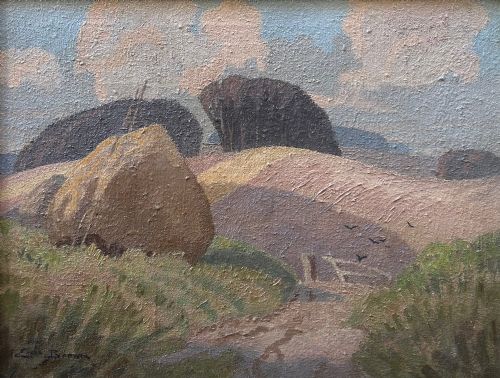


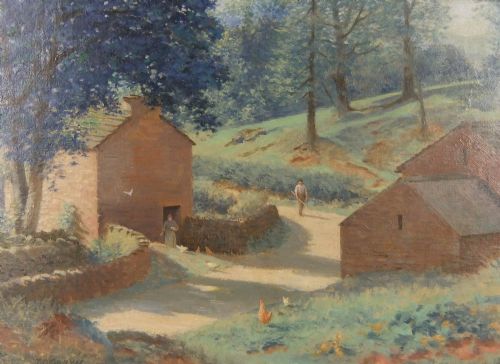
Impressionist Farm Artwork
Impressionist farm artwork captures rural life through loose brushwork and natural light, offering a window into early twentieth-century agricultural scenes.
Impressionist Farm Artwork
When you search for impressionist farm artwork, you encounter pastoral scenes dominated by haystacks, working horses, farmyards, and Yorkshire landscapes. These pieces record rural occupations and agricultural buildings through the lens of early twentieth-century painters.
The selection on this page relies heavily on British and French provincial contexts, spanning the nineteenth century through the nineteen-fifties. Works range from intimate watercolours to large oil paintings on canvas, board, and panel.
Most entries focus on daily agrarian routines, depicting ploughing, milking time, and harvest scenes. Artists utilised these subjects to explore atmospheric light and painterly texture in rural settings.
Materials and technique
Paintings in this category rely primarily on oil paint applied to canvas, wood panels, or boards, alongside watercolours on paper. Artists built texture with layered brushstrokes to capture the play of light on agricultural surfaces.
Support materials varied according to the artist's studio practice, with panel and board providing rigid grounds for outdoor sketching. Canvas allowed for larger compositions depicting sweeping Wharfedale and Swaledale valleys.
Pigments were worked directly with brushes and palette knives to achieve the characteristic broken colour and expressive touch associated with impressionist and post-impressionist schools.
Impressionist Farm Artwork Retail Price Guide 2026
Typical asking prices for impressionist farm artwork among the pieces listed under this phrase on Sellingantiques today, from the lower quarter to the upper quarter. They describe what is for sale here now, not the wider market.
Listings feature works executed in oil and watercolour across a date range spanning from the nineteenth century to nineteen-fifty.
Assessing quality
Quality rests on the confidence of the brushwork and the artist's ability to render atmosphere without overworking the scene. Stronger pieces maintain a lively surface texture that suggests movement and natural light rather than rigid illustration.
Compositional balance separates masterworks from routine topographical records, with better examples drawing the viewer into the working farmyard or landscape through considered perspective and tonal harmony.
Raimond Louis Lecourt·Herbert Royle·Ernest Pile Bucknall·John Atkinson·Owen Bowen·Ernest Higgins Rigg
The Impressionist Farm Artwork Glossary
- Oil paint
- A slow-drying medium composed of pigments suspended in a drying oil, typically linseed. It allows for rich colour blending and thick impasto application.
- Watercolour
- A paint consisting of water-soluble pigments on paper. It relies on the white of the paper to provide luminosity through transparent washes.
- Panel
- A flat piece of wood used as a rigid support for painting. Artists frequently utilised panels for smaller plein-air landscape studies.
- Impressionism
- A nineteenth-century art movement characterised by relatively small, thin yet visible brush strokes and an emphasis on accurate depiction of light.
Impressionist Farm Artwork: Frequently Asked Questions
What subjects appear in impressionist farm artwork?
These works depict agricultural life, including haystacks, farmyards, working horses, and Yorkshire landscapes. Scenes often capture daily routines such as milking time and harvesting.
Artists focused on rural architecture and surrounding fields, recording the changing seasons and rural labour through expressive brushwork.
How do I date an impressionist farm painting?
Dating relies on stylistic markers, artist signatures, and framing methods typical of the late nineteenth and early twentieth centuries. Many pieces carry specific exhibition or studio dates.
Material supports like canvas preparation and panel stamps also provide clues to the period of creation, spanning from the Edwardian era into the nineteen-fifties.
Where were these rural scenes painted?
Painters worked across British regional landscapes, particularly in Yorkshire valleys like Wharfedale and Swaledale, as well as coastal spots near Hinderwell. Some works originate from French provincial settings.
Artists frequently set up outdoors to capture direct observations of working farms and rural communities.
How should I display a vintage farm painting?
Hang these works away from direct sunlight to protect oil pigments and watercolours from fading over time. Maintain stable room humidity to preserve the wooden panels and canvas supports.
Select a period-appropriate frame that complements the palette without overwhelming the subtle textures of the brushwork.