
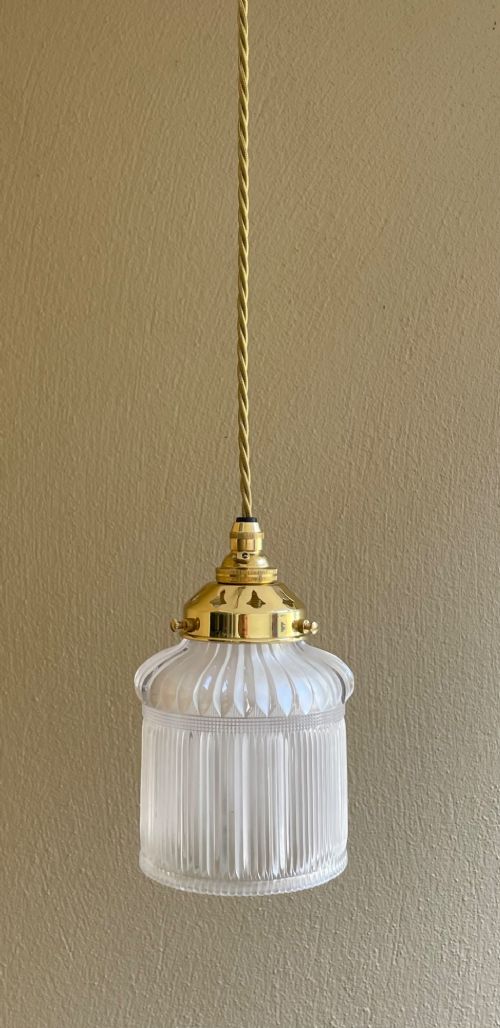


Holophane Glass Pendants
Holophane glass pendants are scientific prismatic light fittings designed to diffuse light evenly, bringing industrial utility and architectural character to a room.
Holophane Glass Pendants
Holophane glass pendants are functional industrial light fittings designed to control and distribute illumination through scientific prism cuts. When searching for holophane glass pendants, buyers encounter lighting fixtures spanning from the nineteenth century through the Edwardian period, nineteen-ten, nineteen-twenty, and nineteen-forty. These pieces primarily take the form of pendant lights featuring distinct glass shades suspended from various fittings.
The versions most frequently met on this page date from the nineteen-twenty period and the Edwardian era. These pendant lights often incorporate bell-shaped or nine-inch shades that display industrial art deco or standard industrial styles. Collectors find both single fixtures and matched pairs ready for installation.
How they were made
Makers produced these shades using thick, moulded prismatic glass designed to bend and scatter light rather than simply block it. This specialised glass attaches to durable metal hardware, including cast iron, polished brass, and chrome galleries.
The combination of heavy glass and robust industrial metal created robust fixtures built for factories, commercial spaces, and public buildings. Simple structural fixings secured the glass shades firmly into their supporting frames.
Listings feature pendant lights spanning the nineteenth century through the nineteen-forties, constructed from brass, chrome, cast iron, and prismatic glass.
What varies in quality
Quality rests upon the crispness of the prismatic glass moulding and the robustness of the accompanying metal gallery. Finer examples display sharp, well-defined optical ribs that effectively direct the light without distortion.
The choice of hardware also distinguishes the pieces, with solid brass or substantial chrome galleries offering a more finished appearance than simpler utility mountings. Matched pairs represent a higher level of completeness for interior schemes.
The Holophane Glass Pendants Glossary
- Prismatic glass
- Moulded glass featuring a series of precise internal prisms designed to refract and diffuse light efficiently. This optical property defines the characteristic sparkle and performance of the shade.
- Gallery
- The metal collar or mount that grips the top of the glass shade and connects it to the suspension rod or flex. Galleries are commonly cast from brass, chrome, or iron.
- Edwardian
- The period of British history spanning the reign of King Edward VII from nineteen hundred and one to nineteen hundred and ten. Pieces from this era often balance industrial function with refined decorative proportions.
- Industrial art deco
- A design style bridging robust factory utilitarianism with the geometric symmetry of the nineteen-twenties and thirties. It influences the decorative details found on the metal fittings of these lights.
Holophane Glass Pendants: Frequently Asked Questions
How do I hang a pendant light?
These pendant lights suspend from ceilings using compatible electrical flex or rigid rods secured to the metal gallery.
Ensure the mounting is rated to support the combined weight of the thick glass shade and metal hardware.
What rooms suit these lights?
Kitchens, hallways, and dining spaces suit these industrial fixtures particularly well due to their downward task illumination.
The prismatic glass provides bright, evenly distributed light that works effectively over work surfaces and tables.
How do I date my pendant?
Dating relies on examining the style of the metal gallery, the manufacturing marks on the glass, and overall proportions.
Edwardian examples often feature softer lines, while nineteen-twenty and nineteen-forty pieces lean towards heavier industrial utility.
Can I clean the prismatic glass?
The thick glass shades tolerate gentle washing in warm soapy water to remove accumulated dust from the interior prisms.
Avoid abrasive cleaners that might scratch the surface or dull the optical properties of the glass.