



Holophane Glass Pendant Light
These holophane glass pendant light pieces bring distinct industrial utility and brilliant prismatic refraction into a room.
Holophane Glass Pendant Light
A holophane glass pendant light is a hanging industrial luminaire designed to diffuse and direct illumination efficiently using specialised ribbed glassware. When you search for a holophane glass pendant light, you encounter fixtures originating primarily from the Edwardian period, the 1910s, the 1920s, the 1940s, and the nineteenth century. These items span industrial, industrial art deco, and Edwardian industrial styles.
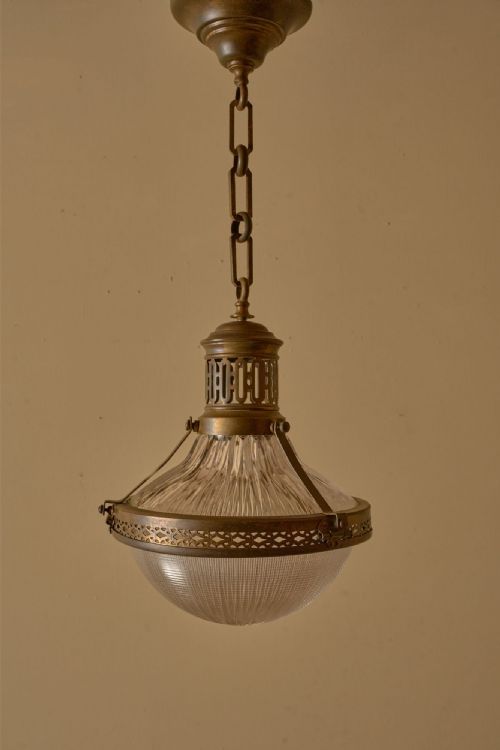
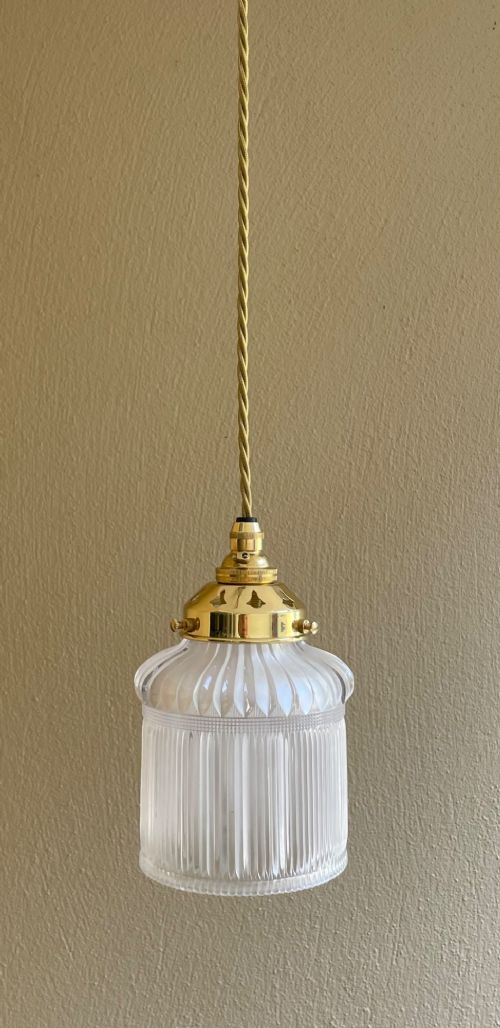
The forms on this page include standard pendants, bell pendants, and flying saucer shades, frequently measuring around nine inches or twelve inches. Most examples combine the iconic prismatic shade with metal galleries and holders.
Edwardian and early twentieth-century interpretations dominate the available selection, often paired with brass or chrome hardware. Buyers choose these fittings to anchor commercial or residential spaces with genuine period industrial character.
How they were made
Makers produced these fixtures using pressed prismatic glass designed to bend and control light output rather than merely block it. Double prismatic versions utilised complex internal and external ribs to maximise luminosity while reducing glare.
Workshops housed the glass shades within robust metal galleries cast from brass, chrome, or cast iron. These hardware components provided structural integrity to hang safely from ceilings or wall-mounted brackets.
Holophane Glass Pendant Light Retail Price Guide 2026
Typical asking prices for holophane glass pendant light among the pieces listed under this phrase on Sellingantiques today, from the lower quarter to the upper quarter. They describe what is for sale here now, not the wider market.
Listings feature periods spanning the nineteenth century, the Edwardian era, the 1910s, the 1920s, and the 1940s, utilising brass, chrome, and cast iron.
What varies in quality
The sophistication of the glass moulding dictates the visual depth of the refraction, with double prismatic variations showing greater optical complexity than standard single-rib shades. Heavier metal galleries cast in brass or iron indicate sturdier construction than lighter alternatives.
The integrity of the original hardware, such as matching chrome or brass fitments, distinguishes standard utility pieces from more substantial or matched pairs.
The Holophane Glass Pendant Light Glossary
- Prismatic glass
- Glass moulded with precise optical ribs designed to refract and diffuse light efficiently. This material defines the core visual identity of the fixtures.
- Gallery
- The metal collar or mount that grips the upper rim of the glass shade and connects to the suspension rod or flex. Galleries are commonly cast from brass or chrome.
- Bell pendant
- A hanging light featuring a shade shaped like a conventional bell. This form directs illumination downward with a focused cone.
- Flying saucer shade
- A wide, shallow shade profile that spreads light across a broader horizontal plane. These wide forms are characteristic of industrial lighting designs.
Holophane Glass Pendant Light: Frequently Asked Questions
How do I clean a prismatic glass shade?
Use warm soapy water and a soft brush to reach into the internal and external ribs where dust accumulates. Avoid harsh abrasives that could dull the surface.
Dry the glass thoroughly with a lint-free cloth to restore the clear sparkle of the prismatic pattern before rehanging.
What rooms suit a nine inch pendant?
Smaller nine inch fixtures work well suspended over kitchen islands in multiples or hung low in compact hallways. Their scale provides focused illumination without overwhelming the space.
Larger spaces benefit from pairing several smaller pendants together to balance the light distribution across the room.
How do I identify an Edwardian example?
Edwardian pieces often feature heavier brass galleries and specific ribbing patterns associated with early twentieth-century manufacturing techniques. The proportions tend to reflect domestic and early industrial utility from the first decade of the 1900s.
Comparing the gallery metalwork and the weight of the glass helps separate these from later mid-century reinterpretations.