



Historical Wall Hanging
A historical wall hanging brings centuries of textile artistry, narrative and pigment directly into a room, offering immediate texture and scale to plain plaster.
Historical Wall Hanging
A historical wall hanging encompasses woven tapestries, embroidered covers, framed maps and textile art produced across the sixteenth, seventeenth, eighteenth and nineteenth centuries. These pieces serve primarily as vertical wall art, transforming large interior surfaces through rich iconography and historic textile technique.
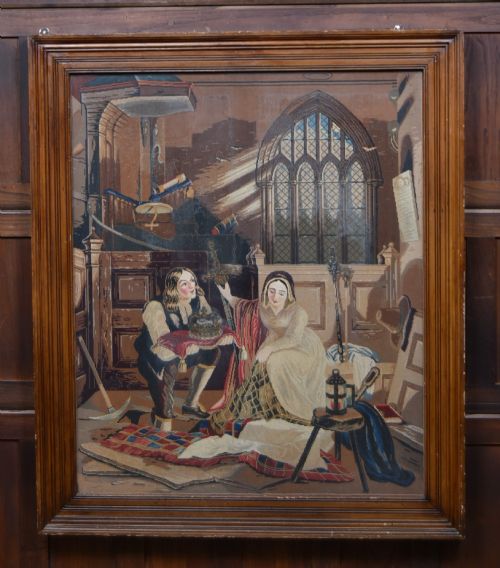
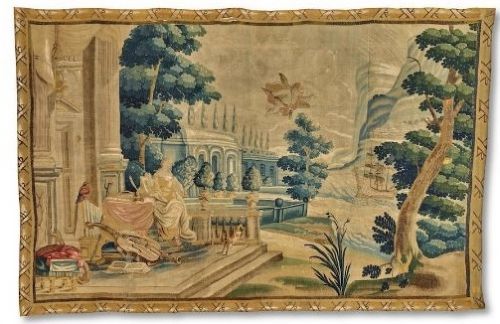
The most substantial examples are seventeenth-century Flemish and North German tapestries depicting mythological or narrative scenes, often framed in gilt wood or displayed on canvas backing. Buyers also encounter nineteenth-century Berlin wool work, French embroidered pieces relating to figures like Napoleon, and eighteenth-century ciselé silk velvet panels.
Smaller decorative elements within the category include vintage flags from the mid-twentieth century and nineteenth-century bronze portrait plaques mounted for display. The variety spans formal Gothic Revival and Baroque compositions down to domestic needlework and cartography.
Materials and construction
These works rely on natural fibres, predominantly wool, silk, cotton, linen and canvas, manipulated through weaving, embroidery and needlework. Silk velvet and wool threads provide the depth and tactile density seen in seventeenth-century and nineteenth-century textile panels.
Sturdier textiles incorporate wood and gilt wood frames to support heavy woven structures or mounted canvases. Metal threads and specialised stitching support the pictorial detail found in embroidered pieces and woven tapestries alike.
Historical Wall Hanging Retail Price Guide 2026
Typical asking prices for historical wall hanging among the pieces listed under this phrase on Sellingantiques today, from the lower quarter to the upper quarter. They describe what is for sale here now, not the wider market.
Napoleon watches over the room from an embroidered wool panel, proving that historic heroes occasionally prefer textile retirement.
Quality factors in textile art
The integrity of the fibres and the retention of natural dye colours largely determine the visual weight of a hanging. Tighter weaves and finer wool or silk stitching preserve narrative detail and structural coherence over centuries.
The sophistication of the design, whether a complex mythological Flemish composition or a precise cartographic map, dictates the artistic ambition of the piece. Original framing, such as period gilt wood, adds to the physical completeness of the work.
The Historical Wall Hanging Glossary
- Berlin wool work
- A type of coloured needlework embroidered on canvas using charted patterns and wool yarn. This technique gained wide popularity during the nineteenth century for producing pictorial wall hangings.
- Ciselé velvet
- A velvet fabric where the pile is cut in patterns against an uncut or lower ground, creating texture through contrasting heights. It appears frequently in eighteenth-century decorative panels.
- Flemish tapestry
- A woven textile artwork produced in the historic Flanders region, renowned for dense narrative scenes and mythological subjects. These large-scale works date primarily from the sixteenth and seventeenth centuries.
- Needlework
- Any craft involving a needle for sewing or embroidery, encompassing wool work and silk stitching on canvas or linen. It forms the basis of many decorative hangings across the nineteenth century.
- Gilt wood
- Wood carved and coated with a thin layer of gold leaf or powder, commonly used for framing large tapestries and mirrors. It provides a reflective border to heavy woven textiles.
Historical Wall Hanging: Frequently Asked Questions
How should I hang a heavy antique tapestry?
Support heavy woven textiles across their entire width rather than pinning them at single points, using a professional mounting system that distributes weight evenly across the backing.
Ensure the hanging avoids direct sunlight and damp environments to protect natural wool and silk fibres from fading or degradation.
Can I clean an old wool wall hanging?
Surface dust should be removed gently using low-suction vacuum attachments protected by mesh screen, avoiding any vigorous rubbing of delicate threads.
Wet cleaning requires specialist textile conservators, as moisture can distort old canvas backings and bleed historic dyes.
What is the difference between a tapestry and needlework?
A true tapestry is woven on a loom where warp and weft threads interlace to form the picture itself, whereas needlework stitches thread through an existing woven canvas or linen ground.
Both techniques produce historic wall hangings, but their structural production methods require entirely different artisan skills.
How do I identify a nineteenth-century textile?
Nineteenth-century pieces often utilise brighter synthetic or improved natural dye palettes, alongside mechanical canvas bases and distinct revival styles like Gothic or Baroque.
Examining the reverse side reveals the consistency of the wool or silk threads and any later framing additions.