



Historic Landscape Scene
These historic landscape scene works capture views of cities, rivers, and countrysides in watercolour, oil, and tapestry.
Historic Landscape Scene
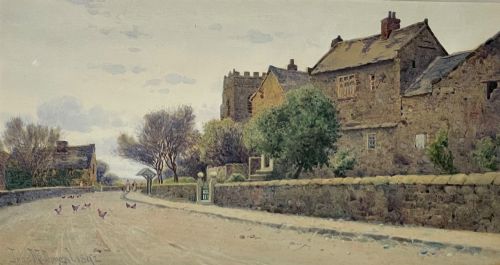
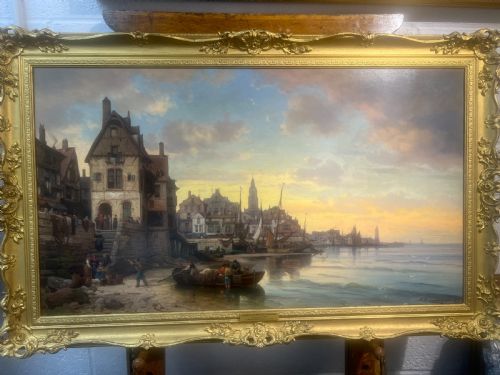
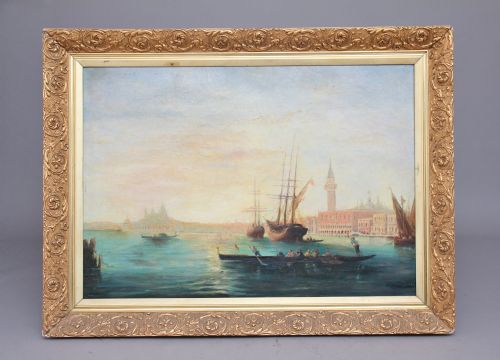
A historic landscape scene records a specific place or countryside through the eyes of artists working from the seventeenth century through to the mid twentieth century. These works capture topographical views of London streets, Yorkshire towns, Venetian lagoons, and rural villages with distinct regional character.
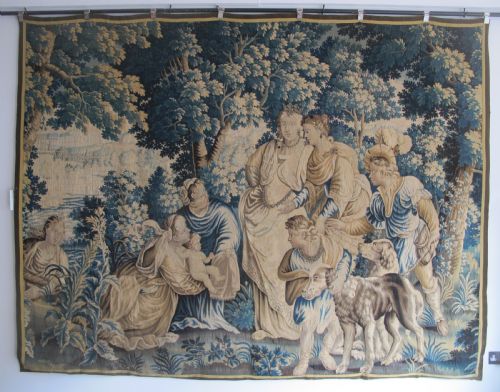
The selections available here range from detailed watercolour paintings on paper to substantial oil paintings on canvas and large French Baroque wall tapestries. Buyers encounter works executed in Victorian, Edwardian, and British Impressionist styles that portray architectural landmarks alongside quiet pastoral settings.
Materials and methods
Artists utilised watercolour paint on paper alongside oil paint applied to canvas, capturing light and atmosphere through layered brushwork. Gold leaf occasionally frames or enhances these compositions, while wool and silk threads form the elaborate weave of period wall tapestries.
Support materials vary from stretched canvas and heavy watercolour paper to wooden panels and hand-woven textile grounds. Each technique allows the creator to render architectural detail, water reflections, and open skies with distinct textural depth.
The listings span from the seventeenth century through to the 1940s, featuring watercolours, oils on canvas, and Aubusson tapestries.
Distinctions in execution
The strength of a composition rests on the artist's handling of perspective, atmospheric light, and spatial depth within the chosen medium. Finer works demonstrate confident brush control and precise architectural rendering rather than generic background filler.
Condition and preservation of the paper, canvas, or textile surface significantly shape the visual integrity of the piece over time. Intact framing, minimal pigment fading, and stable structural grounds distinguish the better examples.
John McDougal·Charles Euphraisie Kuasseg·A. McDonald·John Sanderson Wells·Frank Moss Bennett·Rowland Henry Hill·A.A. Finch·David Small·J.D. Walker
The Historic Landscape Scene Glossary
- Watercolour
- A painting method where fine pigment is suspended in a water-soluble binder and applied to paper. It allows for delicate washes and translucent effects.
- Oil painting
- A medium consisting of pigments suspended in a drying oil, typically applied to canvas or wood. This technique provides rich colour saturation and varied surface texture.
- Wall tapestry
- A heavy textile woven on a loom to display a figurative design or scene. These large wall hangings served both decorative and insulating purposes in historic interiors.
- Impressionism
- An art movement focusing on transient effects of light and everyday subject matter through visible brushstrokes. Practitioners sought to capture the immediate visual sensation of a scene.
Historic Landscape Scene: Frequently Asked Questions
What is a historic landscape scene?
A historic landscape scene is a painted or woven depiction of a natural environment, city street, or architectural landmark created during past centuries.
These artworks document specific locations such as London, Venice, and Yorkshire through the stylistic lens of periods like the Victorian era or early twentieth century.
How do I care for watercolour paintings?
Watercolour paintings require protection from direct sunlight to prevent the pigments from fading over time.
Keep them in stable indoor environments away from excessive moisture and frame them behind glass with acid-free mounts.
How are oil paintings constructed?
Oil paintings are built by applying pigment mixed with drying oils onto a prepared surface like canvas or wood.
Artists can work in layers over extended periods, allowing for rich textures and deep chromatic variations.
What subjects appear in these works?
The subjects range from busy city marketplaces and canals to quiet country villages and architectural landmarks.
Artists frequently recorded specific topographical views that preserve the historic appearance of streets and countryside vistas.