


Historic Cross Stitch
Historic cross stitch samplers record children's hands through wool and silk thread, offering direct tactile links to past domestic education.
Historic Cross Stitch
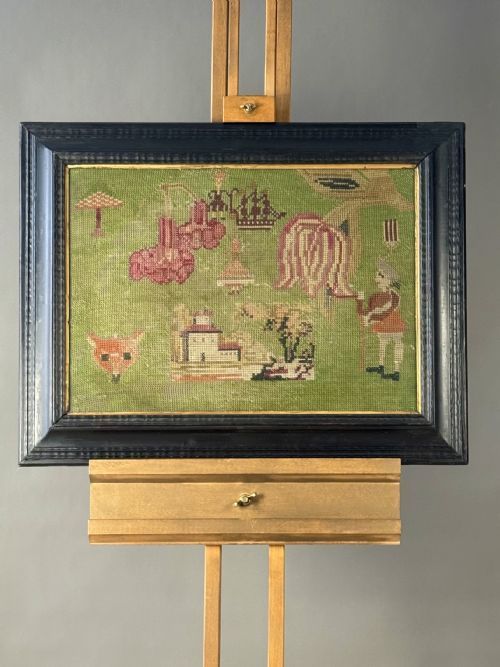
Historic cross stitch pieces are textile art and needlework samplers executed across the 18th century, Georgian, and Victorian periods. These works capture stitched alphabets, verses, and pictorial motifs worked by young makers.
The most common examples encountered here are needlework samplers created by children such as Ann Hodson, Margaret Ann Blackow, and Maggie Muir. These framed textiles frequently record the maker's name, age, and a specific completion date.
Beyond standard alphabets, specialised examples include scriptural texts like The Commandments by Jane Pattinson or moral subjects such as On Education by Eleanor Grady. Framed textile formats dominate this category, often preserved beneath glass within wood or gilded wood frames.
How they were made
Makers worked primarily on linen grounds utilising wool and silk thread. The foundation fabric provides a grid that guided the precise counting of threads for each individual cross stitch.
Needlework samplers frequently combined basic cross stitch with supportive embroidery techniques to delineate borders, figures, and lettering. Finished works were then stretched and mounted into timber frames, sometimes protected behind glass.
One Victorian Scottish sampler proudly preserves an authentic stitch error left behind by eleven-year-old Maggie Muir.
What varies in quality
Quality rests upon the regularity of the stitchwork, the complexity of the motifs, and the preservation of the ground linen. Finer examples display meticulous tension control and harmonious thread colour selection across the entire composition.
The presence of detailed genealogical information, dated signatures, and extensive pictorial elements elevates a sampler above basic lettering exercises. Original framing materials and minimal ground discolouration also contribute to overall desirability.
Ann Hodson·Margaret Ann Blackow·Maggie Muir·Sarah Baker·Jane Pattinson
The Historic Cross Stitch Glossary
- Sampler
- A piece of needlework produced as a demonstration or test of skill in various stitches. These textiles often feature alphabets, numbers, and decorative motifs.
- Linen
- A strong textile made from the fibres of the flax plant. This served as the primary foundation fabric for counted thread embroidery.
- Needlework
- Work done with a needle, including embroidery and stitching. In this context, it describes historic textile art.
- Framed Textile
- A fabric artwork mounted and displayed beneath glass within a protective border. This method secures fragile historic materials from environmental degradation.
Historic Cross Stitch: Frequently Asked Questions
What is a historic cross stitch sampler?
A historic cross stitch sampler is a textile artwork stitched by hand, typically during childhood, to practice lettering and decorative motifs. These pieces record names, dates, and sometimes religious verses.
Surviving examples provide tangible evidence of historical domestic education and needlework traditions across the Georgian and Victorian eras.
How do I date a sampler?
Many samplers include embroidered dates and the age or name of the maker, such as works from 1822 or 1847. Stylistic clues in the typography and border motifs also help determine the period.
Examining the framing materials and the type of linen ground offers further context for establishing the approximate decade of creation.
How should I display antique needlework?
Antique needlework requires protection from direct sunlight to prevent the silk and wool threads from fading. Keeping pieces behind glass in stable indoor environments helps preserve the fragile linen.
Avoid hanging textiles in areas with high humidity or fluctuating temperatures to maintain the structural integrity of the fabric.
Did adults make these samplers?
While schoolgirls executed the vast majority of surviving samplers, the makers were generally children aged ten to fourteen. Signatures and recorded ages on pieces like those by Maggie Muir or Eleanor Grady confirm this youthful authorship.
These textiles served as educational exercises rather than professional decorative items.