

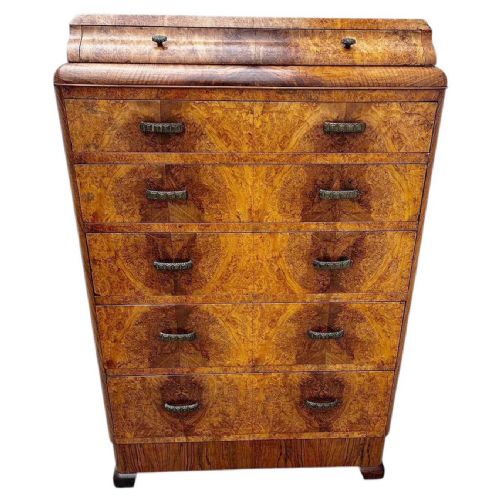
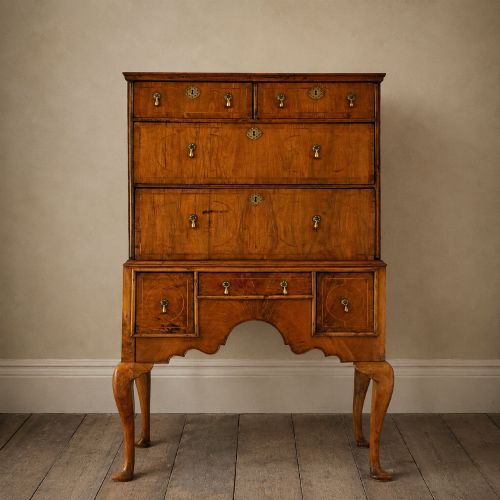


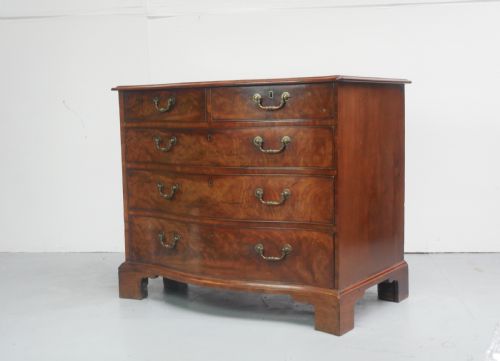


High Chest of Drawers
A high chest of drawers provides upright storage with architectural presence, combining practical depth with refined period craftsmanship.
High Chest of Drawers
When searching for a high chest of drawers, you are looking at elevated storage pieces designed to maximise vertical space without dominating floor space. The selection spans tall forms, including tallboys and chests on stands, offering substantial capacity within a compact footprint.
You are most likely to meet mahogany, walnut, and oak examples, ranging from 18th-century Georgian designs to early 20th-century interpretations. These pieces vary from bow-fronted proportions to miniature furniture and painted finishes.
The category encompasses both multi-drawer upright chests and specialised configurations like chests on associated stands. Each piece demonstrates the historical shift towards taller, more organised domestic storage.
Materials and construction
Cabinet makers utilised dense hardwoods such as mahogany, walnut, and oak for structural stability and longevity. Burr walnut and figured veneers were frequently applied to primary surfaces to create striking grain patterns.
Joinery techniques involved precise drawer construction, often paired with brass handles and working locks. Secondary timbers supported the internal framing, while painted wood and decorative parquetry provided alternative surface treatments.
High Chest of Drawers Retail Price Guide 2026
Typical asking prices for high chest of drawers among the pieces listed under this phrase on Sellingantiques today, from the lower quarter to the upper quarter. They describe what is for sale here now, not the wider market.
Listings feature periods spanning from the early 18th century through to 1930, alongside revival styles.
Distinctions in quality
The upper tier of pieces is distinguished by the choice of highly figured veneers, such as burr walnut and birds eye maple, matched carefully across the drawer fronts. Superior examples display refined proportions, crisp mouldings, and retention of original hardware.
Construction methods also set pieces apart, visible in the precision of the drawer linings and the integrity of the timber. Lesser examples may exhibit simpler painted finishes or replacement elements, whereas finer works maintain cohesive period detailing.
Heals of London·A. Blain of Liverpool
The High Chest of Drawers Glossary
- Tallboy
- A tall chest of drawers, often consisting of a chest placed upon a lower stand or built as a single towering unit. This form emerged to provide increased storage while maintaining a modest floor footprint.
- Chest on Stand
- A chest of drawers raised upon a separate or integrated low table frame. This configuration typically dates to the early periods and lifts the main storage compartment off the floor.
- Bow Front
- A convex curved front profile to a chest of drawers. This styling became popular during the Georgian period and softens the angular appearance of case furniture.
- Serpentine
- A front profile characterised by a convex centre flanked by concave curves, or vice versa. It represents a more complex form of cabinet making requiring skilled woodworking.
- Parquetry
- Geometric patterns formed by small pieces of wood inlaid into a surface. This decorative technique is frequently found on the exterior of high-end case furniture.
- Crossbanded
- A border technique where thin strips of veneer are laid across the grain of the primary panel. This frames the drawer fronts and highlights the central timber.
High Chest of Drawers: Frequently Asked Questions
What is a tallboy?
A tallboy is an upright chest of drawers designed to provide maximum storage capacity within a restricted floor area. These pieces rise significantly higher than standard chests, often incorporating multiple tiers of drawers.
They developed during earlier centuries as domestic spaces required more organised vertical storage. Variations include single tall case pieces and chests elevated on supportive stands.
How do I date a high chest?
Dating relies on examining the timber species, handle styles, construction methods, and overall silhouette. Earlier pieces from the 18th century often feature walnut or oak with hand-cut joinery, while 19th and early 20th-century versions introduce mahogany, pine, and distinct revival styles.
Secondary woods and drawer linings also provide physical clues to the period of manufacture. Comparing the proportions against known stylistic eras helps narrow down the decade.
Where were these pieces used?
These tall storage units were primarily placed in bedrooms and dressing rooms to hold folded garments and linens. Their vertical orientation allowed households to store extensive wardrobes without occupying excessive floor space in private chambers.
Over time, smaller versions and miniature forms also found use in reception rooms or hallways as display and secondary storage surfaces.
Are all high chests made of solid wood?
While structural frames and drawer linings are typically solid timber, many decorative surfaces utilise veneers applied over a stable base wood. Walnut, mahogany, and burr veneers were chosen for their visual grain patterns rather than structural load-bearing.
This technique prevented warping on large drawer fronts while presenting a luxurious exterior finish. Secondary timbers like pine or oak were commonly utilised inside the carcase.