

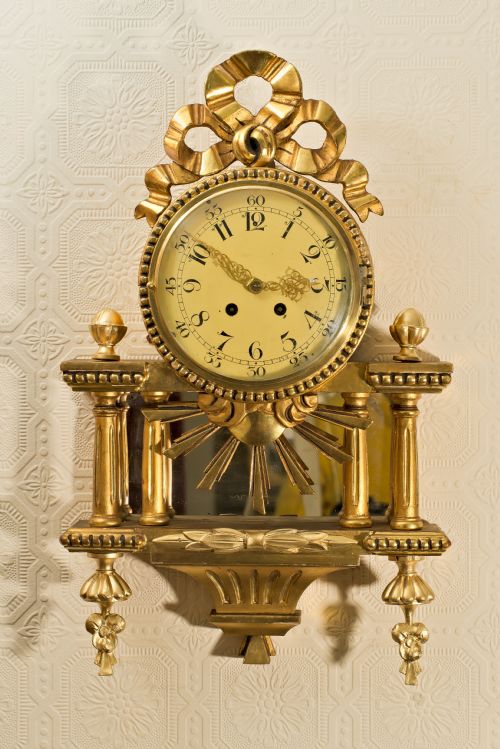


Hanging Wood Clock
A hanging wood clock brings both reliable timekeeping and architectural warmth to a room, making it a foundational piece for traditional interiors.
Hanging Wood Clock
A hanging wood clock is a wall-mounted timepiece housed in a timber case, designed to be read at eye level in domestic or public spaces. These items range from simple drop-dial office timepieces to ornate continental wall regulators and cartel designs. Buyers meeting this selection encounter walnut, mahogany, oak, and giltwood cases spanning the nineteenth and early twentieth centuries.
Victorian examples and 19th Century drop-dial models dominate the appearance of these clocks, alongside Edwardian and 1920s interpretations. Continental pieces such as Vienna wall clocks and French-influenced cartel forms sit alongside British school and drop-dial utility clocks. Each object utilises timber framing to protect the mechanical movement while serving as a prominent wall decoration.
How they were made
Cabinetmakers constructed the wooden housings of these clocks using solid timbers such as mahogany, walnut, and oak, often shaping the bezels and surrounds with carved detail or giltwood finishes. Dense hardwoods provided the structural stability necessary to house heavy mechanical movements and swinging pendulums securely on a wall. Glass doors and brass bezels protected the fragile enamel or metal dials from dust and damage.
The mechanisms within these wooden cases relied on brass gear trains, driven either by weight drops or spring-driven fusee systems that required careful hand-assembly by clockmakers. Enamel dials featured hand-painted numerals, while the overall aesthetic drew on established historical movements like Rococo Revival, Louis XVI style, and Gustavian Neoclassical design.
Hanging Wood Clock Retail Price Guide 2026
Typical asking prices for hanging wood clock among the pieces listed under this phrase on Sellingantiques today, from the lower quarter to the upper quarter. They describe what is for sale here now, not the wider market.
Some nineteenth-century Vienna clocks come with double-weight systems that occasionally require strategic furniture placement to avoid midnight chiming surprises.
What varies in quality
The distinction between standard production clocks and finer pieces lies in the crispness of the timber carving and the sophistication of the internal movement. Clocks featuring specialised mechanisms like fusee movements or signed dials by notable makers demonstrate a higher level of workshop execution. Superior examples display carefully selected wood grain and harmonious proportions that elevate the object beyond simple utility.
Decoration also dictates the tier of a hanging wood clock, with hand-gilded giltwood cartel cases and elaborately carved oak housings demanding greater artisan skill than plain utility models. The preservation of original surfaces, dials, and glass further separates standard examples from pieces that retain their complete historical integrity.
Wetterstrands·Johann Baptist Beha·Perivale of England
The Hanging Wood Clock Glossary
- Cartel clock
- A wall clock housed in an ornate, often giltwood frame that is fixed directly to the wall. These decorative timepieces originated in France during the baroque period and favor asymmetrical scrolls and naturalistic motifs.
- Drop-dial
- A clock style featuring a circular dial mounted above an extended wooden trunk or case, which houses the pendulum. This design gained popularity in British offices, railway stations, and homes during the nineteenth century.
- Fusee mechanism
- A conical pulley device inside a clock that equalizes the diminishing power of a mainspring as it unwinds. This mechanical addition ensures more accurate timekeeping throughout the duration of the spring's run.
- Vienna regulator
- A precision wall clock developed in Austria, celebrated for its accurate movement and long wooden case with glass side panels. These clocks were typically driven by heavy weights and regulated by a gridiron pendulum.
- Giltwood
- Timber that has been coated with a thin layer of gold leaf or gilt paint to simulate solid gold ornamentation. It appears frequently on decorative cartel clock frames from the nineteenth and early twentieth centuries.
Hanging Wood Clock: Frequently Asked Questions
What is a hanging wood clock?
A hanging wood clock is a wall-mounted timepiece enclosed in a timber case, designed to display the time while adding decorative presence to an interior wall. These pieces range from utilitarian school clocks to ornate gilded cartel and Vienna regulator models.
They function as both functional instruments and architectural wall art, utilising woods like mahogany, walnut, and oak to frame the dial and mechanical movement.
How do I hang a heavy wooden wall clock?
Hanging a heavy wooden wall clock requires securing the mounting bracket directly into wall studs or using heavy-duty wall anchors rated for the weight of the timber case and movement. Because these clocks often house dense hardwood cases and brass mechanisms, stable wall support is essential.
Ensuring the clock hangs level prevents the pendulum from striking the inside of the case and allows the escapement to maintain an even beat.
How do I wind a mechanical wall clock?
Mechanical wall clocks are wound using a specialised winding key inserted into the winding holes on the enamel dial, turning it gently until resistance is felt. Care must be taken not to overwind the mainspring, as this can cause internal damage.
Many antique models require weekly winding, while weight-driven variants may need their weights pulled back up to the top of the case depending on the train configuration.