

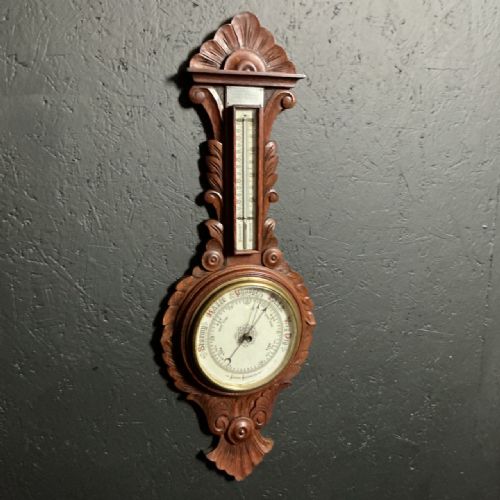


Hanging Weather Dial
These hanging weather dial pieces are practical instruments of timber and glass, mounted to monitor atmospheric change with precision.
Hanging Weather Dial
When you search for hanging weather dial, you are looking at domestic barometers designed to hang on a wall rather than stand on a floor or table. The examples listed here encompass stick forms, banjo shapes, and wheel designs spanning the Georgian, Regency, Victorian, and Edwardian eras.
The version you are most likely to meet on this page is the nineteenth century oak or mahogany wall barometer, often featuring a mercury tube or aneroid dial. These instruments range from simple domestic indicators to refined pieces bearing the names of notable London and provincial makers.
Materials and construction
Cases utilise dense hardwoods such as mahogany, oak, walnut, rosewood, and boxwood, chosen for stability and finished with subtle boxwood stringing or carved detail. The timber houses delicate glass tubes containing mercury or mechanical aneroid movements behind protective glass faces.
Metal dials and plates are frequently constructed from silvered brass, etched with barometric scales and maker inscriptions that reflect the high standards of period instrument makers.
Hanging Weather Dial Retail Price Guide 2026
Typical asking prices for hanging weather dial among the pieces listed under this phrase on Sellingantiques today, from the lower quarter to the upper quarter. They describe what is for sale here now, not the wider market.
Current listings span the eighteenth, nineteenth, and early twentieth centuries, featuring oak, mahogany, walnut, rosewood, and boxwood.
Judging quality and execution
Quality rests in the crispness of the timber case carving, the restraint of the inlay, and the legibility of the silvered metal scale. Finer instruments display precise hand-engraving on the dial plate and robust mechanical construction within the case.
Simpler domestic versions prioritize utility with plain oak housings, whereas higher tier examples demonstrate the refined proportions and signature details associated with established opticians and instrument makers.
JB Bergna, Newcastle·Maple & Co·Negretti & Zambra·A Pinchetti & Co, London·Tarone Gally & Co·George Dollond of London
The Hanging Weather Dial Glossary
- Barometer
- An instrument used to measure atmospheric pressure in order to forecast weather. These devices utilise either a column of liquid or a sealed metal box.
- Stick barometer
- A vertical instrument configuration that displays atmospheric pressure directly through the height of a mercury column in a glass tube. This form represents an early and precise method of recording pressure.
- Wheel barometer
- A dial instrument featuring a circular face where a float on the mercury column connects to a pointer via a pulley system. This layout allows for easier reading from a distance.
- Aneroid barometer
- A portable mechanism that measures pressure using a flexible metal capsule rather than liquid. This invention allowed barometers to become more compact and less fragile.
- Silvered metal
- A brass or copper dial plate treated to achieve a bright, reflective silver finish. Graduations and maker details are then engraved and blackened for clarity.
Hanging Weather Dial: Frequently Asked Questions
What is a hanging weather dial?
A hanging weather dial is a wall-mounted instrument designed to track changes in atmospheric pressure to help forecast the local weather.
These pieces combine functional science with cabinetmaking, utilising timber cases and engraved metal dials to display measurements.
How do I hang a wall barometer?
These instruments require a secure fixing point on a solid interior wall, away from direct sunlight, radiators, or drafts that might affect the internal mechanism.
Most traditional cases feature a sturdy brass ring or hanging bracket integrated into the top of the timber frame for this purpose.
How do I tell an 18th century barometer from a Victorian one?
Eighteenth century examples frequently employ walnut or inlaid mahogany in tall, slender stick barometer formats with restrained proportions.
Victorian and Edwardian pieces often expand into wider oak banjo or wheel configurations, sometimes featuring heavier carvings and aneroid movements.
Are these barometers still accurate?
Many period instruments remain capable of tracking barometric pressure changes, though mercury tubes require careful handling and professional calibration.
Collectors generally appreciate them both as working scientific instruments and as decorative examples of historic woodworking.