



Grey Mountain Painting
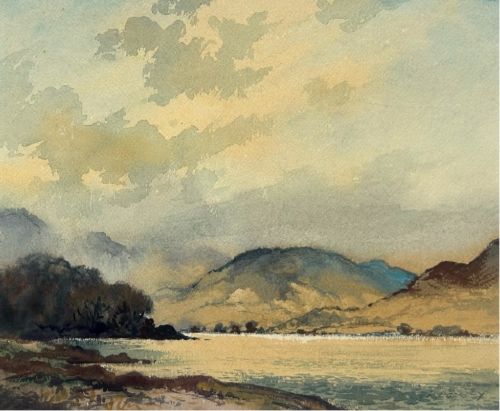
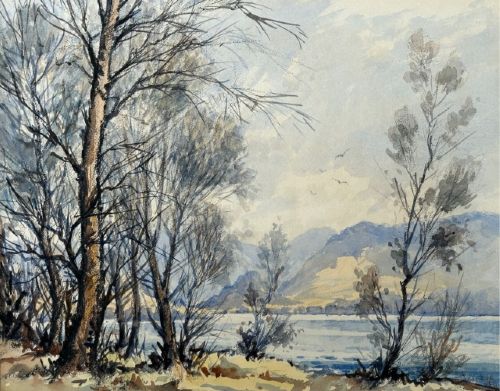
These grey mountain painting selections capture craggy peaks and sweeping valleys across watercolours and oils from the nineteenth and twentieth centuries.
Grey Mountain Painting
When you search for a grey mountain painting, you encounter landscapes depicting rugged summits, lochs, and alpine passes rendered in watercolours, oils, and inks. These works range from nineteenth-century British and Swiss views to mid-century Scottish and Chinese compositions.
The pieces on this page most commonly appear as framed watercolours or oil paintings on canvas and board, capturing atmospheric highland scenery and tranquil lake districts. Artists utilise muted palettes to convey the stark geology and overcast skies of remote terrain.
How they were made
Artists create these works using watercolour pigment and ink on paper, or oil paint applied to canvas and wood boards. Many watercolours are preserved behind glass, maintaining the delicate washes and fine linework characteristic of topographical and impressionist studies.
Framing often involves traditional wood surrounds that complement the period of the artwork, whether Victorian or mid-century. The combination of absorbent paper or prepared board with layered pigments allows for subtle tonal shifts in depicting stone and mist.
Grey Mountain Painting Retail Price Guide 2026
Typical asking prices for grey mountain painting among the pieces listed under this phrase on Sellingantiques today, from the lower quarter to the upper quarter. They describe what is for sale here now, not the wider market.
Several artists clearly braved chilly Swiss winds and damp Scottish mists to capture these crags.
What varies in quality
Quality rests upon the handling of light, atmospheric depth, and the assurance of the brushwork in capturing topographical detail. Works by established painters demonstrate a superior command of proportion and tonal gradation within the mountainous backdrop.
The preservation of the paper, canvas, and original framing also distinguishes finer examples. Stronger pieces maintain vibrant pigment integrity without excessive fading or discolouration across the sky and water.
Robert Leslie Howey·Ya Ming·Stanley Orchart·William Miller Frazer·Hirst Walker·Noel Harry Leaver·James Poole
The Grey Mountain Painting Glossary
- Watercolour pigment
- A colourant suspended in a water-soluble binder, applied to paper to create translucent washes of grey and blue.
- Oil on board
- A painting technique where oil paint is applied directly to a wooden support rather than stretched canvas.
- Victorian
- Relating to the reign of Queen Victoria, associated here with detailed nineteenth-century topographical landscapes.
- Mid-Century Modern Art
- Artistic production spanning the middle decades of the twentieth century, encompassing impressionist and expressive interpretations of scenery.
Grey Mountain Painting: Frequently Asked Questions
What periods do these mountain paintings cover?
The selection spans from the nineteenth century through to the mid-twentieth century, including Victorian and various mid-century artistic movements.
You will find works dated across decades such as the eighteen-seventies, nineteen-hundreds, and nineteen-sixties.
How should I care for a watercolour mountain painting?
Watercolours on paper require protection from direct sunlight to prevent the pigments from fading over time.
Keeping them behind glass with stable indoor humidity preserves the paper support and prevents foxing.
Are these paintings signed by the artists?
Several pieces feature artist signatures, inscriptions, or studio stamps, while others are presented within distinct artistic traditions.
Signed works often include attribution to named British and international painters of the period.