


Green Peridot Necklace
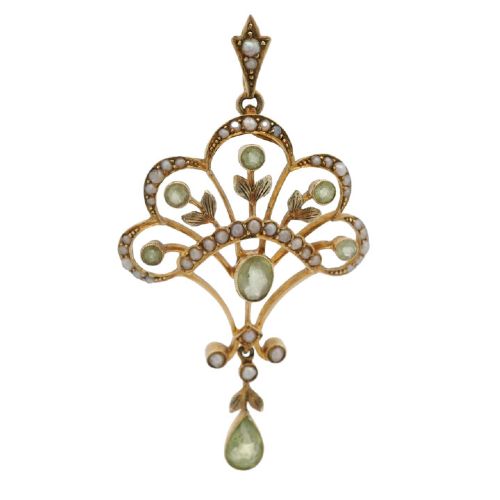
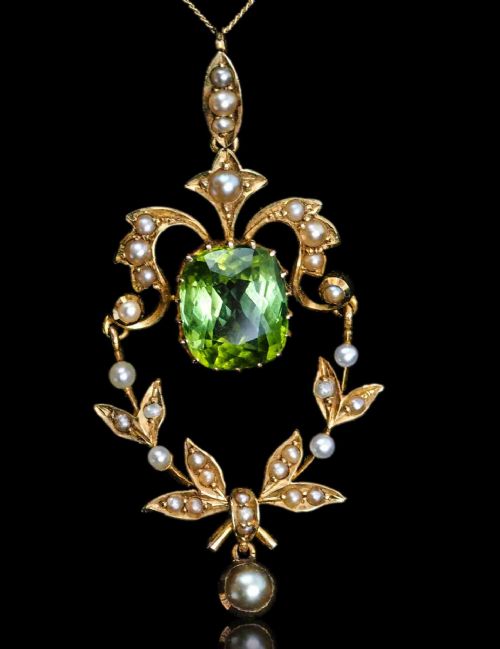
A green peridot necklace brings a distinctive lime brilliance, pairing the olive stone with seed pearls in Edwardian and Victorian gold mounts.
Green Peridot Necklace
A green peridot necklace centres on the bright olive-green gemstone, most frequently found mounted in Edwardian or Victorian gold settings alongside seed pearls.
Buyers browsing this selection encounter delicate lavalier pendants, floral drop designs, and Garland necklaces dating from the late nineteenth century up to the mid-twentieth century.
The prevalent forms combine peridot with pearls and diamonds set in fifteen-carat or nine-carat yellow gold, reflecting the fine jeweller's art of the period.
Materials and construction
Goldsmiths utilised nine-carat and fifteen-carat yellow gold alongside silver and platinum to form the delicate wirework and settings for each green peridot necklace.
Gems were secured alongside seed pearls and occasional diamonds or tourmalines, employing open-backed settings to maximise light passage through the transparent stones.
The listings span from the late Victorian era through Edwardian designs into the nineteen-fifties, predominantly featuring peridot combined with seed pearls.
Judging quality and craftsmanship
Quality rests in the precision of the gold wirework and the matching of stone saturation, where finer examples display vibrant green peridots without dark inclusions.
The integrity of the original settings and the survival of all matched seed pearls separate exceptional survivals from pieces that have suffered later repairs.
Murrle Bennett
The Green Peridot Necklace Glossary
- Peridot
- A transparent gemstone ranging from yellow-green to olive, prized since antiquity for its distinctive bright hue. It forms deep within the earth's mantle and reaches the surface via volcanic activity.
- Seed pearl
- A very small natural or cultured pearl, typically under two grains, drilled and threaded onto wire or silk. They were extensively used in clusters around larger central stones in late Victorian and Edwardian jewellery.
- Lavalier
- A necklace featuring a pendant drop that hangs below the main chain, often incorporating multiple articulated sections. This style gained immense popularity during the Edwardian and Art Nouveau periods.
- Garland style
- A jewellery design idiom of the early twentieth century mimicking looped ribbons, floral festoons, and lace using diamonds and pearls. It draws inspiration from eighteenth-century French decorative arts.
Green Peridot Necklace: Frequently Asked Questions
How do I date a peridot necklace?
Dating relies on examining the metal purity marks, clasp types, and stylistic vocabulary such as Art Nouveau whiplash lines or Edwardian garland motifs. The construction of the reverse side often reveals period-specific manufacturing techniques.
Comparing the stone cuts against known historical periods further refines the timeline, as early twentieth-century cutting styles differ noticeably from Victorian work.
Are seed pearls durable for daily wear?
Seed pearls are relatively delicate organic gems that require gentle care, as cosmetics, perfumes, and prolonged moisture can damage their lustrous nacre over time. Storing them away from harder gemstones prevents surface scratching.
Pieces incorporating seed pearls benefit from periodic checks of the tiny settings and stringing to ensure no loss occurs during regular use.
What is the difference between Victorian and Edwardian styles?
Victorian pieces tend to feature heavier gold weights, robust bezels, and romantic motifs, reflecting the broader span from the mid-nineteenth century onward. Colour palettes often embrace rich, deep tones.
Edwardian designs lighten considerably, favouring platinum and yellow gold with intricate pierced work, garland swags, and an emphasis on airy, lace-like lightness.
How should I clean my antique necklace?
Cleaning requires only a soft cloth and lukewarm water, avoiding harsh chemical dips or ultrasonic cleaners that can dislodge seed pearls or damage softer stones like peridot. Gentle wiping preserves the original metal patina.
Professional inspection is advisable if the mounting shows any looseness or if the pearls appear insecure in their tiny claw settings.