



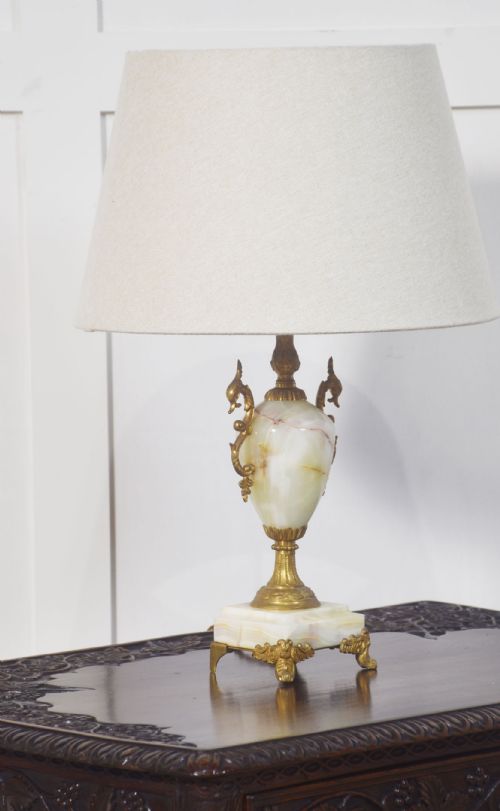
Green Marble Lighting
Green marble lighting brings weight and natural grain to a room, pairing cold stone with warm metal mounts.
Green Marble Lighting
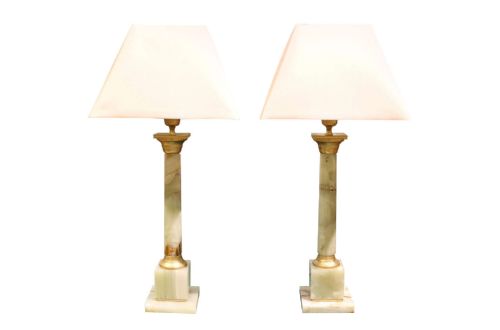
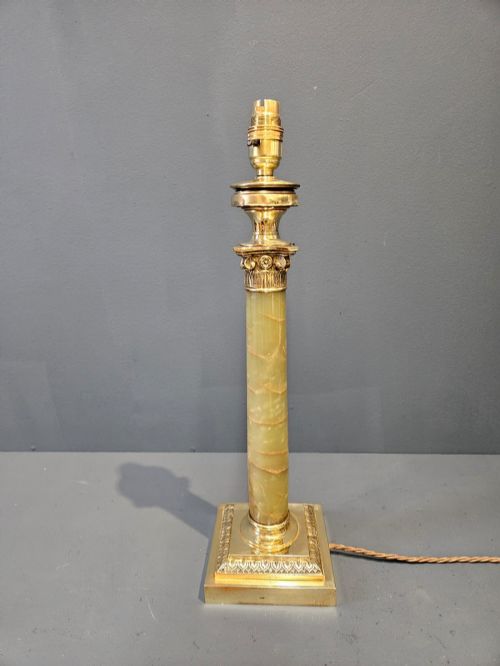
Green marble lighting spans table lamps, desk lamps, floor lamps, and candelabra from the Victorian era through the Art Deco period and mid-century. You will frequently encounter heavy stone bases paired with brass, gilt bronze, or ormolu mounts, often standing alongside onyx and spelter alternatives.
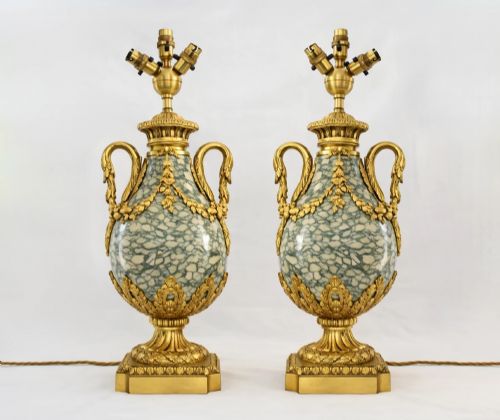
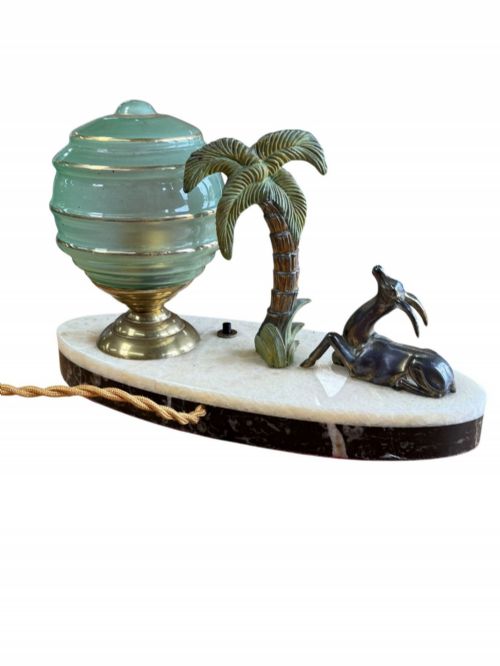
The selection ranges from neoclassical cassolettes and French Louis XVI style designs to industrial or figural torcheres and Italian glass fruit lamps. Pieces from the late nineteenth century lean towards classical metal mounts, while 1920s and 1930s examples embrace streamlined geometric forms.
These fixtures serve both functional illumination and decorative presence, utilising fabric shades or exposed bulbs. Their origins stretch across British and continental workshops, with a strong representation of French and Italian craftsmanship.
Materials and construction
Makers shaped the heavy stone columns and urn bases on lathes, then polished the surfaces to reveal the natural veining of the marble and onyx. Metal components such as brass, gilt bronze, and ormolu were cast, chased, and fitted around the stone as collars, feet, and capitals.
Electrical components, where added later or integrated during the twentieth century, were run through central drilled channels in the stone or hidden behind metal sleeves. Spelter and bronze formed the figural elements, frequently given patinated or gilt finishes to contrast with the dark green mineral.
Green Marble Lighting Retail Price Guide 2026
Typical asking prices for green marble lighting among the pieces listed under this phrase on Sellingantiques today, from the lower quarter to the upper quarter. They describe what is for sale here now, not the wider market.
Listings feature periods from the Victorian era through the 1930s, utilising materials including marble, brass, gilt bronze, and onyx.
Assessing quality and finish
The refinement of the metal casting and the precision of the stone turning set individual items apart. Finer examples display crisply chased ormolu and heavy, solid brass mounts that fit flush against the polished marble.
Depth of colour and consistency in the mineral grain determine the visual impact of the base. Superior pieces employ dense, well-figured stone free from clumsy repairs, paired with substantial bronze rather than lighter spelter.
The Green Marble Lighting Glossary
- Cassolette
- A decorative vessel with a reversible lid that functions as a vase or a burner. In lighting, these are often adapted into grand table lamps.
- Ormolu
- Finely ground high-carat gold applied to a bronze base through a mercury amalgamation process. This technique gives mounts a deep, lasting warmth.
- Spelter
- A zinc alloy commonly used as a cost-effective substitute for bronze. It takes patination well but feels lighter and softer than true bronze.
- Campana
- An inverted bell-shaped vessel form derived from ancient Roman pottery. These frequently form the urn bases of classical lamps.
- Torchere
- A tall standing lamp designed to cast light upwards towards the ceiling. Grand examples often feature figural bronze supports.
Green Marble Lighting: Frequently Asked Questions
How do I date a marble lamp?
Examine the wiring, the style of the metal mounts, and the construction of the base to establish a timeline. Victorian pieces often use heavy brass and classical motifs, whereas 1930s items favour streamlined geometric shapes.
Look for maker stamps or casting numbers underneath the base or near the lamp holder. Screws, threading, and switch types also offer clues to whether the electrical components are original or later replacements.
Can these lamps take modern bulbs?
Most standard fittings can accommodate modern LED or low-energy bulbs provided the wattage matches the historical rating. It remains wise to have older wiring checked by a qualified electrician before daily use.
Ensure the shade carrier or harp fits the chosen bulb size securely. The heavy stone base provides enough stability for various shade weights without tipping.
How should I clean green marble?
Dust the stone regularly with a soft, dry cloth to prevent grime settling into the natural pores of the marble. Avoid acidic cleaners, vinegar, or harsh detergents that can etch or dull the polished surface.
For the metal mounts, use a gentle cloth without abrasive polishes that might strip the original gilt or bronze patina. Keeping the stone away from excess moisture preserves both the finish and the internal wiring.
Are these pieces heavy?
The combination of dense stone and cast metal makes these lamps substantially heavier than ceramic or wooden alternatives. This weight provides excellent stability, particularly for taller floor lamps and large candelabra.
Take care when lifting or moving them, supporting both the stone base and the central stem rather than pulling by the mount or shade.