
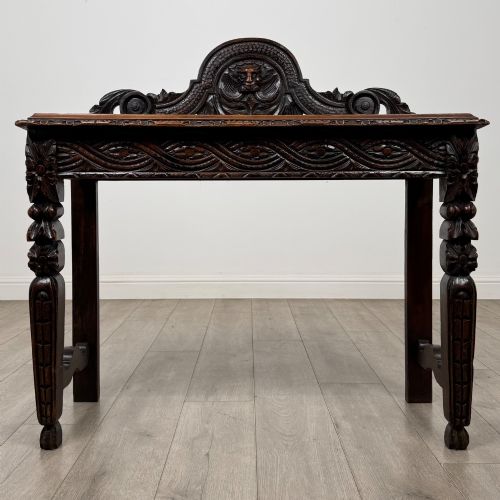
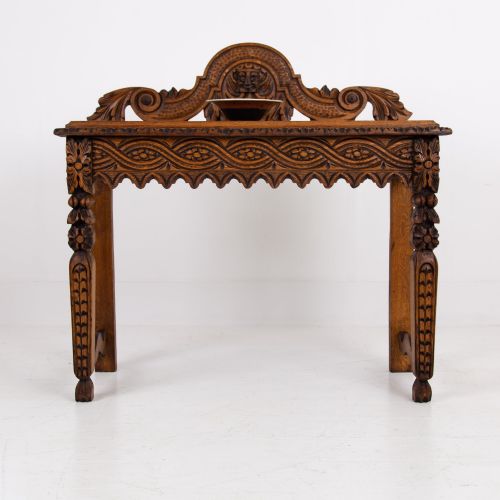
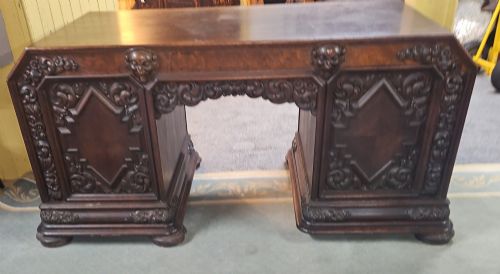


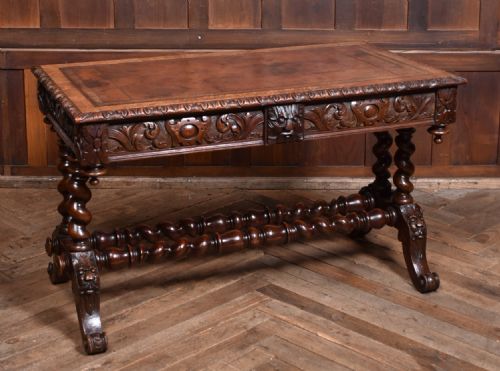


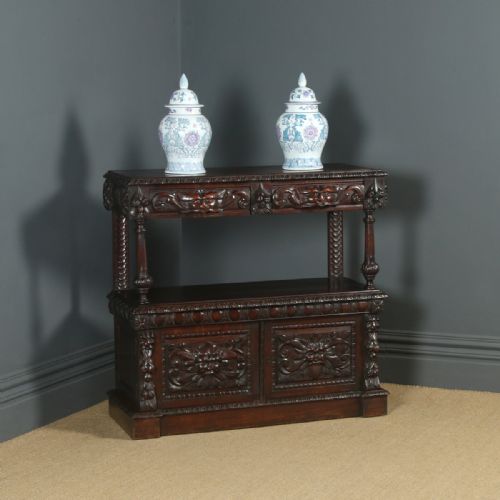
Green Man Oak Table
A green man oak table brings nineteenth-century gothic revival myth and foliage into a room through deep relief carving.
Green Man Oak Table
A green man oak table is a nineteenth-century furnishing shaped by Victorian gothic and renaissance revival aesthetics, frequently encountered as side tables, hall tables, and writing desks.
The evidence shows these pieces originating across the Victorian era, spanning specific decades from eighteen fifty to nineteen hundred, constructed in solid oak and golden oak.
Side tables and hall tables dominate the forms currently available, alongside desks, bureaux, and dining sets bearing the characteristic foliate mask.
Materials and Technique
Construction relies heavily upon solid oak and golden oak, sometimes complemented by brass hardware and leather inserts for writing surfaces.
Maker skill is evident in the hand-carved relief work defining the green man masks, mythical beasts, and architectural revival details across panels and drawers.
Listings demonstrate construction in solid oak and golden oak, spanning Victorian and Flemish Renaissance revival styles.
Standards of Execution
Structural integrity of the timber, consistency of the oak grain, and proportion in revival styling distinguish exceptional cabinet work from standard production.
Winterhalder and Hofmeier
The Green Man Oak Table Glossary
- Green man
- A sculptural motif of a human face emerging from or entwined with leaves, vines, and branches. It symbolises rebirth and spring in architectural and furniture ornamentation.
- Gothic Revival
- An architectural and decorative style popular during the nineteenth century that imitates medieval forms. It utilises pointed arches, heavy mouldings, and ecclesiastical motifs.
- Flemish Renaissance Revival
- A nineteenth-century design movement incorporating northern European Renaissance elements. This style often employs exuberant strapwork, cartouches, and high-relief carving.
- Console table
- A table designed to be fixed against a wall, frequently supported by ornamental brackets or legs. In nineteenth-century interiors, these served as decorative surfaces in halls and reception rooms.
- Golden oak
- A specific light-toned variant of oak timber favoured in later Victorian furniture production. It highlights natural grain patterns when finished.
Green Man Oak Table: Frequently Asked Questions
What is a green man oak table?
A green man oak table is a nineteenth-century Victorian or revival furnishing featuring hand-carved foliate mask ornamentation.
These pieces range from compact hall tables to larger writing desks and dining sets constructed from solid oak.
How were these tables used?
They functioned primarily as decorative and practical surfaces in nineteenth-century hallways, libraries, and reception rooms.
Writing desks and side tables provided functional workspaces and display areas for households of the period.
How do I date a green man oak table?
Dating relies on stylistic markers from the Victorian era, including gothic revival details and specific revival movements like the Flemish Renaissance.
Evidence points to production spanning the mid to late nineteenth century up to nineteen hundred.
How do I care for antique oak furniture?
Antique oak benefits from stable indoor humidity and protection from direct sunlight to prevent timber movement.
Regular dusting with a dry cloth and occasional application of appropriate wax maintains the finish of the carved surfaces.