





Green Iridescent Glass
Green iridescent glass captures light with metallic sheens, offering vibrant hues and fluid forms that elevate any mantelpiece.
Green Iridescent Glass
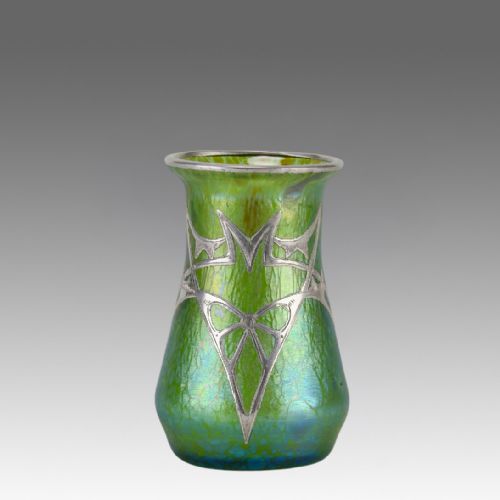
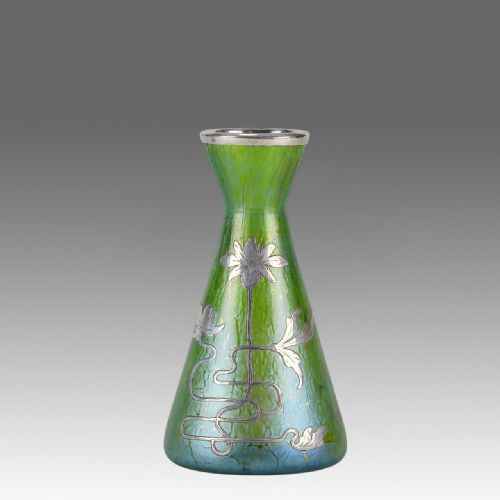
Green iridescent glass mostly comprises turn-of-the-century art glass vessels, dominated by vases, decorative bottles, and bowls from the Art Nouveau and Secessionist periods. Makers shaped these pieces with organic, flowing lines, frequently mounting them in pewter stands or mounting them with sterling silver overlays.
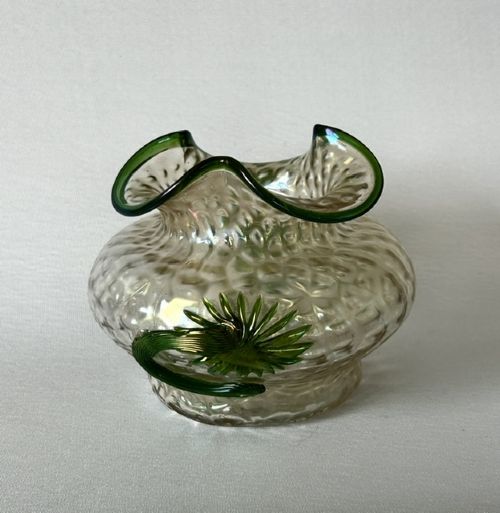
Vases range from trumpet-shaped Jack in the Pulpit forms to bulbous Martele and Papillon decors produced by Bohemian glassworks. Earlier examples include Georgian wine and champagne bottles exhibiting accidental or burial-induced iridescence from centuries underground.
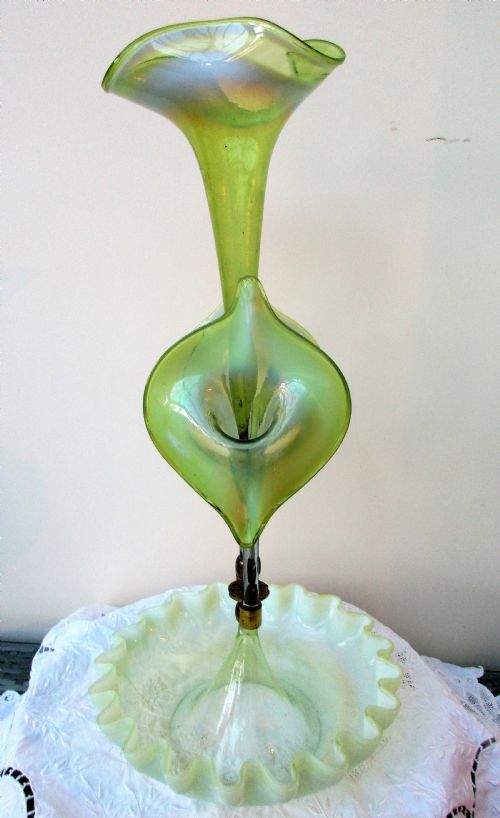
The selection leans heavily towards Bohemian production from the late nineteenth and early twentieth centuries, alongside English Victorian epergnes and occasional trinket boxes fitted with silver lids.
What varies in quality
Quality rests on the depth and complexity of the optical sheen, the crispness of applied metalwork mounts, and the sophistication of the vessel's form. Pieces featuring integrated pewter or hallmarked silver stands by recognised workshops demonstrate greater ambition.
The distribution and intensity of the iridescence across the green body dictate visual success, alongside the integrity of blown shapes such as organic epergnes and sculptural vases.
Green Iridescent Glass Retail Price Guide 2026
Typical asking prices for green iridescent glass among the pieces listed under this phrase on Sellingantiques today, from the lower quarter to the upper quarter. They describe what is for sale here now, not the wider market.
Some eighteenth-century bottles acquired their iridescent shimmer entirely by accident after spending generations buried in privy pits.
Johann Loetz·Loetz Witwe·Kralik glassworks·A. J. Pepper & Co·J Reinemann
The Green Iridescent Glass Glossary
- Iridescent Glass
- Glass treated with metallic oxides while hot to produce a rainbow-like sheen on the surface. This technique creates shimmering reflections that shift in changing light.
- Art Nouveau
- A decorative style characterised by fluid, organic lines and floral motifs popular around nineteen hundred. It heavily influenced the design of Bohemian glass vessels.
- Secessionist
- An early twentieth-century Central European design movement favouring geometric austerity combined with organic curves. It often appears alongside metalwork mounts on glass pieces.
- Epergne
- A large table centrepiece featuring multiple branching holders for fruit or flowers. Victorian examples frequently utilise green glass components.
- Papillon
- An iridescent surface décor resembling butterfly wings, created by rolling molten glass over metallic fragments. Loetz utilised this effect extensively on green vessels.
Green Iridescent Glass: Frequently Asked Questions
What is the difference between Loetz and Kralik glass?
Loetz pieces often feature distinct surface treatments like the papillon décor and complex metal mounts by firms such as Reinemann. Their forms tend towards sculptural Art Nouveau experimentation.
Kralik production frequently encompasses organic shapes and domestic items like lidded trinket boxes mounted with silver by makers such as Pepper and Company.
Are Georgian green glass bottles iridescent?
Georgian wine and champagne bottles acquire iridescence through long periods of burial in the earth. This chemical reaction with soil minerals creates a silvery patina over the dark green glass.
Artistic iridescent glass from the twentieth century achieves this effect intentionally in the furnace through metallic oxide vapours applied during blowing.
How can I identify an Art Nouveau vase?
Art Nouveau vases display asymmetrical, plant-like contours inspired by natural growth. Look for pinched rims resembling floral petals, such as Jack in the Pulpit forms.
The presence of Secessionist silver overlay or pewter stands further points to this design period around the turn of the twentieth century.