




Green Forest Wall Tapestry
A green forest wall tapestry brings woodland foliage into a room, offering deep leafy tones and historic texture.
Green Forest Wall Tapestry
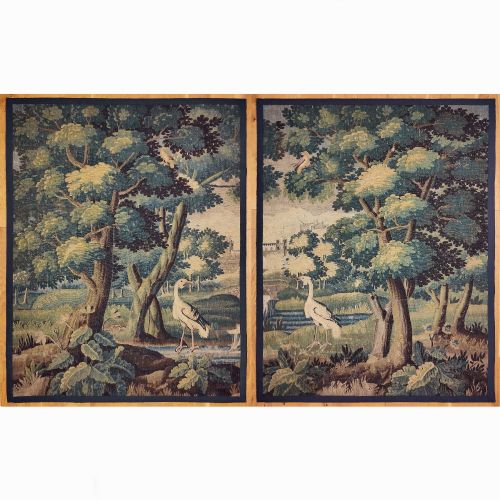
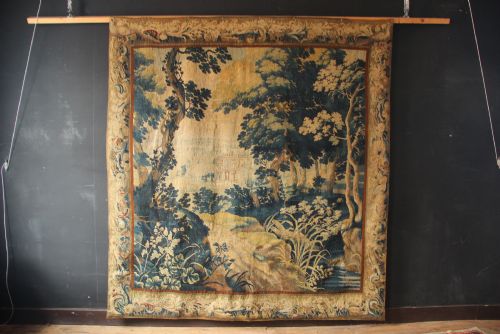
A green forest wall tapestry presents a dense woodland scene dominated by verdant foliage, trees and often distant castles or birds. These hangings transform a plain interior by introducing a rich sense of depth and organic colour.
Most examples encountered here belong to the verdure tradition, where plant life forms the primary subject matter. The aesthetic draws heavily on Flemish and French weaving traditions spanning the seventeenth, eighteenth and nineteenth centuries.
Buyers will find pieces ranging from grand seventeenth-century Flemish compositions to later nineteenth-century French interpretations. These works serve as substantial textile focal points for large wall spaces.
Materials and construction
These textiles rely on a combination of wool, silk, cotton and linen fibres. Weavers used these materials to build up the intricate textures of leaves, bark and distant landscapes.
The construction involves specialised loom techniques practiced in historical European centres such as Aubusson and Flanders. Artisans interwove dyed warp and weft threads to create complex pictorial surfaces.
Green Forest Wall Tapestry Retail Price Guide 2026
Typical asking prices for green forest wall tapestry among the pieces listed under this phrase on Sellingantiques today, from the lower quarter to the upper quarter. They describe what is for sale here now, not the wider market.
Many seventeenth-century weavers tucked microscopic birds deep into the canopy, waiting quietly for centuries to be spotted.
Evaluating the weaving
The distinction between standard and exceptional pieces rests in the subtlety of the colour gradation and the density of the weave. Finer textiles employ delicate shifts in wool and silk to render individual leaves and shadowed thickets with remarkable clarity.
The complexity of the narrative or landscape design also dictates the standard of the work. Early Flemish and Aubusson examples often display a greater depth in botanical detail compared to later nineteenth-century productions.
The Green Forest Wall Tapestry Glossary
- Verdure
- A type of tapestry featuring a landscape heavily populated by trees, plants, leaves and birds. These scenes emphasise lush greenery and natural foliage.
- Aubusson
- A historic French town renowned for its carpet and tapestry weaving industry. Pieces originating from this centre often showcase refined pastoral or forest designs.
- Flemish Baroque
- An artistic style prevalent in seventeenth-century Flanders characterised by dramatic movement and rich detail. Tapestries from this period exhibit deep perspective and elaborate botanical motifs.
- Warp and weft
- The foundational threads of a textile where the warp runs vertically and the weft is woven horizontally across them. This interlacing creates the pictorial surface of the hanging.
Green Forest Wall Tapestry: Frequently Asked Questions
How do I hang a tapestry?
Hanging a large textile safely requires distributing the weight evenly across a concealed wooden batten or metal rod. Sew a heavy-duty fabric sleeve along the top reverse edge to slide onto the support.
Ensure the piece hangs clear of direct sunlight to protect the wool and silk fibres from fading. Allow adequate space between the wall and the textile for air circulation.
What is a verdure tapestry?
A verdure tapestry depicts a stylised woodland scene where trees, foliage and occasionally animals fill the entire composition. These pieces were designed to bring the outside landscape into domestic interiors.
Originating largely from Flemish and French workshops, they rely on varied shades of green and brown wool and silk.
How are different centuries told apart?
Distinguishing between seventeenth, eighteenth and nineteenth-century pieces involves examining the palette, border design and weaving fineness. Earlier works from Flanders often feature darker, richer tones and complex architectural or floral borders.
Later nineteenth-century French interpretations tend to show brighter hues and looser botanical renderings. Comparing the specific fibre usage also provides clues to the era of production.