





Green Cut Glass Bottle
A green cut glass bottle brings deep colour and brilliant light to a dressing table.
Green Cut Glass Bottle
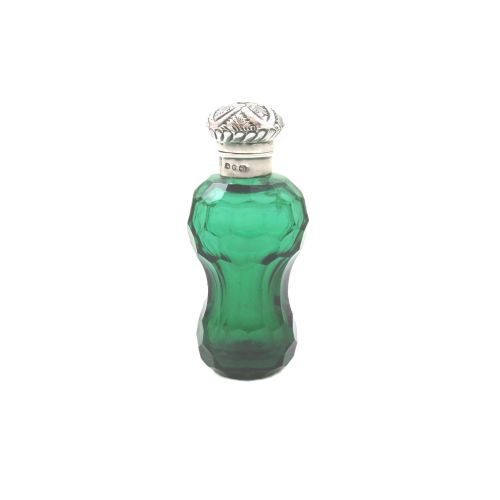
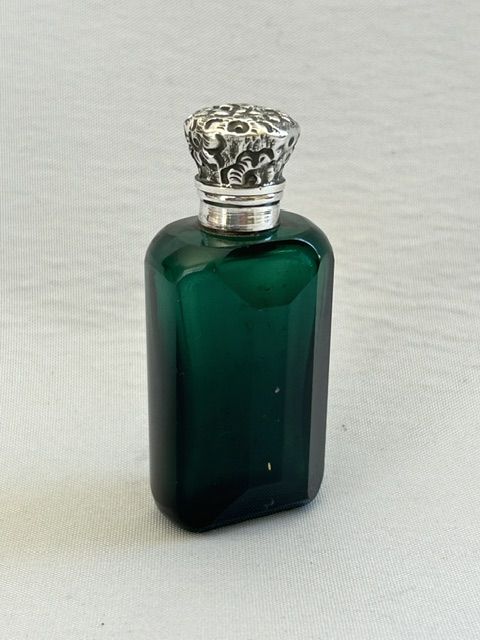
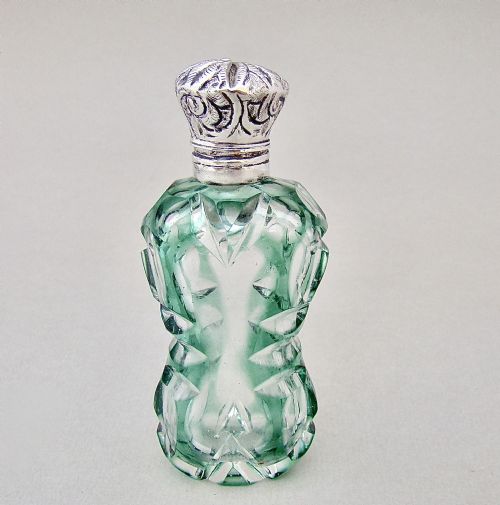
A green cut glass bottle most commonly appears on this page in the form of a Victorian or Art Deco scent or perfume bottle, often mounted in sterling silver. These vessels were designed to hold fragrances safely on a dressing table or in a travel case, combining utility with decorative presence.
The selection ranges from tall hock decanters to small scent flasks and fitted perfume caskets. Bristol green glass and colour overlay glass dominate the forms, reflecting nineteenth and early twentieth-century manufacturing traditions.
How they were made
Glassmakers produced these items using heavy crystal or layered overlay glass, applying wheel-cutting techniques to carve geometric or linear patterns through the outer green layer to clear glass beneath. This method created high contrast and a tactile faceted surface.
Silversmiths and metalworkers fitted many of these glass bodies with sterling silver collars, hinged caps, or decorative mounts, frequently incorporating enamel work in later periods such as the Art Deco and mid-century eras.
Green Cut Glass Bottle Retail Price Guide 2026
Typical asking prices for green cut glass bottle among the pieces listed under this phrase on Sellingantiques today, from the lower quarter to the upper quarter. They describe what is for sale here now, not the wider market.
A Victorian glass bottle lets you carry your favourite scent while pretending to scheme in a drawing room.
What varies in quality
Quality rests upon the crispness of the glass cutting and the depth of the colour saturation. Sharply defined facets catch the light cleanly, whereas softer cutting lacks the same brilliance.
The integrity of the metal mounts and the presence of fully legible hallmarks also determine the standing of a piece. Original silver caps and intact enamel add notable substance to an item.
Henry Perkins·Mappin & Webb
The Green Cut Glass Bottle Glossary
- Overlay glass
- A vessel formed of two or more distinct layers of glass, typically a vibrant green outer casing over a clear or contrasting body, which is then cut away to reveal the underlayer. This technique demands immense skill from the glassblower and cutter.
- Bristol green
- A deep, rich hue of green glass historically produced in the West Country of England during the eighteenth and nineteenth centuries. It remains a defining characteristic of many domestic glass vessels from the period.
- Hock decanter
- A tall, slender wine decanter traditionally used for Germanic white wines, often rendered in coloured glass during the Victorian era. These pieces make striking display objects.
- Guilloché enamel
- A decorative technique where a precise, repetitive pattern is mechanically engraved beneath a translucent layer of enamel. It appears frequently on silver-mounted caps from the twentieth century.
- Perfume casket
- A decorative box or case lined to hold multiple scent bottles securely. These often feature bronze or precious metal frameworks housing fine glass vessels.
Green Cut Glass Bottle: Frequently Asked Questions
What is a green cut glass bottle?
A green cut glass bottle is a decorative vessel made from coloured glass featuring wheel-cut facets that catch the light. These items were principally produced as scent bottles or decanters.
They combine rich green hues with reflective surfaces, making them both practical containers and decorative objects for the home.
How were perfume bottles used?
Victorian and twentieth-century perfume bottles held liquid scents on dressing tables or inside travel luggage. Their tight stoppers and silver screw caps prevented evaporation.
Many examples were also kept within fitted caskets or displayed openly for their aesthetic appeal.
How do I date a silver mounted bottle?
Dating relies primarily on the sterling silver hallmarks stamped onto the collars or caps. These marks record the assay office and year of assay.
Stylistic cues such as Art Nouveau curves or Art Deco geometric enamel also help narrow down the period of manufacture.
What is overlay glass?
Overlay glass consists of a clear or contrasting glass body covered by a distinct second layer of coloured glass. The outer layer is then cut through to reveal the glass underneath.
This creates a striking two-tone pattern with a textured, tactile surface.
Are these bottles safe for daily use?
While many of these bottles remain structurally sound, antique glass and historical silver mounts require gentle handling. Modern use should be approached with care to preserve interior residue and delicate metal hinges.
Most buyers choose to display them rather than use them for everyday cosmetics.