

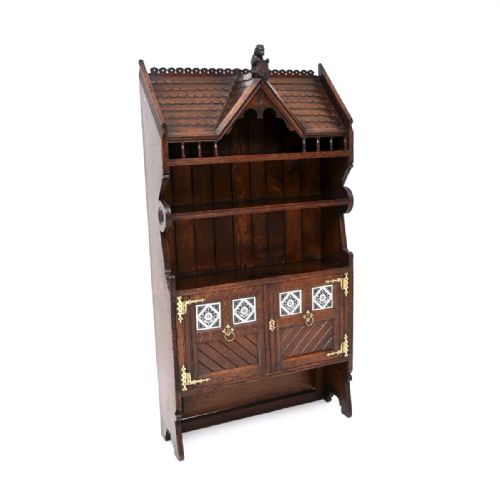

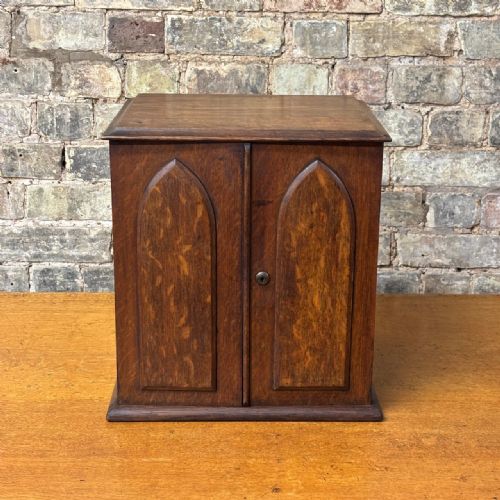


Gothic Oak Wall Cabinet
A gothic oak wall cabinet brings medieval verticality and heavy timber grain into modern rooms.
Gothic Oak Wall Cabinet
A gothic oak wall cabinet draws on medieval architectural vocabulary, taking the form of hanging cupboards, corner units, and key cabinets intended for domestic storage. These pieces emerge in styles ranging from Victorian Gothic Revival to Arts and Crafts and the Aesthetic Movement, spanning dates from the seventeenth century through the nineteenth century.
The version most commonly met on this page is the Victorian Gothic Revival or Arts and Crafts wall-mounted cupboard. Such pieces employ heavy timbers and carved panel doors to create storage with distinct historical presence.
How they were made
Makers construct these cabinets predominantly from solid oak, sometimes supplemented with beech, utilising traditional joinery and panel construction to house carved or linenfold wooden elements. Wrought iron and brass provide hinges, escutcheons, and latches that anchor the medieval aesthetic.
Surface treatments rely on natural timber finishes, occasional pigment, and surface burning techniques such as pokerwork to delineate decorative motifs across the wood.
Gothic Oak Wall Cabinet Retail Price Guide 2026
Typical asking prices for gothic oak wall cabinet among the pieces listed under this phrase on Sellingantiques today, from the lower quarter to the upper quarter. They describe what is for sale here now, not the wider market.
A French manoir cellar yielded one sturdy oak alcove cupboard, bringing an aroma of old wine and provincial history straight to the wall.
What varies in quality
The standard of a cabinet rests upon the crispness of its carved panels and the integrity of its timber construction. Pieces featuring deep relief carving and well-chosen grain command greater visual weight than simpler constructions.
Original hardware, including brass or wrought iron hinges and locks, elevates a piece significantly compared to later replacements. The balance between structural joinery and decorative flourish dictates the overall success of the design.
John Moyr Smith
The Gothic Oak Wall Cabinet Glossary
- Gothic Revival
- An architectural and decorative style drawing inspiration from medieval forms, pointed arches, and heavy proportions. It dominates the ornamentation found on nineteenth-century woodwork.
- Linenfold
- A style of wood panel carving that imitates folded linen cloth, frequently utilised on vertical cabinet doors. This technique adds texture and depth to flat wooden surfaces.
- Pokerwork
- A decorative method using heated tools to burn designs into wood, seen on specific Arts and Crafts pieces. It creates dark, contrasting linear patterns across the oak surface.
- Aesthetic Movement
- A late nineteenth-century design current emphasising visual beauty over narrative subject matter. Cabinets from this circle display refined decorative schemes.
Gothic Oak Wall Cabinet: Frequently Asked Questions
What is a gothic oak wall cabinet?
A gothic oak wall cabinet is a small hanging cupboard or key cabinet built from oak and ornamented with medieval architectural motifs such as pointed arches and linenfold panels. These pieces mount securely to walls to provide enclosed storage.
They reflect revivalist design movements from the Victorian era and the Arts and Crafts period, bringing substantial timber character into compact wall spaces.
How were these cabinets used originally?
Originally, these wall-mounted cupboards served to store small valuables, keys, documents, or tableware within reception halls, kitchens, and private studies. Their elevated position kept important items secure and accessible.
Key cabinets and corner cupboards specifically maximised awkward room layouts while concealing everyday items behind heavy wooden doors.
How do I hang a heavy oak wall cabinet?
Hanging a heavy oak cabinet requires locating solid wall studs or masonry supports to bear the substantial weight of the timber and its contents. Appropriate heavy-duty fixings matched to the wall type are essential.
Because these pieces utilise dense oak and traditional joinery, professional installation ensures the cabinet remains secure over time.
How do I tell Victorian Gothic Revival from earlier styles?
Victorian Gothic Revival pieces often combine nineteenth-century machine assistance and standard hardware with historical motifs, whereas seventeenth-century examples display distinct hand- adzed tool marks and pegged joinery.
Examining the hinges, interior construction, and timber seasoning helps determine whether a piece belongs to the 1880s revival or the earlier seventeenth-century period.