



Golden Oak Roll Top
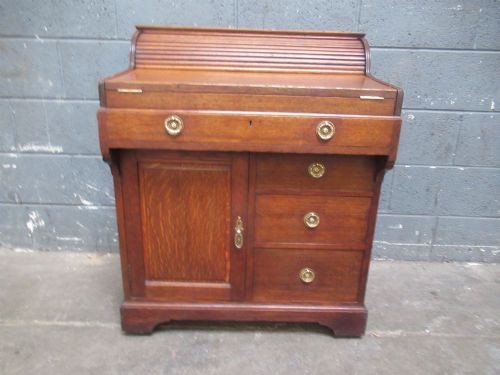
A golden oak roll top brings warmth and working space to a room, offering clever pigeonholes behind a sliding slatted tambour.
Golden Oak Roll Top
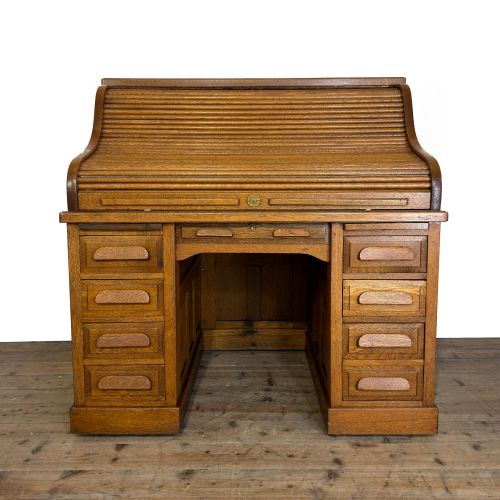
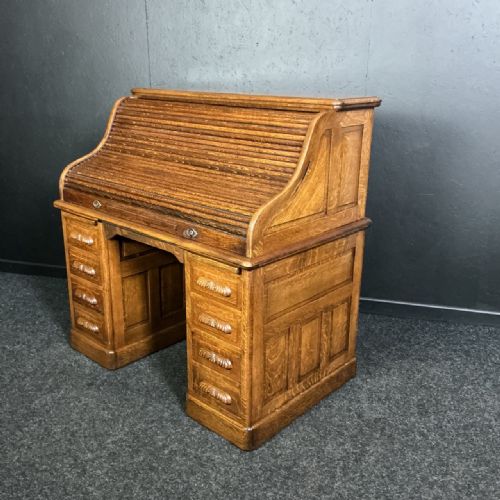
A golden oak roll top sits firmly in the Edwardian and Victorian eras, taking the form of large pedestal writing desks, bureau bookcases, and occasional cigar cabinets. These pieces combine heavy-duty office utility with domestic timber tones, making them substantial furniture for a study or library.
The version most commonly met on this page is the Edwardian desk in pale oak, often fitted with internal drawers and a writing surface lined in tooled leather. Larger Victorian cylinder desks and tambour cabinets also appear, showing how businesses and wealthy households stored their paperwork.
Makers such as Maples of London and Paris supplied these pieces alongside regional cabinetmakers, using durable timbers designed for heavy daily use. The overarching style remains functional and timber-focused, valuing practical storage over fragile ornamentation.
How they were made
Construction relies heavily on solid oak and oak veneers, selected for grain pattern and strength, paired with brass and metal hardware for handles and locks. Slats of timber form the flexible tambour shutter that rolls smoothly along grooved tracks to conceal the writing surface.
Writing surfaces are frequently inset with tooled leather, whilst secondary materials like glass, canvas, and lead appear in specialised compartments or associated bureau bookcases. Joinery is robust, designed to withstand the tension of a sliding roll top and the weight of numerous internal document drawers.
Golden Oak Roll Top Retail Price Guide 2026
Typical asking prices for golden oak roll top among the pieces listed under this phrase on Sellingantiques today, from the lower quarter to the upper quarter. They describe what is for sale here now, not the wider market.
Listings feature items primarily from the Edwardian and Victorian eras, constructed from oak, brass, and leather.
What varies in quality
Quality shows in the smoothness of the tambour mechanism and the precision with which the narrow wooden slats align when closed. A superior desk operates without sticking, whereas lesser examples suffer from warped tracks or stiff shutters.
The calibre of internal cabinetwork also dictates value, distinguished by hand-dovetailed drawer boxes, well-figured timber selection, and original brass fittings. Scale plays a part too, as monumental Victorian cylinder desks demand exceptional timber stability to prevent movement in the large curved panels.
Maples of London and Paris
The Golden Oak Roll Top Glossary
- Tambour
- A flexible shutter made from narrow strips of wood glued to canvas or leather backing, allowing it to slide around a curved track. This clever mechanism conceals the desk interior when closed.
- Cylinder top
- A solid curved wooden panel that rolls back into the desk body, offering a smoother and more formal profile than a slatted tambour. It requires expert joinery to maintain alignment over decades of use.
- Pedestal desk
- A large freestanding desk comprising two supporting banks of drawers with a central recess for the sitter. These heavy pieces provide substantial storage beneath the main writing surface.
- Bureau bookcase
- A combination piece featuring a slanted or roll-top desk base surmounted by glazed shelving for books. It represents a practical multi-purpose item for domestic studies.
- Tooled leather
- A writing surface insert decorated with pressed or gilt patterns around the perimeter. It provides a smooth, durable pad for handwriting.
Golden Oak Roll Top: Frequently Asked Questions
How do I maintain the roll top?
Keep the wooden tracks clean and lightly waxed so the tambour slides freely without catching on dust or dry timber. Avoid placing heavy heat sources nearby that might cause the wood to warp.
Regular care preserves the delicate glue and canvas backing that holds the narrow slats together. Gentle treatment ensures the mechanism remains operational for daily use.
What periods do these desks cover?
The pieces available predominantly span the Edwardian era and the late Victorian period, roughly around nineteen hundred. Cabinetmakers favoured pale oak finishes during these decades.
Victorian examples tend towards heavier proportions and cylinder fronts, while Edwardian versions frequently feature lighter golden oak and tambour shutters. Both styles reflect the administrative demands of their time.
Are all these desks made of solid oak?
While solid oak forms the structural frames and desktop surfaces, makers often utilised oak veneers on large flat panels to prevent splitting. Secondary timbers appear inside hidden drawers.
Brass, leather, and glass are integrated where function requires, such as writing surfaces and bookcase doors. This combination of materials ensured stability in heavy office furniture.