
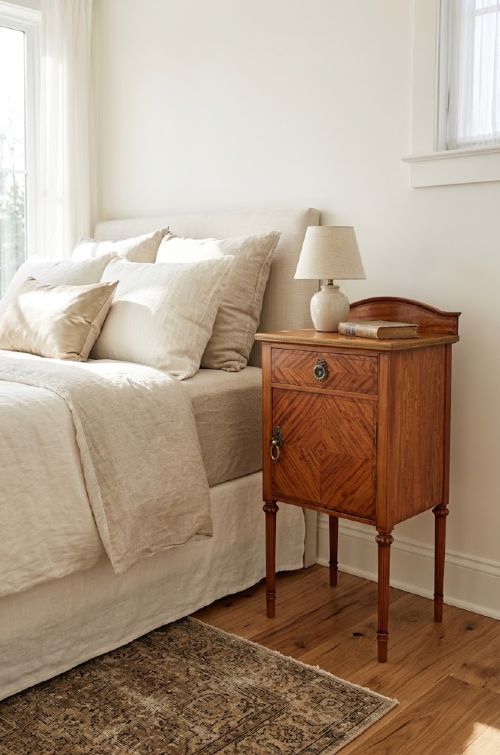


Golden Mahogany Side Table
A golden mahogany side table brings warm timber tones and refined proportions to a room, offering practical surface space with understated elegance.
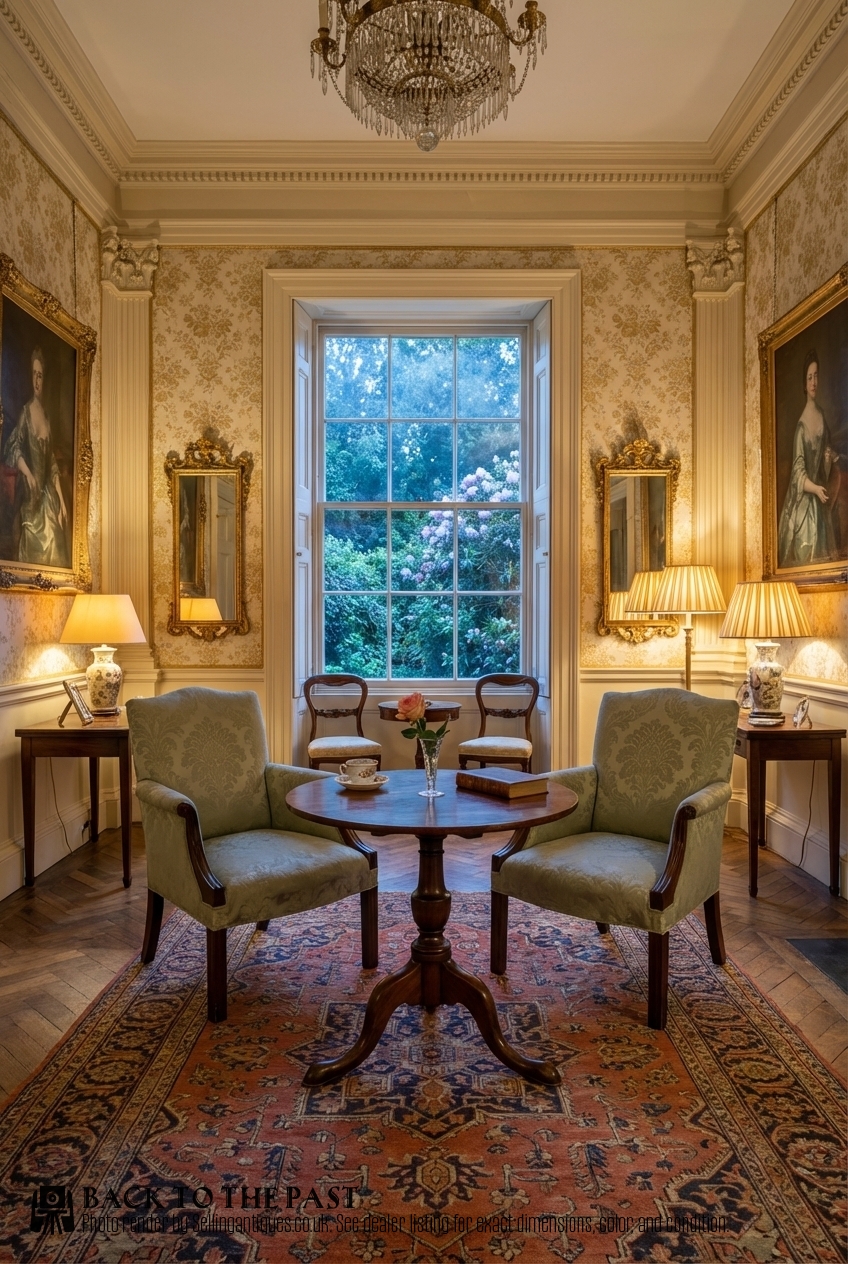
Golden Mahogany Side Table
A golden mahogany side table encompasses a range of compact freestanding furniture designed for occasional use, displaying the warm honey and amber hues characteristic of the timber. These pieces appear across several eras, including the Georgian, Regency, and Victorian periods, as well as the Edwardian era and the later Sheraton Revival. Buyers encounter various forms on this page, such as Pembroke tables, tilt-top tripod tables, nests of tables, commodes, and bedside cupboards.
The materials span primarily mahogany and satinwood, occasionally accented with rosewood or brass fittings. Styles draw heavily on Sheraton and Georgian design principles, favouring slender legs, satinwood banding, and delicate proportions over heavy ornamentation. While some function as bedside tables or card tables, others serve as etageres and small occasional tables for parlours and drawing rooms.
How they were made
Construction relies heavily on solid mahogany and satinwood veneers, selected for grain figure and natural warmth. Cabinetmakers utilised timber framing with pegged or dovetailed joints for stability in smaller occasional pieces such as tripod tables and Pembroke drop-leaf tables.
Surface decoration frequently incorporates contrasting satinwood stringing and mahogany crossbanding, executed with fine hand-cut inlay techniques. Brass castors, hinges, and handles complete the construction on mobile or multi-part forms like nests of tables and etageres.
Form variations include fold-over card tables, multi-tiered etageres, nested sets, and tilt-top tripod tables.
What varies in quality
The quality of a golden mahogany side table rests upon the selection and matching of the timber veneers, where superior examples exhibit deep, luminous grain patterns and consistent colour. Finer pieces demonstrate precision in the execution of satinwood inlay and stringing, maintaining crisp geometry along table edges and drawer fronts.
Structural integrity and proportion also dictate standing within the range. Pieces retaining their original brass hardware, uncompromised tripod mechanisms, or well-fitted drop leaves command greater regard among collectors than those with altered components.
Williamson
The Golden Mahogany Side Table Glossary
- Golden mahogany
- A descriptive term for mahogany timber possessing a lighter, warmer, honey-toned colour rather than the dark reddish-brown common in later Victorian furniture.
- Pembroke table
- A small occasional table featuring two hinged drop leaves on opposing sides, frequently fitted with a single drawer.
- Tripod table
- A small standalone table supported by a central pillar resting on three spreading legs, often configured with a tilting top mechanism.
- Satinwood
- A lustrous, fine-grained hardwood of a pale yellowish colour, utilised extensively for banding, stringing, and veneer panels in Sheraton and revival furniture.
- Etagere
- A set of open shelves supported by uprights or columns, used for displaying small decorative objects or books.
Golden Mahogany Side Table: Frequently Asked Questions
What is a golden mahogany side table?
A golden mahogany side table is a compact piece of furniture made from lighter-toned mahogany, often accented with satinwood inlay. These tables were designed for functional placement in sitting rooms, bedrooms, and parlours.
They appear in various formats across this page, including tripod tables, card tables, and Pembroke tables, dating from the eighteenth century through to the Edwardian period.
How do I date a side table?
Dating relies on observing construction methods, timber choice, and stylistic vocabulary. Eighteenth-century and Georgian pieces generally exhibit hand-cut joinery and simpler, robust proportions, while Regency examples incorporate classical revival motifs.
Edwardian and Sheraton Revival pieces often utilise lighter satinwood veneers and machine-assisted construction techniques alongside period stylistic references.
Where were these tables used?
These tables served multiple domestic purposes in traditional interiors. Pembroke and card tables stood in reception rooms for entertaining, whilst smaller tripod and bedside tables functioned as functional surfaces next to seating or beds.
Etageres and nests of tables provided tiered storage and display space without occupying excessive floor area in smaller drawing rooms.
Are these tables sturdy?
Most occasional and side tables are built to support moderate everyday loads such as lamps, books, or tea services. Slender-legged forms like tripod tables and nests require careful placement on level flooring to maintain stability.
Solid mahogany and joined timber construction generally provide sufficient durability for continuous daily use in modern homes.