

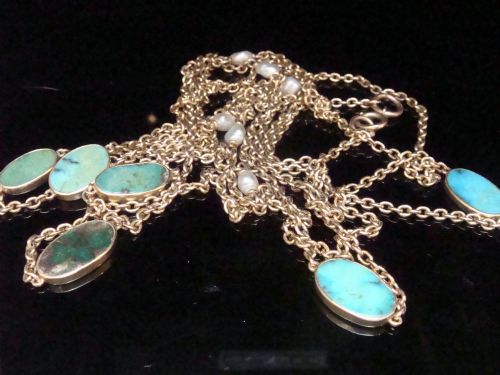
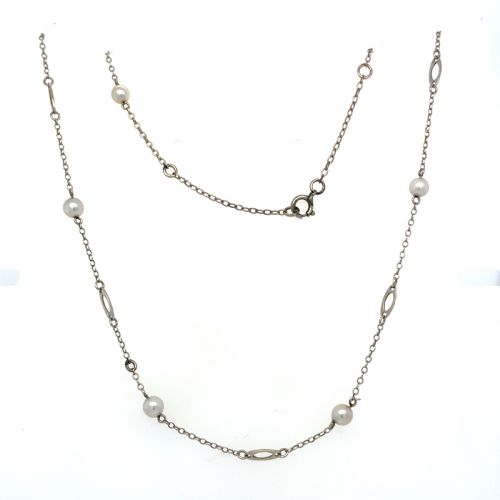
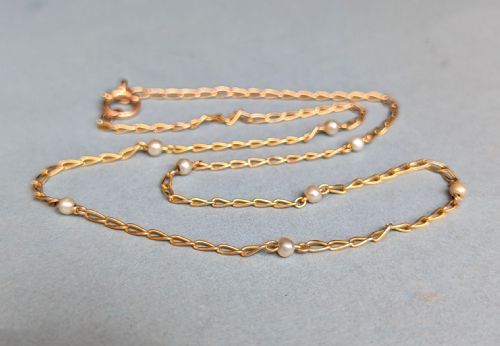


Gold Station Necklace
A gold station necklace brings together fine precious metals and evenly spaced gems or pearls, offering a delicate rhythm of light along the neckline.
Gold Station Necklace
When you search for a gold station necklace, you encounter delicate chains interspersed with distinct decorative elements or pearls at regular intervals. These pieces trace their origins through several distinct eras, spanning Victorian, Edwardian, and mid-century designs.
The materials recorded in these listings range from 9ct and 15ct yellow gold to 18ct white gold, paired frequently with natural pearls, turquoise, and diamonds. Each configuration offers a different weight and presence, from long multi-inch guards to shorter pendant chains.
How they were made
Goldsmiths constructed these chains using traditional hand-working techniques in yellow and white gold, often employing 9ct, 15ct, or 18ct alloys. Links were individually formed, soldered, and polished to create fluid movement along the neck.
Gems and pearls were secured using specialised settings such as bezel or fine wire fixings to hold turquoise, seed pearls, and diamonds at precise intervals. These stations were integrated directly into the chain structure during manufacture.
Gold Station Necklace Retail Price Guide 2026
Typical asking prices for gold station necklace among the pieces listed under this phrase on Sellingantiques today, from the lower quarter to the upper quarter. They describe what is for sale here now, not the wider market.
Listings feature pieces spanning the Victorian, Edwardian, and mid-century periods, utilising yellow gold, white gold, turquoise, and natural pearls.
What varies in quality
Quality in these pieces rests upon the integrity of the gold alloy and the uniformity of the set pearls or stones. Heavier weights, such as substantial longuard chains, indicate robust construction designed for daily wear.
The refinement of the metalwork, from the delicacy of the links to the secure action of clasps like dog clips, distinguishes finer examples. The natural lustre and matching of pearls or turquoise stations further define the tier of the piece.
The Gold Station Necklace Glossary
- Longuard chain
- A very long necklace, often worn doubled or tripled, frequently fitted with a swivel or dog clip for pendants. These pieces originated in the nineteenth century and continued into the Edwardian era.
- Dog clip
- A spring-loaded snap hook used on watch chains and longuards to secure pendants or charms. This mechanism allows the wearer to attach and detach items easily.
- Seed pearl
- A very small, naturally occurring pearl, often drilled and strung in multiples. They appear extensively in antique and Edwardian jewellery for delicate floral or linear motifs.
- Station necklace
- A chain design featuring decorative elements, gems, or pearls spaced at intervals along its length. This layout distributes visual interest evenly around the neck.
Gold Station Necklace: Frequently Asked Questions
How do I wear a longuard chain?
Longuard chains offer remarkable versatility through their substantial length and secure clasps like dog clips. You can loop them twice around the neck or suspend watches and pendants from the fastening.
Their historical design allows them to function both as decorative chains and as practical holders for keepsakes. The weight of the gold ensures the loops hang evenly.
What materials are used in these necklaces?
These necklaces incorporate various gold purities, including 9ct, 15ct yellow gold, and 18ct white gold. Gemstone stations frequently feature turquoise, diamonds, and natural saltwater or seed pearls.
The combination of metal alloys and organic gems defines the aesthetic of each period. Platinum also appears in mid-century settings alongside white gold.
How can I tell the period of a necklace?
Dating relies on stylistic clues, gold purity marks, and the specific combination of materials used in the construction. Edwardian pieces often utilise 15ct gold and natural pearls in long formats.
Mid-century designs tend toward cleaner lines in 9ct or 18ct white gold with different stone cuts. Examining the clasp types and link formation provides further chronological context.