
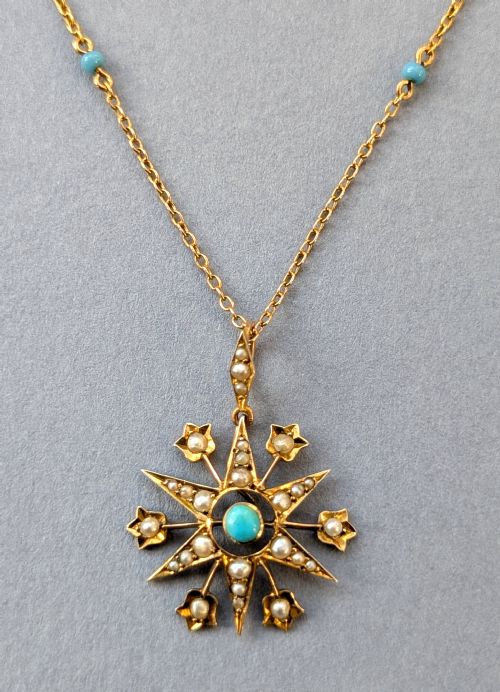


Gold Star Pearl Pendant
A gold star pearl pendant catches the light with celestial motifs and gentle seed pearls, bringing Victorian and Edwardian craftsmanship straight to the neckline.
Gold Star Pearl Pendant
These pieces frequently double as brooches or incorporate locket compartments, reflecting the versatile jewellery designs of the period. Alongside straightforward pendants, collectors find variations featuring central gemstones like turquoise, diamond, sapphire, and peridot set within gold frameworks.
Materials and construction
Goldsmiths shaped these pieces using 9ct, 15ct, and 18ct gold, alongside durable yellow and rose gold alloys. Seed pearls and larger pearls form the central star motifs and delicate borders, often paired with turquoise, diamonds, rubies, or garnets.
Craftsmen utilised secure settings to hold fragile seed pearls and faceted stones in place within intricate starburst, floral, and celestial frameworks. Many examples combine pendant loops with hinged brooch pins, allowing versatile wear as both necklaces and dress ornaments.
Victorian stargazers could wear the cosmos close to their hearts long before modern telescopes brought the planets into our living rooms.
Assessing quality
Quality rests in the precision of the goldwork and the uniformity of the seed pearls used across the celestial design. Finer examples display meticulous setting of diamonds and gemstones alongside perfectly matched pearls that maintain their natural lustre.
The complexity of the metalwork also distinguishes pieces, with superior pendants featuring layered starbursts, delicate engraving, or enamel work rather than plain flat stampings. Original components like integrated chains, glass-backed locket compartments, and secure pin mechanisms further elevate a piece.
The Gold Star Pearl Pendant Glossary
- Seed pearl
- A very small natural or saltwater pearl, often measuring under two millimetres in diameter. These tiny pearls form the delicate clustered petals and star points characteristic of Victorian and Edwardian jewellery.
- Celestial star
- A decorative motif depicting stars, sunbursts, or moons inspired by astronomical observation and romantic sentiment. These motifs dominated late nineteenth-century design.
- Carat
- A unit measuring the purity of gold used in jewellery construction. Pieces in this category typically utilise nine, fifteen, or eighteen carat gold.
- Cabochon
- A gemstone shaped and polished with a smooth, rounded surface rather than faceted edges. Red rock crystal cabochons frequently appear in these pendant designs.
- Lavaliere
- A pendant necklace featuring dangling drops or stones suspended below the main body. This style gained popularity during the Edwardian period.
Gold Star Pearl Pendant: Frequently Asked Questions
How do I date a gold star pearl pendant?
Dating relies on examining the gold purity marks, stone-setting techniques, and overall stylistic characteristics of the piece. Victorian examples often feature higher carat gold alloys and intricate seed pearl clusters.
Edwardian pieces tend to show lighter, airier metalwork sometimes paired with peridots, pink sapphires, or demantoid garnets. Hallmarks and box settings also provide definitive clues to the period of manufacture.
Can I wear a pendant brooch daily?
Wearing these antique pieces requires care due to the delicate nature of seed pearls and older gold settings. It is wise to remove them before engaging in physical activities or applying cosmetics.
Store the pendant in a dedicated jewellery box to protect the pearls and any protruding pin mechanisms. Regular gentle cleaning by a professional helps maintain the integrity of the gold and stones.
Were all star pendants made as necklaces?
Many star pendants were designed with dual functionality, incorporating both a suspension loop and a secure pin on the reverse. This allowed the owner to wear the item interchangeably as a pendant on a chain or pinned to clothing as a brooch.
Examining the back of the piece reveals whether a hinged pin and C-clasp were originally integrated alongside the bail. This versatility was a common feature of fine jewellery from the late nineteenth century.