
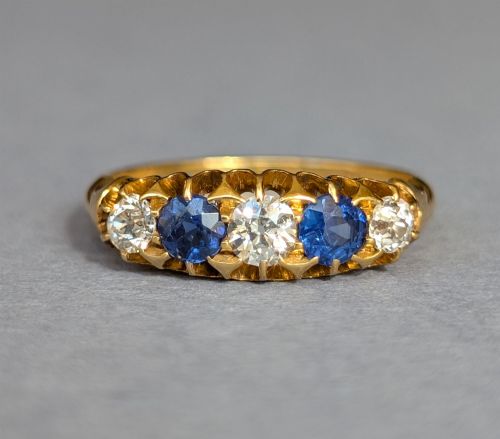
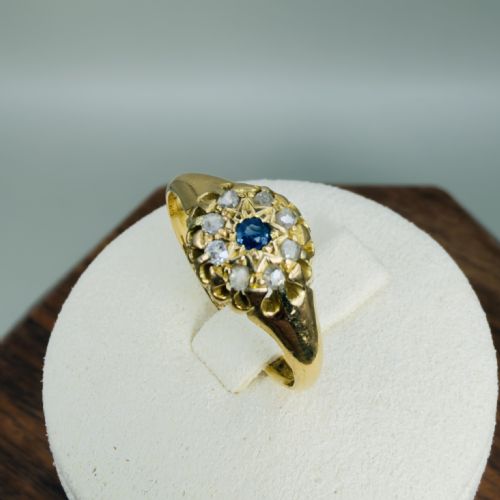


Gold Sapphire Carved Ring
A gold sapphire carved ring brings together deep blue stones and warm metal in enduring Victorian and Edwardian cluster, boat and five stone forms.
Gold Sapphire Carved Ring
A gold sapphire carved ring spans Victorian, Edwardian and mid-century periods, showing how goldsmiths combined precious stones with yellow gold. The pieces on this page appear primarily as cluster, boat, half hoop and five stone configurations.
Victorian and Edwardian examples dominate the selection, often pairing deep blue sapphires with old mined cut diamonds. Makers set these stones in 18ct gold and 9ct gold mounts designed to sit low on the hand.
Materials and construction
Goldsmiths worked chiefly in 18ct yellow gold and 9ct gold, fabricating settings that secured natural sapphires alongside old cut or rose cut diamonds. The metalwork frequently incorporates boat and cluster shapes.
Stones are secured with claw settings or flush mounts that showcase the depth of the sapphire. Hallmarks and assay marks often stamp the inner band with details of English origin.
Some Edwardian stackers were built so narrow they could comfortably share a single finger with half a dozen neighbours.
Quality factors
The standard of a gold sapphire carved ring rests on the saturation and clarity of the sapphire alongside the cut of its accompanying diamonds. Old mined cut diamonds display distinct facet patterns that differ from later machine cuts.
Structural integrity of the gold setting and the crispness of the original hand-carved details dictate the finesse of the piece. Substantial 18ct gold shanks retain their thickness better over decades of wear than thinner mounts.
The Gold Sapphire Carved Ring Glossary
- Boat ring
- A ring featuring a curved navette or boat-shaped face that tapers toward the shoulders. This silhouette accommodates a row of graduated stones.
- Cluster ring
- A ring design centred on a principal stone surrounded by a tighter cluster of smaller gems. This arrangement maximises the visual presence on the finger.
- Old mined cut
- A diamond cut from the nineteenth century featuring a smaller table, higher crown and culet. These stones catch candlelight with a softer, blocky sparkle.
- Half hoop
- A ring setting where stones span the upper arc of the band in a continuous line. They often alternate sapphires and diamonds.
- Basaltic sapphire
- A natural sapphire originating from alkali basaltic sources, known for robust saturation. These stones bring deep, intense blue tones to antique pieces.
Gold Sapphire Carved Ring: Frequently Asked Questions
How do I care for an antique gold sapphire carved ring?
Clean these rings gently using warm soapy water and a soft brush, avoiding harsh chemical dips that can damage older settings or softer stones.
Store them separately in a fabric-lined box to prevent the diamonds from scratching the softer gold shanks or the sapphire faces.
Can I wear my gold sapphire carved ring every day?
Sapphires possess good durability for daily wear, but antique settings require mindful handling during heavy physical tasks or manual work.
Regular checks by a jeweller ensure the claws holding the sapphires and diamonds remain secure and tight.
What is the difference between Victorian and Edwardian rings?
Victorian rings tend to feature heavier yellow gold mounts with deep blue sapphires paired with chunky old mined cut diamonds.
Edwardian designs often introduce lighter, more delicate gold work and intricate gallery details that reflect the transition of the early twentieth century.
Are these rings made with natural sapphires?
The pieces from these periods feature natural sapphires sourced from historic mines, showing characteristic inclusions visible under magnification.
These untreated or traditionally heated stones display organic variations in colour depth rather than uniform synthetic perfection.