

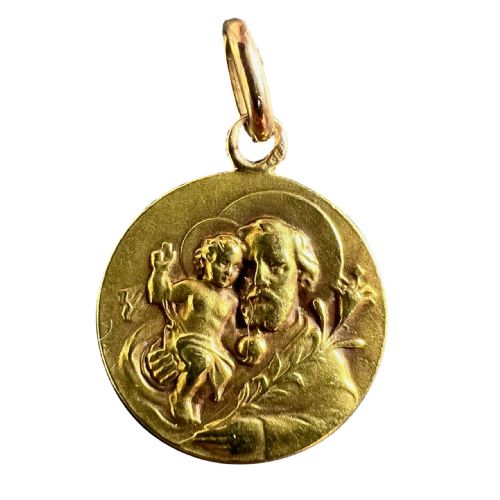
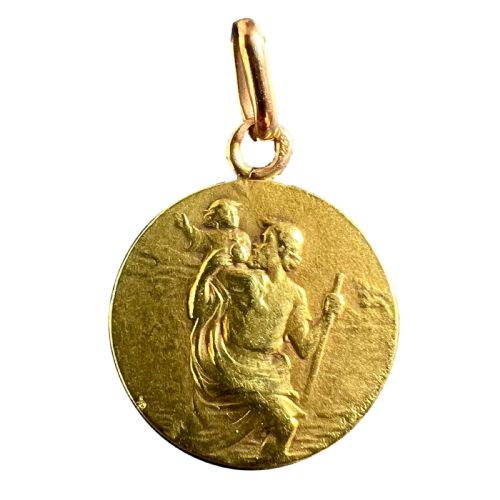
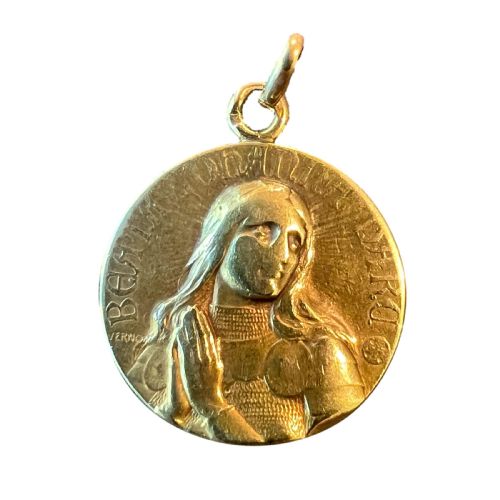


Gold Saint Medallion Pendant
A gold saint medallion pendant is a devotional charm in precious metal, offering both wearable art and personal protection.
Gold Saint Medallion Pendant
When you search for a gold saint medallion pendant, you encounter devotional jewellery originating from France, spanning periods from the late nineteenth century through the mid twentieth century. These pieces take the form of pendants, charms, and medals that depict figures such as the Virgin Mary, Saint Christopher, Saint Joseph, Saint John the Baptist, and Saint Therese.
The version you are most likely to meet on this page is an eighteen carat yellow gold French religious medal, frequently dated to nineteen ten. These items often combine engraved iconography of sacred figures, including the Sacred Heart and Madonna and Child, with traditional charm and pendant formats.
The selection also includes variations incorporating white gold, rose gold, and mother of-pearl, alongside distinct styles such as Art Nouveau and Art Deco. Makers represented on the page include Emile Monier, Mazzoni, Guilbert, Vernon, Sellier, Rasumny, Dropsy, Tairac, Perriat, Becker, Charl, Monet, and Ruffony.
How they were made
The construction of these medallions relies primarily on eighteen carat yellow gold, alongside occasional uses of white gold, rose gold, and mother-of-pearl inserts. Goldsmiths shaped these materials into oval and circular frames designed to hold detailed bas-relief portraits and sacred iconography.
Gold Saint Medallion Pendant Retail Price Guide 2026
Typical asking prices for gold saint medallion pendant among the pieces listed under this phrase on Sellingantiques today, from the lower quarter to the upper quarter. They describe what is for sale here now, not the wider market.
The listings span periods from eighteen ninety through to nineteen fifty, dominated by nineteen ten examples in eighteen carat yellow gold.
What varies in quality
Quality in these devotional medallions rests largely upon the crispness of the sculptural relief and the precision of the background engraving. Finer examples display deep, three-dimensional modelling of facial expressions and drapery by recognised medallists, whereas simpler items present flatter, more stylised stampings.
The choice of precious metal variation also influences the character of the piece, with standard yellow gold offering traditional warmth while rose gold or white gold variations introduce distinct tonal contrast. The legibility of hallmarks and signature stamps from notable French workshops further distinguishes standard production from superior work.
Emile Monier·Mazzoni·Guilbert·Vernon·Sellier·Rasumny·Dropsy·Tairac·Perriat·Becker·Charl·Monet·Ruffony
The Gold Saint Medallion Pendant Glossary
- Medal
- A flat, coin-like devotional object bearing religious imagery or text. These pieces were often struck to commemorate saints or sacred events.
- Pendant
- An ornament that hangs from a necklace or chain. They are frequently worn close to the heart.
- Charm
- A small decorative trinket attached to a bracelet or pendant loop. In these listings, charms often double as small devotional medals.
- Bas-relief
- A sculptural technique where the figures project slightly from the background plane. This method defines the portraits of saints on gold medallions.
- Hallmark
- An official stamp indicating the purity of the precious metal. French pieces typically feature specific state control marks for eighteen carat gold.
Gold Saint Medallion Pendant: Frequently Asked Questions
How do I identify the period of a medal?
Periods are identified through stylistic cues such as Art Nouveau curves, Art Deco geometry, and specific hallmark stamps from French workshops.
Most pieces on this page date from the late nineteenth century through to nineteen fifty.
Can these medals be worn daily?
Yes, eighteen carat gold provides sufficient durability for everyday wear when paired with a secure chain.
Their compact size makes them comfortable additions to daily jewellery arrangements.
What materials are used besides yellow gold?
Selected pieces incorporate white gold, rose gold, and mother-of-pearl alongside the standard yellow gold components.
These alternative materials appear in specific French religious and decorative styles from the early twentieth century.