
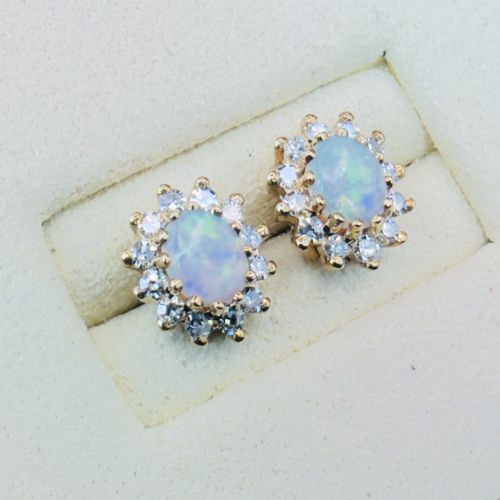
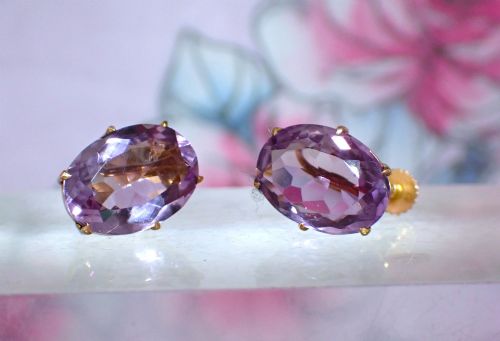


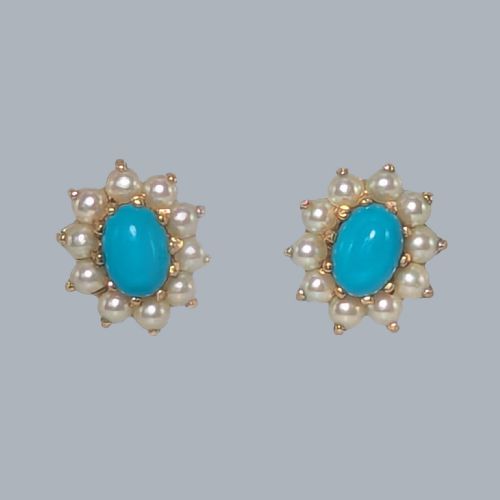


Gold Gemstone Cluster Studs
Gold gemstone cluster studs gather central stones in tight mineral halos, bringing bright colour and distinct period character to the ear.
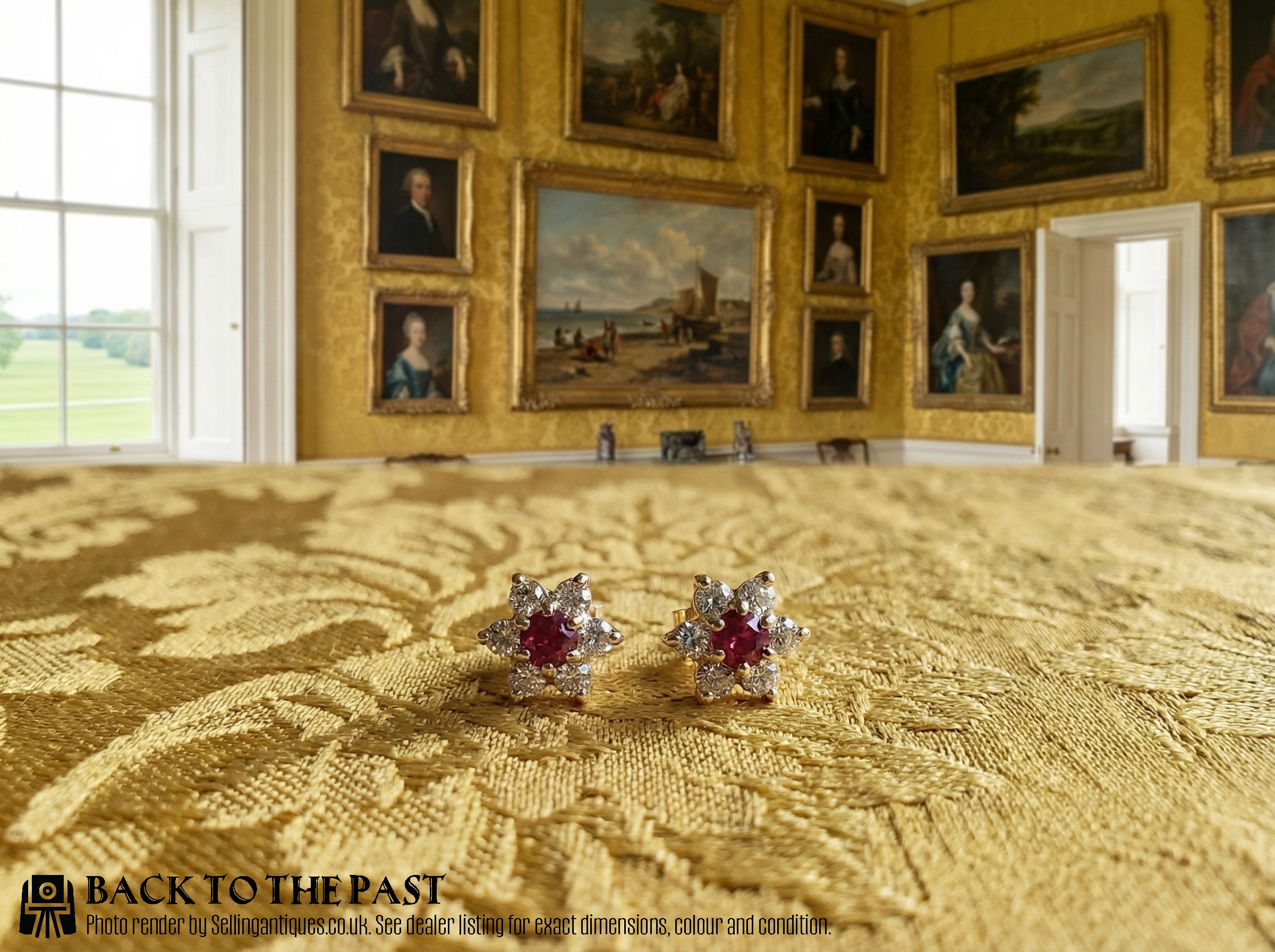
Gold Gemstone Cluster Studs
Gold gemstone cluster studs present a central gem surrounded by a tight ring of smaller stones, creating a compact head on a post or screw fitting. The form spans Georgian, Victorian, Edwardian, Art Deco and mid-century periods, showing shifts from heavy closed settings to lighter open wirework.
Most examples found here combine 9ct gold or 18ct white gold with garnets, sapphires, emeralds or amethysts paired with diamonds. The arrangement puts the primary colour in focus while surrounding it with contrasting white brilliance.
Earrings in this grouping include both direct stud fittings and drop variants where the cluster hangs slightly below the lobe. The silhouettes range from simple oval and round outlines to geometric shapes influenced by mid-century design.
Materials and construction methods
Goldsmiths shaped these pieces from 9ct and 18ct yellow, rose and white gold, occasionally incorporating platinum into the top faces during the Art Deco decades. Stones were secured using claw settings, collets or flush mountings depending on the period and the hardness of the minerals used.
Cluster layouts demanded precise stone-matching for colour and cut, particularly when pairing diamonds with saturated emeralds, sapphires or aquamarines. Early pieces relied on hand-cut gems with irregular facets, whereas mid-century examples show uniform machine-cut stones.
The listings span eight distinct eras from the Georgian period through to mid-century modern design.
Judging quality in cluster earrings
Quality rests on the depth of colour in the central gemstone and the uniformity of the surrounding stones. Superior pieces maintain consistent saturation and matching clarity across the entire cluster without dull patches or mismatched replacements.
Fine construction shows in the neatness of the metalwork at the reverse and the secure seating of each claw. Older examples retain original fittings that function smoothly, while heavier cluster heads remain balanced on the ear without drooping.
The Gold Gemstone Cluster Studs Glossary
- Cluster
- An arrangement where a central stone is encircled by a ring of smaller gems. This layout maximises visual impact and light return.
- Cabochon
- A gemstone shaped and polished with a smooth convex surface rather than faceted. This cut is common in opals and garnets.
- Collet
- A band of metal that holds a gemstone in place by its girdle. It forms a clean, solid edge around the stone.
- Filigree
- Delicate ornamental work consisting of twisted fine gold wire soldered in open patterns. It adds intricate texture to the earring frame.
- Screw-on
- A fastening mechanism utilising a threaded post and a threaded nut. This design secures the earring safely on non-pierced or pierced lobes.
Gold Gemstone Cluster Studs: Frequently Asked Questions
How do I care for vintage gold cluster earrings?
Clean these pieces gently using warm soapy water and a soft brush, avoiding harsh chemical dips that can damage softer gems like opals or pearls.
Store each pair separately in a lined box to prevent the cluster edges from scratching neighbouring metalwork or softer stones.
Are these earrings suitable for daily wear?
Sturdy 9ct and 18ct gold settings handle regular use well, provided the stones sit firmly in their claws and the posts remain straight.
Pairs featuring softer minerals such as turquoise or pearls require extra care to avoid knocks during active tasks.
What is the difference between Edwardian and mid-century clusters?
Edwardian designs typically feature delicate millegrain edges and lacy platinum-topped gold wirework around pastel or deep-toned gems.
Mid-century examples lean towards bolder geometric arrangements, heavier gold weights and saturated primary colours like strong sapphires and emeralds.
Do all cluster studs require pierced ears?
While the majority use standard posts, certain historical pairs feature screw-on fittings designed for lobes without piercings.
Check the listing details to confirm whether a pair relies on traditional posts, screw backs or clip mechanisms.