
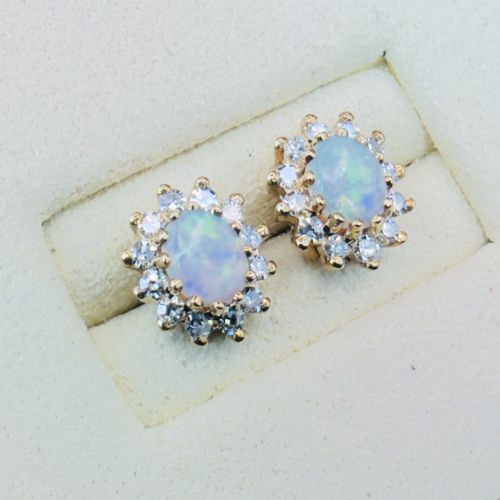


Gold Diamond Halo Studs
Gold diamond halo studs gather a central gem within a ring of smaller diamonds, offering bright sparkle close to the earlobe across several historical periods.
Gold Diamond Halo Studs
When you search for gold diamond halo studs, you encounter cluster earrings designed to sit directly on the ear. These pieces place a prominent central stone, such as sapphire, emerald, aquamarine, opal, garnet, zircon, amethyst, pearl, or an additional diamond, firmly at the focus of the design.
A tight border of smaller diamonds encircles this central gemstone, framing its outline and adding considerable brilliance to the overall face of the jewel. The listings show examples originating from the Edwardian era, the nineteen thirties, nineteen forties, nineteen fifties, and nineteen sixties, alongside traditional and classic halo styles.
The physical form relies on stud fittings or screw backs rather than dangling drops, keeping the clustered work secure and flush against the lobe. White gold, yellow gold, and platinum serve as the principal precious metal foundations for these cluster arrangements.
What varies in quality
The choice and natural quality of the central gemstone dictate much of the character in these pieces, from deep Colombian emeralds and basaltic sapphires to high zircons and mabe pearls. Stone weight, clarity, and depth of colour directly influence the visual impact of the central cluster.
The precision of the diamond halo setting determines the overall harmony of the piece, requiring evenly matched small diamonds that follow the contour of the primary stone without gaps. Heavier metal gauge in the gold or platinum mountings also contributes to the longevity and substance of the earrings.
Listings feature nine carat and eighteen carat gold alongside platinum, incorporating central stones from natural emeralds to basaltic sapphires.
The Gold Diamond Halo Studs Glossary
- Halo
- A ring of smaller pavé or prong-set diamonds surrounding a larger central gemstone to increase total brilliance. This layout defines the primary visual arrangement of the cluster.
- Cluster
- An arrangement of multiple gemstones grouped closely together in a single mounting. In these earrings, the design brings several stones into a unified face.
- Cabochon
- A gemstone shaped and polished with a smooth, rounded convex surface rather than faceted faces. This cut appears frequently on opals and select coloured stones within the listings.
- Mabe pearl
- A cultured half-pearl grown against the inside shell of an oyster, resulting in a domed surface with a flat back. These stones provide substantial size to retro cluster earrings.
- Rose cut
- An antique diamond cut featuring a flat base and a domed crown composed of triangular facets that meet in a point. This historical cut offers a softer reflection of light.
Gold Diamond Halo Studs: Frequently Asked Questions
What periods do these earrings come from?
The pieces span several decades, including Edwardian and Art Deco designs from the early twentieth century. Mid-century examples from the nineteen fifties and nineteen sixties also appear regularly in the selection.
Makers utilised distinct gold colours and stone combinations across these eras, moving from platinum-topped Edwardian work to yellow and white gold variations in later decades.
What stones appear besides diamonds?
Central gems include sapphires, emeralds, aquamarines, opals, garnets, zircons, amethysts, and pearls. These coloured stones form the focal point inside the surrounding diamond cluster.
Each gemstone brings a distinct hue and historical context to the individual pair of earrings.
Are these earrings designed for daily wear?
The cluster stud format sits close to the ear, making them practical for regular use when secured with proper post or screw-back fastenings. Precious metals like eighteen carat gold and platinum provide adequate durability for regular ownership.
Care should be taken with softer organic or treated stones such as opals and pearls during daily activities.
How do screw-back fastenings work?
Screw-back closures feature a threaded post and a matching nut that screws down securely against the earlobe. This mechanism was common in mid-century earrings to prevent loss.
Owners twist the backing gently along the thread until the fitting rests comfortably behind the ear.