
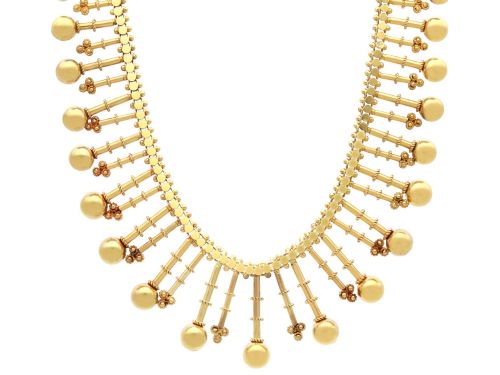
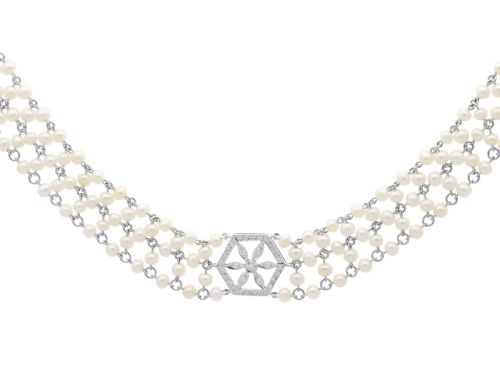


Gold Collar Necklace
A gold collar necklace sits flat and solid against the throat, framing the collarbones with heavy metal work.
Gold Collar Necklace
A gold collar necklace takes many forms across the Victorian, Edwardian, and mid-century periods, ranging from heavy pocket watch chains adapted for the neck to rigid diamond neck collars. You will find solid 9-carat and 18-carat gold links, woven mesh designs, and articulated geometric bands.
Many pieces reflect specific mid-century Italian modernist aesthetics or earlier Edwardian riviere settings using red paste and gold gilt metal. Others combine structural gold chains with pearls, diamonds, onyx, and ruby accents.
The archive shows sturdy pocket watch chains worn as chokers alongside delicate Edwardian paste necklaces and substantial French woven gold choker collars. These pieces sit close to the neck, offering a distinct presence compared to long pendant chains.
Materials and construction
Makers constructed these pieces using solid 9ct gold, 18ct yellow gold, 18ct white gold, and gold gilt metal, often weaving wire into flexible herringbone or mesh link patterns. The use of silk thread appears alongside pearls, while heavy chains incorporate interlocking links designed to drape smoothly.
Gemstones including diamonds, emeralds, rubies, and black onyx are set into the metalwork, sometimes secured with floral or bow-shaped clasps. Techniques range from intricate chain-making adapted from pocket watch accessories to cast and polished Italian modernist goldwork.
Design and execution
The distinction between standard examples and the finest pieces lies in the complexity of the link construction and the weight of the gold used. Substantial solid gold woven chains and marked designer pieces demonstrate superior metalwork and articulation.
Quality also shows in the integration of gemstone settings, where diamonds, pearls, and onyx are securely mounted within well-balanced gold structures rather than simply applied as surface decoration.
Georges Lenfant·Kria Gioielli
The Gold Collar Necklace Glossary
- Collar
- A short necklace designed to fit closely around the neck, often wide and rigid or semi-rigid in construction.
- Riviere necklace
- A necklace composed of a continuous line of gemstones of similar size and cut, mounted in individual settings.
- Albert chain
- A heavy pocket watch chain, traditionally secured to a waistcoat, often repurposed and worn as a choker necklace.
- Paste
- Hand-cut glass used to imitate gemstones in antique and vintage jewellery, valued for its own historical craftsmanship.
- Mesh link
- A flexible fabric-like textile created from interconnected gold wires, allowing the necklace to drape smoothly over the collarbone.
Gold Collar Necklace: Frequently Asked Questions
How do I wear a collar necklace?
A collar necklace sits high on the neck, usually resting directly against the collarbone. It works well with open necklines that allow the structure of the piece to remain uninterrupted.
Because these necklaces demand attention by their placement and weight, they require minimal additional neck adornment to stand out.
Are these necklaces solid gold?
The materials vary across the pieces, encompassing solid 9ct gold, 14ct gold, and 18ct yellow or white gold. Some items are formed from gold gilt metal or incorporate silk thread elements.
Checking the individual description confirms the specific metal standard used in the construction of each collar.
What is the difference between a choker and a collar?
A collar often possesses a more rigid, structured form that stays flat against the skin, whereas a choker is simply defined by its short length around the throat. Many antique watch chain collars combine flexibility with substantial weight.
Both styles sit higher than standard necklaces, but collars frequently feature wider bands of linked or woven metal.
How can I tell the period of a gold collar?
Dating relies on the materials, hallmark stamps, and manufacturing techniques, such as the woven mesh patterns typical of mid-century pieces or the heavier links of Victorian pocket watch chains. Edwardian examples often feature paste stones and intricate gilt work.
Comparing the clasp style and gemstone settings against known historical periods provides further clues to its origin.