

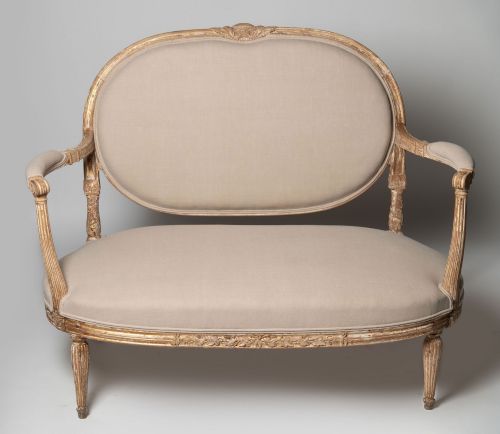


Giltwood Parlor Sofa
A giltwood parlor sofa brings the golden warmth of 19th-century French and English reception rooms directly into your home.
Giltwood Parlor Sofa
A giltwood parlor sofa is a grand seating piece designed for formal reception rooms, typically taking the form of a settee, canapé, or salon suite element. You will most frequently encounter 19th-century examples bearing the stylistic hallmarks of Louis XVI, Regency, and Rococo Revival design.
These seating pieces serve as striking focal points in a drawing room or large interior, combining carved wooden frames with luxurious textile upholstery. The listings on this page include French and English pieces, ranging from compact two-seat settees to larger historic settees and matching salon suites.
Originating in eras that prized ornate interior decoration, these sofas combine architectural framing with decorative painting and gilding. Whether described as a gilded canapé or an English settee in the rococo taste, each piece reflects the formal entertaining habits of the Victorian period and earlier.
How they were made
The foundational frames of these sofas are typically constructed from beech or other sturdy hardwoods, shaped through skilled carpentry to create curved cabriole legs, scroll arms, and elaborate crest rails. Carvers then applied intricate decorative motifs directly into the wood before the surface preparation.
Guilders applied thin layers of metal leaf over a prepared ground to achieve the characteristic bright or burnished finish seen on giltwood and gold-painted surfaces. Upholsterers completed the construction using traditional textiles such as damask, silk, and linen to pad and cover the seats and backs.
Giltwood Parlor Sofa Retail Price Guide 2026
Typical asking prices for giltwood parlor sofa among the pieces listed under this phrase on Sellingantiques today, from the lower quarter to the upper quarter. They describe what is for sale here now, not the wider market.
Materials recorded across the available inventory include giltwood, beech, wood, silk, linen, and various damask upholstery textiles.
What varies in quality
Quality in a giltwood parlor sofa rests primarily upon the depth and crispness of the hand-carved wooden details adorning the frame. Superior examples display sharp, well-defined acanthus leaves, floral swags, and fluted columns rather than soft or shallow moulding.
The application and preservation of the gilt surface also dictate the standing of a piece, distinguishing historic gold leaf or period paint from later interventions. Furthermore, the integrity of the underlying hardwood frame and the quality of the textile upholstery contribute significantly to the overall execution.
The Giltwood Parlor Sofa Glossary
- Giltwood
- Wood that has been decorated with gold leaf or metal leaf applied over a prepared base. This finish provides the characteristic metallic gleam seen on formal 19th-century salon furniture.
- Canapé
- A traditional French term for an ornamental sofa or settee, featuring an upholstered back and seat within an exposed decorative frame. These pieces often match accompanying armchairs in a salon suite.
- Rococo Revival
- A 19th-century design style that revived the asymmetrical curves, C-scrolls, and naturalistic floral motifs of the 18th-century French rococo movement. It is commonly found on Victorian parlor seating.
- Damask
- A reversible figured fabric traditionally woven in silk, wool, or linen, frequently utilised for the upholstery of formal historic seating. Its pattern contrasts flat and satin weaves to catch the light.
Giltwood Parlor Sofa: Frequently Asked Questions
What is a giltwood parlor sofa?
A giltwood parlor sofa is a historic, highly decorative seating piece from the 19th century featuring a gold-leaf or gold-painted wooden frame. These settees were made for formal reception rooms and drawing rooms.
They combine structural woodwork with luxurious fabric upholstery such as damask or silk. Today, they function as statement pieces in sophisticated interiors.
How were these sofas used originally?
These settees were placed in formal parlors and salons to seat guests during social calls, musical evenings, and receptions. Their grand appearance signaled the social status and taste of the homeowner.
Because they were meant for display and polite conversation, their frames often display elaborate carvings and gilt finishes designed to catch candlelight and daylight.
How do I live with a giltwood parlor sofa?
Living with a historic settee involves placing it out of direct sunlight to protect delicate gilded surfaces and antique textiles. Gentle dusting with a dry, soft cloth maintains the wooden frame without disturbing the finish.
These pieces pair well with both traditional antique furnishings and contrasting modern interiors. They work best as focal points where their decorative frames can be fully appreciated.
How do I tell different styles apart?
Styles like Louis XVI and Regency are identified by straight, fluted legs, neoclassical symmetry, and geometric framing. Rococo Revival pieces are easily distinguished by flowing asymmetrical curves, floral crests, and cabriole legs.
Examining the carved motifs on the wooden crest rail and the shape of the legs will usually reveal the specific stylistic influence of the piece.