
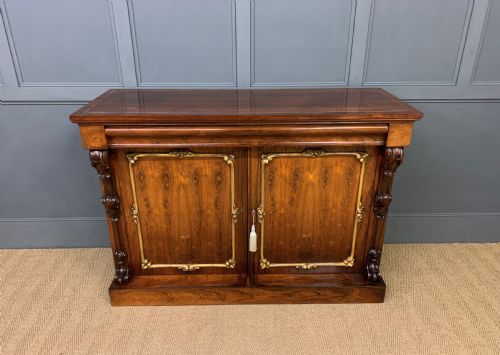


Gilt Low Credenza
These gilt low credenza pieces are low-slung timber cabinets carrying gilded metal mounts, offering long top surfaces and enclosed storage for any formal room.
Gilt Low Credenza
A gilt low credenza centres on low-height timber cabinets and sideboards designed with prominent gilded highlights, often housing books, porcelain or records behind glass and panelled doors. Buyers seeking a gilt low credenza encounter 19th Century and Regency designs alongside mid-Victorian revival pieces.
The selections recorded on this page feature side cabinets, open bookcases, and pier cabinets rather than strict twentieth-century credenzas, spanning styles from French Empire and Rococo Revival to the Victorian Aesthetic Movement. Timber carcasses in rosewood, walnut, and simulated rosewood dominate the physical forms.
How they were made
Cabinet makers constructed the primary carcasses from dense hardwoods including rosewood, walnut, and olive wood, frequently incorporating inlaid details and glass panels into doors and sides. Surfaces often display simulated timber grains or parcel gilding.
Mounts and decorative accents utilise cast or chased ormolu and brass fixed to the timber frame. Marble tops and leather elements also appear among the structural components of these mid-nineteenth-century cabinets.
Several bookcases here come equipped with clever leather dummy books designed to conceal actual storage compartments.
What varies in quality
Quality rests in the precision of the timber cabinetry and the crispness of the cast metal mounts rather than surface shine. Pieces bearing attributions to named workshops show superior joinery and more refined proportions in their breakfront outlines.
The choice of primary timber shifts the character of the piece entirely, moving from simple simulated rosewood to solid figured walnut and exotic coromandel. Better examples integrate their ormolu mounts fluidly into the overall architectural lines of the cabinet.
Lamb of Manchester·Gillows
The Gilt Low Credenza Glossary
- Ormolu
- Gilded bronze used for decorative mounts on furniture. It provides bright metallic contrast against dark timbers like rosewood and walnut.
- Credenza
- A low cabinet or sideboard used for display and storage. Nineteenth-century examples often incorporate glass doors and open shelving.
- Parcel gilt
- Partially gilded woodwork where gold leaf highlights specific carved or turned details. This technique draws the eye to architectural mouldings.
- Breakfront
- A piece of furniture where the central section projects forward from the flanking wings. This creates depth and shadow across the front elevation.
Gilt Low Credenza: Frequently Asked Questions
What is a gilt low credenza used for?
These cabinets serve primarily as low sideboards or display units within reception rooms and dining spaces. Their long top surfaces hold lamps or decorative objects while enclosed lower sections store tableware or books.
The open bookcase and pier cabinet variants on this page offer flexible display options for collections while maintaining a low visual profile against living room walls.
How do I date a nineteenth-century side cabinet?
Dating relies on identifying the underlying stylistic vocabulary, such as Regency reeding, Rococo Revival curves, or Aesthetic Movement linearity. Timber choices also help narrow the period.
Makers working in the mid-nineteenth century frequently combined traditional cabinet woods like walnut with imported exotics and cast brass mounts characteristic of revival design.
Are all these cabinets low in height?
The pieces listed span low formats including pier cabinets, sideboards, and open bookcases designed to sit beneath dado height or window sills. Their proportions keep sightlines open across a room.
Makers engineered these low proportions to maximise display space on top without overwhelming domestic interiors.
Which woods appear most often?
Rosewood and walnut dominate the construction of these cabinets, alongside olive wood and coromandel. Some examples utilise simulated rosewood finishes over alternative timber bases.
These dense hardwoods provide stable foundations for intricate inlay work and secure mountings for heavy ormolu decorations.