
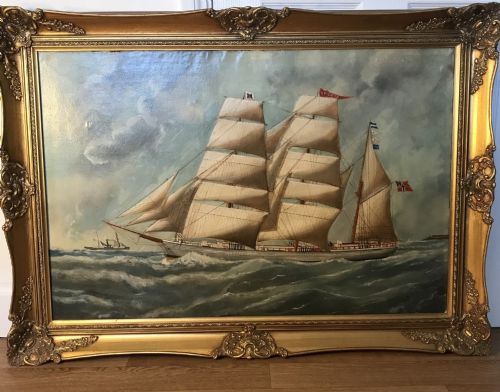
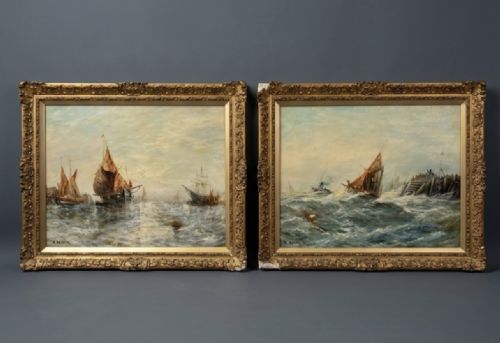
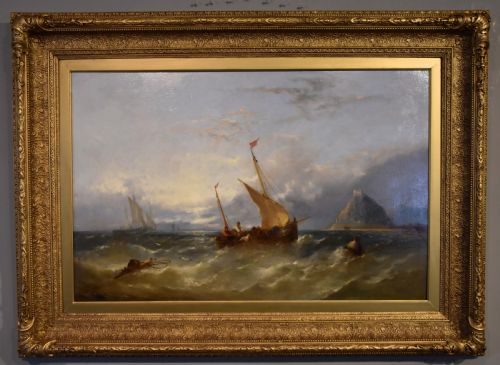


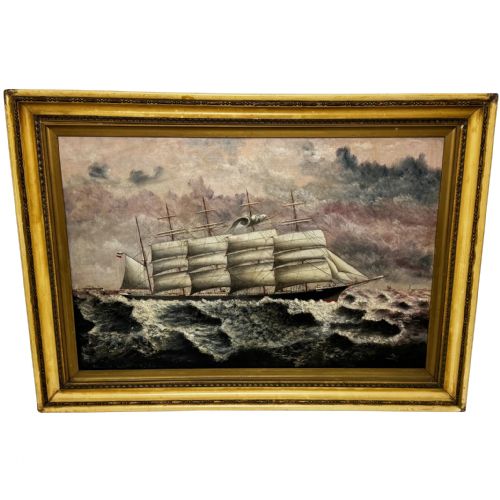


Gilded Frame Sea Paintings
Gilded frame sea paintings bring nineteenth-century maritime history and coastal weather directly onto the wall in heavy, luminous borders.
Gilded Frame Sea Paintings
Gilded frame sea paintings capture coastal scenes, ship portraits, and dramatic shipwrecks across the nineteenth and early twentieth centuries.
Buyers meet works executed in oil on canvas, oil on board, and watercolour on paper, all housed within decorative surrounds.
The selections span Victorian realism, maritime art, and pierhead paintings originating from British and European hands.
Materials and methods
Artists painted on stretched canvas, wooden boards, and heavy paper using oil and watercolour mediums to depict water and light.
Frames combine wooden bases with gesso, gold leaf, and gilt wood, creating the bright borders that enclose the maritime subjects.
Listings feature works from the nineteenth century, the Victorian era, and the nineteen thirties, executed in oil on canvas, wood, and paper.
Quality factors
Depth of skill in rendering water, rigging, and atmospheric coastal light separates standard maritime works from superior compositions.
The preservation of the original gold leaf and the structural integrity of the heavy gesso moulding determine the overall quality of the surround.
William Henry Williamson·Daniel Sherrin·John McDougal·Claude Thomas Stanfield Moore·Thomas Rose Miles·Thomas Bush Hardy·Charles Dixon·Joseph Heard·William Langley·Eugene Boudin·Robert Farren·V Dybdal·Charles Martin Powell
The Gilded Frame Sea Paintings Glossary
- Pierhead painting
- A specific record of a named vessel, often commissioned by its captain or owner to show the ship near port. These works focus heavily on accurate rigging and hull details.
- Gesso
- A plaster-like mixture applied to a wooden frame base to provide a smooth surface for gilding. It allows for intricate moulded decorative details.
- Marine art
- Paintings that focus primarily on ships, the sea, and coastal views. This genre includes historical naval battles, shipwrecks, and calm harbour scenes.
- Gilt wood
- Wood that has been treated with a thin layer of gold leaf or gold paint. It provides the characteristic metallic sheen seen on period frames.
- Watercolour
- A paint consisting of pigment suspended in a water-based solution, frequently applied to paper in coastal scenes. It offers a translucent quality suited to light and sky.
Gilded Frame Sea Paintings: Frequently Asked Questions
How do I hang a heavy gilded frame sea painting safely?
Heavy frames require sturdy picture hooks fixed directly into wall studs or proper masonry anchors. Steel picture wire attached securely to heavy-duty D-rings supports the weight safely.
Ensure the wall surface is sound and the hanging wire has minimal slack so the painting tilts correctly against the wall.
What periods do these maritime paintings cover?
The available works primarily date from the nineteenth century through the Edwardian era up to nineteen thirty. Victorian pieces form a large portion of the selection.
Earlier nineteenth-century pieces sit alongside later works from the early twentieth century, showing changing approaches to coastal art.
How should I clean a gilded wood frame?
Dust the ornate mouldings gently with a soft, dry brush to remove surface particles without disturbing the gold leaf. Avoid liquid cleaners, water, or chemical solvents which strip the gilt surface.
Professional conservators should handle any deep cleaning or restoration required on fragile gesso decorations.