
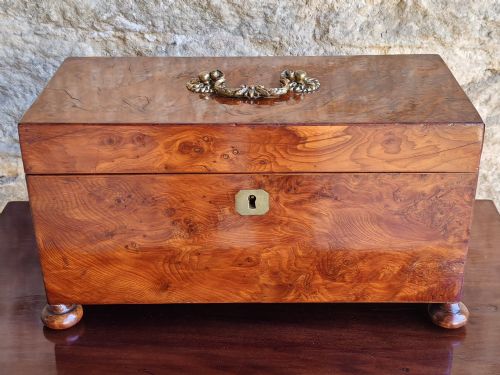
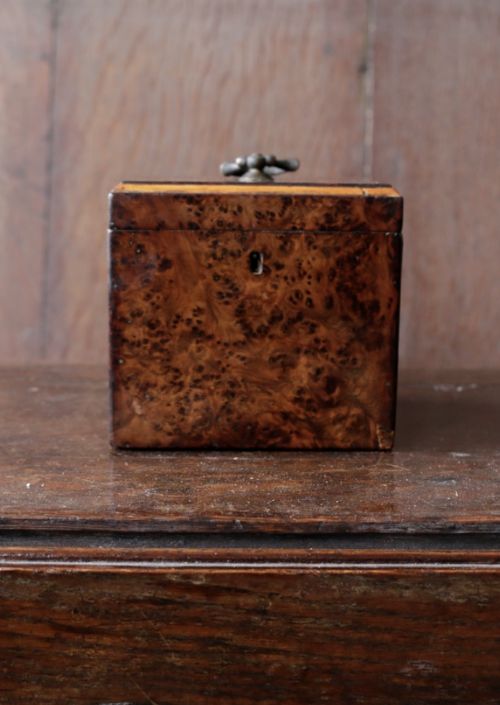


Georgian Yew Tea Caddy
A georgian yew tea caddy offers rich figuring and warm timber tones, bringing small-scale cabinet-making skill straight into a modern room.
Georgian Yew Tea Caddy
A georgian yew tea caddy sits among domestic boxes and caskets designed to secure precious tea leaves during the eighteenth and early nineteenth centuries. Buyers searching for a georgian yew tea caddy generally encounter compact storage containers shaped as cubes, rectangles, octagons, or semicircular forms.
The evidence spans the eighteenth century, the regency era, and stretches into later nineteenth century examples dated around eighteen sixty. Surviving formats range from miniature tea caddies and standard chests to larger double canister layouts complete with mixing bowls, alongside related forms like teapoys.
Materials and construction
Cabinet-makers utilised solid timber and decorative veneers of yew wood and burr yew, often highlighting natural grain patterns across the surfaces. Metal components such as brass appear alongside bone details, creating contrasting highlights against the timber.
Decoration relied heavily on precision techniques, including inlaid stringing in boxwood and ebony, as well as complex marquetry work on geometric hexagonal bodies and domed tops.
Recorded forms range from miniature boxes and octagonal tea chests to large double canisters with mixing bowls.
Quality differences in timber and form
Superior examples display intensely rippled burr yew grain coupled with intricate inlay work, whereas simpler pieces rely on plain yew wood surfaces. Architectural complexity also dictates standing, with multi-sided octagonal, hexagonal, and curved semi-circular shapes demanding greater joinery skill than standard rectangular boxes.
The Georgian Yew Tea Caddy Glossary
- Burr yew
- A timber growth on a yew tree that produces swirling, highly figured grain patterns. Cabinet-makers prized this material for decorative veneer panels on high-status boxes.
- Teapoy
- A pedestal table fitted with a tea caddy top or internal storage compartments. These freestanding pieces allowed tea service directly within a drawing room.
- Stringing
- Thin inlaid lines of contrasting wood, such as boxwood or ebony, embedded into the surface veneer. This technique framed panels and accentuated geometric box edges.
- Marquetry
- The art of arranging pieces of veneer into decorative patterns and pictures on a wooden carcase. Georgian makers applied this method to hexagonal and rectangular caddies.
Georgian Yew Tea Caddy: Frequently Asked Questions
What is a georgian yew tea caddy?
A georgian yew tea caddy is a wooden storage box made to hold loose tea leaves securely under lock and key. These pieces date primarily from the eighteenth and early nineteenth centuries.
Craftsmen shaped them into cubes, octagons, and rectangular chests using yew wood and burr yew timber. Many included internal compartments to separate different tea varieties.
How were tea caddies used originally?
Tea was an expensive commodity in the Georgian period, requiring secure storage away from household servants and damp air. The lady of the house typically kept the key and doled out the leaves herself.
Some larger caddies featured integrated glass mixing bowls where green and black teas were blended before brewing. Lidded internal canisters kept the aromas fresh between uses.
How do I date a yew tea caddy?
Dating relies on observing overall furniture styles, construction methods, and decorative embellishments like stringing or marquetry. Pieces from the seventeen seventies often feature simpler geometric lines.
Later Regency examples around eighteen twenty introduced bolder architectural shapes and contrasting ebony details. Reference dates on surviving pieces usually span from seventeen seventy to the early nineteenth century.
How do I care for burr yew wood?
Burr yew timber benefits from stable room environments away from direct sunlight and severe temperature fluctuations. Excessive heat can cause old veneers to lift or crack over time.
Apply traditional wax polish sparingly to maintain the natural lustre of the wood grain without building up heavy residues. Dust the surfaces gently with a dry, soft cloth.