
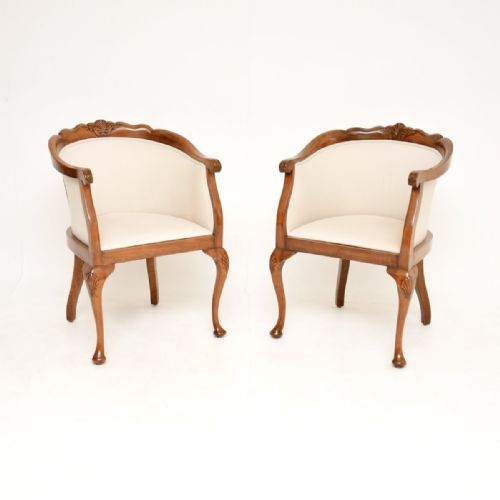
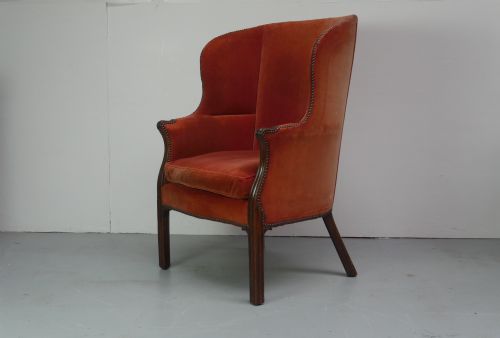


Georgian Barrel Back Armchair
A georgian barrel back armchair offers enveloping comfort and draught-excluding wings, making it a timeless choice for any fireside.
Georgian Barrel Back Armchair
A georgian barrel back armchair is defined by its rounded, upholstered back that curves continuously into the arms to block draughts. These seating pieces appear frequently from the Georgian era and the eighteenth century, alongside later revivals.
Buyers will encounter single chairs and occasional pairs executed in forms such as wing armchairs and tub armchairs. The primary origins noted in the evidence centre on English craftsmanship.
While many examples belong strictly to the Georgian period, the listings also include pieces from the nineteenth century, nineteen hundred, and nineteen twenty, as well as Queen Anne style and George III or George IV interpretations.
Construction and materials
Makers built the frames of a georgian barrel back armchair using solid timbers, predominantly mahogany and walnut, supplemented by other hardwoods. These robust wooden structures supported deep, continuous upholstery.
Upholstery methods involved traditional textiles, velvet, tapestry upholstery, and modern recycled cotton fabric, occasionally secured with brass details. The curved backs required precise carpentry to achieve the characteristic semi-circular enclosure.
The evidence shows examples spanning the Georgian era, the nineteenth century, and the early twentieth century, including Queen Anne style revivals.
Assessing quality
The distinction between standard and superior pieces rests on the grace of the curved wooden framework and the proportions of the wings. Finer examples maintain an elegant line where the back flows seamlessly into the armrests.
Upholstery choices also shape the character of the piece, ranging from simple cotton coverings to rich velvet, green leather, and intricate tapestry work. The integrity of the underlying hardwood frame remains the ultimate measure of durability.
The Georgian Barrel Back Armchair Glossary
- Georgian
- A style and period spanning the eighteenth and early nineteenth centuries, characterised by classical proportions and substantial woodwork.
- Tub armchair
- A comfortable chair featuring a low, rounded back that encircles the sitter.
- Wing armchair
- A seating form equipped with projecting side panels designed to deflect draughts from the fire.
- Tapestry upholstery
- A heavy, decorative woven textile used historically for durable furniture coverings.
Georgian Barrel Back Armchair: Frequently Asked Questions
How do I spot an eighteenth century piece?
Identifying an eighteenth century piece involves examining the timber grain, construction joints, and the hand-carved details on the wooden legs. Older frames show traditional joinery methods rather than modern fixings.
Upholstery fabrics often reflect later replacements, but the underlying hardwood frame reveals the true age and origin of the chair.
Were these chairs used at a desk?
These armchairs served primarily as comfortable seating for parlours, libraries, and firesides rather than desk work. Their generous proportions and enclosing wings prioritized relaxation.
Their sturdy hardwood construction made them durable enough for daily domestic use across multiple centuries.
How should I care for vintage upholstery?
Caring for vintage or antique upholstery depends entirely on the specific fabric material used, whether velvet, leather, or woven textile. Regular gentle dusting helps protect delicate fibres from settling grime.
Avoiding direct sunlight prevents the colours of older fabrics and textiles from fading prematurely over time.