

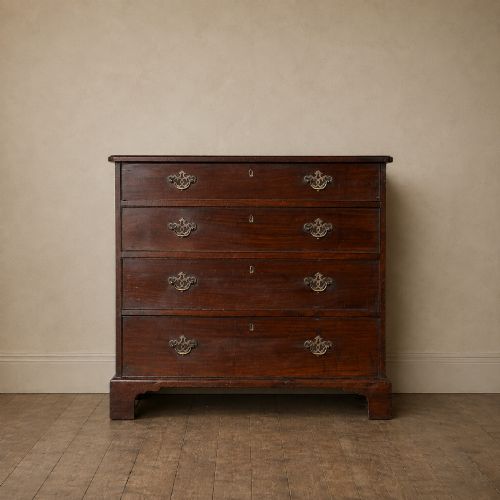
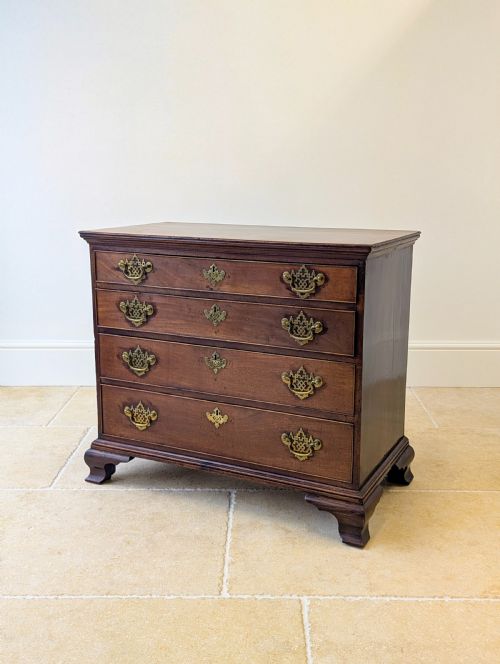
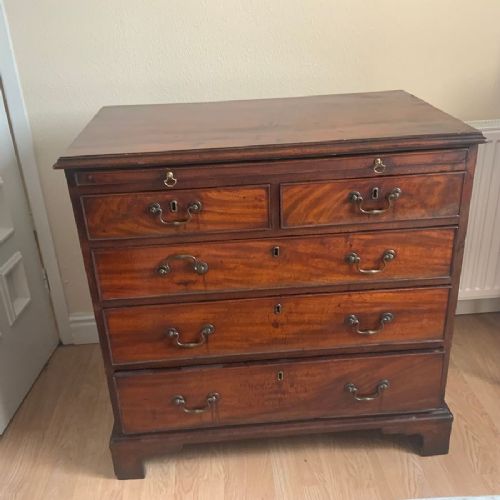


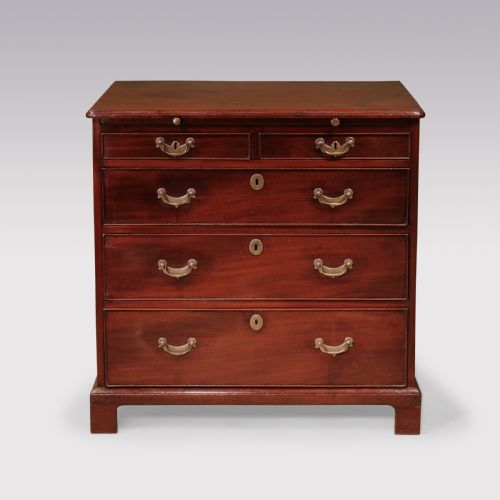


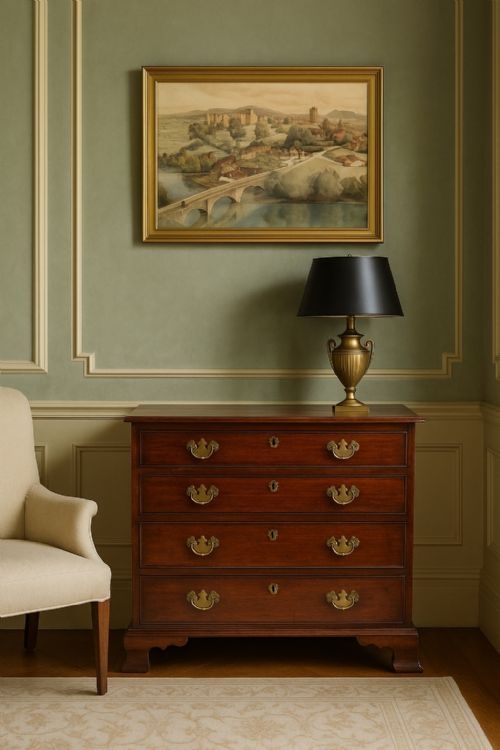


George II Mahogany Chest of Drawers
A george ii mahogany chest of drawers delivers solid mid-eighteenth-century proportions and rich cabinet timber that grounds a traditional interior.
George II Mahogany Chest of Drawers
A george ii mahogany chest of drawers brings together mid-eighteenth-century case furniture built from dense tropical hardwoods. These pieces originate in the Georgian era, with several examples bearing the distinct influence of Thomas Chippendale's design vocabulary.
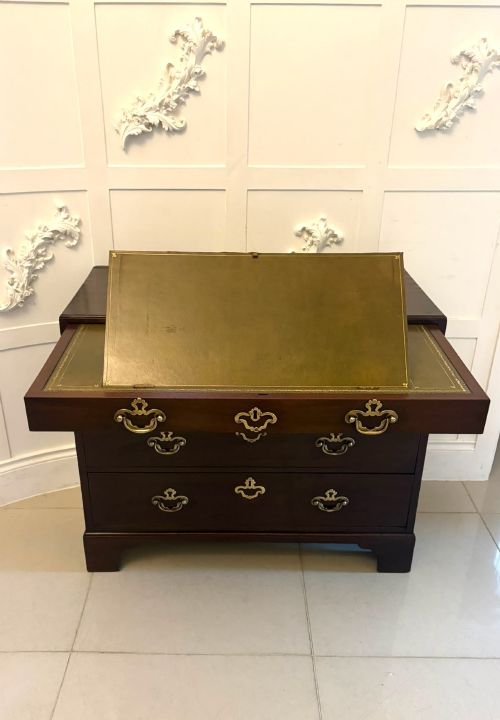
The selection on this page centres on standard chests, tall chests on chests, dressing chests, and forms equipped with integrated writing drawers or fitted secretaire desks. Oak frequently appears as a secondary timber for drawer linings and internal carcase construction, supporting the primary mahogany facades.
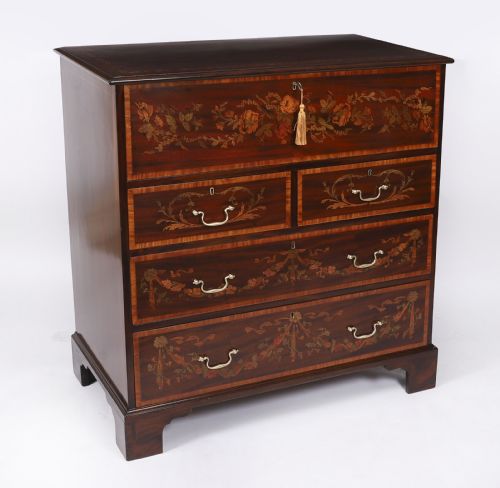
Buyers meet both straightforward drawer configurations and more complex variants featuring pull-out brush slides, marquetry inlay, or red walnut surfaces. The scale ranges from compact dressing chests to towering double-body tall-boys designed for larger chambers.
Materials and Construction
Brass hardware, including cast drop handles and escutcheons, secures the operational fronts, while decorative embellishments rely on marquetry inlay rather than applied metalwork. Structural joinery incorporates hand-cut dovetails for drawer boxes and sturdy framing to support substantial stacked carcases.
George II Mahogany Chest of Drawers Retail Price Guide 2026
Typical asking prices for george ii mahogany chest of drawers among the pieces listed under this phrase on Sellingantiques today, from the lower quarter to the upper quarter. They describe what is for sale here now, not the wider market.
Current listings span the eighteenth century, featuring oak linings, brass hardware, and marquetry inlay across multiple chest forms.
Judging Quality
The standard of a george ii mahogany chest of drawers rests on the crispness of its timber figure and the integrity of its structural timber. Pieces retaining original feet, such as ogee brackets, hold a distinct advantage over those with replaced supports.
Internal execution distinguishes standard utility items from finer cabinetwork, particularly in the hand-dovetailing of oak drawer linings and the smooth operation of integrated brushing slides. The subtlety of marquetry inlay and the retention of period brass hardware further separate the ordinary examples from superior survivals.
Giles Grendey·Robert Gillows II
The George II Mahogany Chest of Drawers Glossary
- Brushing slide
- A pull-out shelf located above the top drawers, historically used for grooming or writing correspondence without opening the main storage compartments.
- Chest on chest
- A tall storage form comprising two stacked sections, where a narrower upper chest sits upon a wider lower base.
- Secretaire chest
- A chest of drawers featuring a dedicated top drawer that drops down to reveal a fitted writing desk with small pigeonholes and drawers.
- Ogee bracket foot
- A moulding profile forming an S-curve on corner feet, providing stable elevation for case furniture of the mid-eighteenth century.
- Dovetail
- A joint interlocking wedge-shaped fingers, utilised extensively in period drawer construction to secure corners against lateral strain.
George II Mahogany Chest of Drawers: Frequently Asked Questions
What is a brush slide used for?
A brush slide provides a pull-out wooden surface positioned just beneath the top moulding of the chest. Eighteenth-century users pulled this shelf forward to clean clothes or to write brief notes.
Today, this feature adds functional surface area without altering the compact silhouette of the chest during daily use.
How do I identify a George II chest?
Look for dense mahogany timber, robust proportions, and traditional bracket feet characteristic of the mid-eighteenth century. Details like oak drawer linings and cast brass hardware often accompany these pieces.
Many examples also incorporate functional additions such as dressing attachments or writing slides within the upper carcase.
Where does red walnut appear?
Red walnut serves as a primary cabinet timber on select mid-eighteenth-century case pieces. This material yields a warm, reddish-brown tone distinct from standard dark mahogany.
Cabinet makers utilised this timber for drawer fronts and primary exterior surfaces to achieve specific visual grain patterns.
How do I maintain mahogany furniture?
Keep wooden surfaces away from direct heat sources and strong sunlight to prevent the timber from drying out. Regular dusting with a soft cloth preserves the natural finish without requiring heavy polishes.
Stable room humidity protects both the primary mahogany exterior and the internal oak structural components from shifting.