

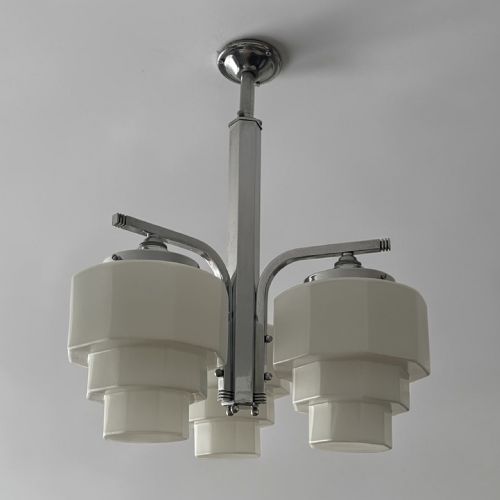
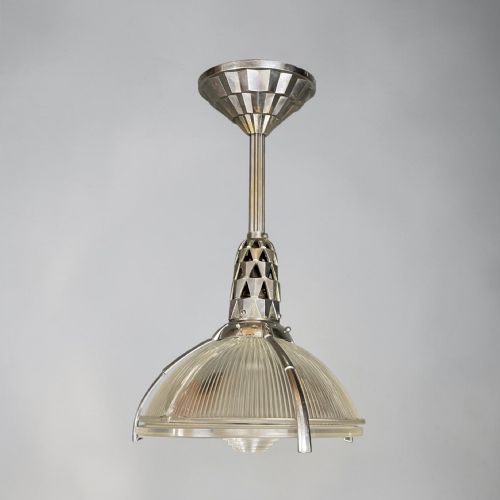


Geometric Light Fixture
A geometric light fixture brings sharp angles and striking symmetry into a room, offering genuine period character.
Geometric Light Fixture
A geometric light fixture encompasses ceiling lights, pendants, wall lights, table lamps, and chandeliers originating from the early twentieth century. Buyers seeking this style encounter pieces predominantly from the 1920 and 1930 periods, alongside turn of the century designs.
The dominant aesthetic draws heavily on Art Deco and Amsterdam School traditions, favouring clean lines and structural forms. Ceiling fixtures and hanging lanterns form the majority of the available lighting types.
Origins include notable European workshops and designers of the interwar years, translating architectural shapes into functional illumination.
How they were made
Construction relies heavily on metal framing paired with glass elements, utilising chrome, brass, copper, steel, bronze, and wrought iron. Metal components are shaped through casting, hand chasing, or nickel plating to achieve finished structural bodies.
Glass elements incorporate frosted glass, opaque panels, and moulded shades designed to soften and diffuse the illumination. Fabric occasionally appears in specific lamp designs to temper the light output.
Geometric Light Fixture Retail Price Guide 2026
Typical asking prices for geometric light fixture among the pieces listed under this phrase on Sellingantiques today, from the lower quarter to the upper quarter. They describe what is for sale here now, not the wider market.
Materials recorded in current inventory include chrome, frosted glass, brass, metal, copper, fabric, and nickel plated metal.
What varies in quality
The standard of workmanship shows in the precision of the metal framing and the treatment of surfaces, whether hand chased copper or polished chrome. Superior examples display crisp architectural lines and heavier gauges of metal.
Glass components differentiate standard production from finer output through thickness, moulding definition, and overall optical clarity. The integration between metal supports and glass shades reveals the primary level of maker skill.
Émile-Jacques Ruhlmann·Karl Palda
The Geometric Light Fixture Glossary
- Art Deco
- A design style of the 1920s and 1930s characterised by sleek geometric shapes, stylised motifs, and modern industrial materials. It replaced organic floral curves with rigid symmetry.
- Amsterdam School
- An architectural and design movement originating around 1900, known for expressive brickwork, rounded forms, and elaborate metalwork. It heavily influenced contemporary decorative arts in the Netherlands.
- Frosted Glass
- Glass treated to scatter light and create a translucent appearance, commonly used in lamp shades to reduce glare. The frosting technique softens the intensity of the bulbs within.
- Hand Chased
- Metalworked by hand using hammers and punches to sink or raise decorative surface patterns. This technique leaves subtle individual marks of the maker.
- Nickel Plated Metal
- A base metal coated with a thin layer of nickel to provide a bright, corrosion resistant finish. It offers a cooler sheen than untreated brass or copper.
Geometric Light Fixture: Frequently Asked Questions
What periods do these lights come from?
The lighting fixtures originate primarily from the early twentieth century, spanning from 1900 through the 1920s and 1930s.
Most examples align with the Art Deco movement of the interwar decades.
Which room types suit these fixtures?
Ceiling pendants and chandeliers fit central spaces requiring focused downward illumination or ambient overhead lighting.
Wall lamps and table lamps provide secondary accent lighting in living areas and studies.
How do I identify Art Deco lighting?
Look for symmetrical geometric shapes, stepped forms, and sharp architectural angles rather than flowing organic curves.
Combinations of chrome, brass, and frosted glass are typical hallmarks of this design vocabulary.
What materials are used in construction?
Metals such as chrome, brass, copper, steel, bronze, and wrought iron form the structural framework of the fixtures.
Frosted and opaque glass shades complete the assembly to diffuse the light.