

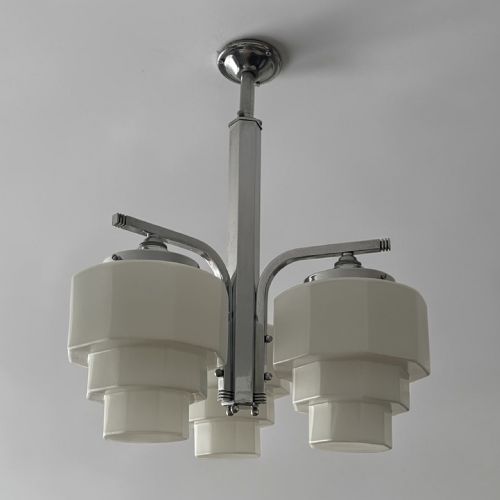
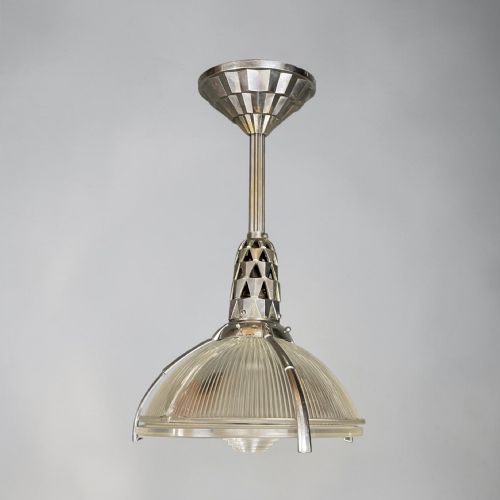


Geometric Glass Shade
A geometric glass shade brings structured symmetry and period light to a room, most often found in Art Deco ceiling and table fixtures.
Geometric Glass Shade
A geometric glass shade forms the focal point of lighting fixtures designed during the early decades of the twentieth century, particularly the 1920s and 1930s. Buyers searching for a geometric glass shade encounter pendants, plafonniers, and table lamps that merge functional illumination with striking angles.
The pieces appearing on this page span the 1910s to the 1930s, heavily weighted toward Art Deco designs with distinct industrial or domestic applications. Forms range from ceiling lanterns and flush-mounted plafonniers to desk lamps and figural table bases.
Art Deco and Arts and Crafts styles dominate the selection, bringing clean lines and architectural silhouettes into interior spaces. These shades are matched with metals such as brass, chrome, nickel plated metal, and patinated metal to complete the composition.
Materials and Construction
Glass production for these shades relies on moulding and frosting techniques to achieve opaque, textured, or peach-tinted finishes. Moulded glass allows for sharp angles and repeating patterns that diffuse light evenly across a room.
Metalwork provides the structural framework, utilising chrome, brass, copper, and wrought iron. These metals are cast, plated, or patinated to hold the glass securely while framing its geometric properties.
Geometric Glass Shade Retail Price Guide 2026
Typical asking prices for geometric glass shade among the pieces listed under this phrase on Sellingantiques today, from the lower quarter to the upper quarter. They describe what is for sale here now, not the wider market.
Listings feature items from the 1910s, 1920s, and 1930s, dominated by Art Deco styling.
Quality and Distinction
Quality rests in the crispness of the glass moulding and the integrity of the supporting metal mount. Sharp geometric facets and uniform frosting demonstrate superior manufacturing standards.
The weight and finish of the metal components indicate standard of production, with heavy brass, nickel plated metal, and solid chrome housings marking out the better examples.
Émile-Jacques Ruhlmann·Muller Bros·Walther and Sohne·Karl Palda
The Geometric Glass Shade Glossary
- Plafonnier
- A ceiling light fixture mounted flush or close to the ceiling. This form directs light downwards through a decorative glass bowl or shade.
- Frosted Glass
- Glass treated to create a milky, textured surface that diffuses light. This treatment softens glare while highlighting the shape of the shade.
- Art Deco
- A design style characterised by sleek lines, geometric shapes, and industrial materials. It flourished during the 1920s and 1930s across lighting and decorative arts.
- Chrome
- A hard, corrosion-resistant metal plating applied to steel or brass bases. It provides a bright, reflective finish typical of twentieth-century lighting.
- Pendant Light
- A hanging light fixture suspended from the ceiling by a cord, chain, or metal rod. It places the shade at a lower level to illuminate specific zones.
Geometric Glass Shade: Frequently Asked Questions
What periods do these shades date from?
The pieces span the early twentieth century, with examples originating from the 1910s, 1920s, and 1930s. Art Deco aesthetics dominate the selection.
Design characteristics shift from earlier Arts and Crafts influences toward streamlined, geometric motifs as the decades progress.
How are table lamps and ceiling lights mounted?
Table lamps utilise heavy metal bases in brass, chrome, or patinated metal to support the glass shades securely. Ceiling fixtures employ flush mounts, chains, or rods.
Wiring and installation methods reflect standard domestic electrical setups of their respective periods of manufacture.
What glass types are common in these shades?
Frosted glass and moulded glass appear frequently, often combined with peach-tinted or opaque finishes. These treatments help diffuse light evenly.
Moulding techniques allow for precise angles and structured patterns characteristic of the period style.
Can these fixtures be used in modern rooms?
These pieces integrate into contemporary interiors by providing functional task or ambient lighting with distinct historical character. Their clean lines suit minimalist and traditional spaces alike.
Careful placement as central pendants or desk lamps highlights their architectural forms.