


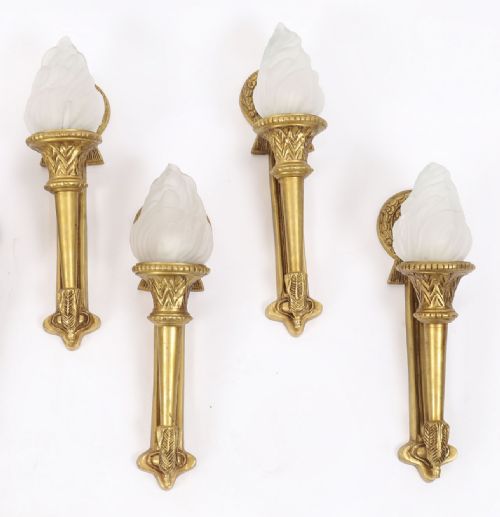


Frosted Glass Wall Lamp
These frosted glass wall lamps deliver a diffused, warm glow that flatters a room instantly.
Frosted Glass Wall Lamp
A frosted glass wall lamp provides architectural illumination by fixing directly to vertical surfaces while softening the bulb's output. When you search for a frosted glass wall lamp, you encounter pieces spanning the Victorian era through the 1930s.
The selection leans heavily towards the Art Deco period, featuring geometric lines, clam shell forms, and skyscraper profiles alongside earlier Neo-Classical torch designs. You will frequently find matching pairs and suites suited for flanking mirrors or fireplaces.
How they were made
Makers utilised moulded and frosted glass to diffuse light effectively, pairing the shades with metal fixtures cast from brass, chrome, or ormolu. Wrought iron and bronze also appear in heavier structural mounts, particularly on gothic and carriage style pieces.
Techniques relied on precise metalworking and specialised glass treatment to achieve the characteristic opaque finish. Bakelite components occasionally surface in the electrical fittings of later twentieth-century iterations.
Frosted Glass Wall Lamp Retail Price Guide 2026
Typical asking prices for frosted glass wall lamp among the pieces listed under this phrase on Sellingantiques today, from the lower quarter to the upper quarter. They describe what is for sale here now, not the wider market.
Listings feature frosted glass wall lamps across the 19th Century, Victorian, Edwardian, and 1930 periods in brass, chrome, and iron.
What varies in quality
The distinction between standard examples and superior pieces rests on the weight of the metal and the crispness of the glass moulding. Finer specimens display detailed casting work in the ormolu or brass mounts and retain original branded glass shades.
Substantial wall lights exhibit heavier gauges of chrome and iron that maintain structural integrity over decades of use. The integration between the heavy wall bracket and the delicate glass shade dictates the overall refinement of the fixture.
Dugué·Lalique
The Frosted Glass Wall Lamp Glossary
- Ormolu
- Gilded bronze used for decorative mounts and decorative fittings. This technique was popular in Neo-Classical designs.
- Bakelite
- An early synthetic plastic utilised for switchgear and electrical housing. It indicates mid-century manufacturing methods.
- Sconce
- A wall-mounted lighting fixture designed to hold bulbs or candles. These units project illumination outward into the room.
- Skyscraper
- An architectural style applied to lighting during the 1930s. It references stepped, vertical geometric setbacks.
- Frosted glass
- Glass treated by acid-etching or sandblasting to diffuse harsh light. This process creates a smooth, opaque surface.
Frosted Glass Wall Lamp: Frequently Asked Questions
How do I install an antique wall lamp?
Professional installation by a qualified electrician is recommended for all vintage wiring. Modern mounting brackets often require adaptation to fit historical backplates securely.
Ensure the wall substrate can support the weight of heavier cast iron or ormolu fixtures. Local building codes should guide the placement height alongside existing junction boxes.
Can I use modern LED bulbs?
Contemporary LED bulbs function safely within vintage fixtures provided the wattage matches historical requirements. Selecting warm colour temperatures preserves the original lighting atmosphere.
Consider dimmable options to control the light output through dense frosted glass shades. Check the bulb dimensions to ensure proper clearance inside enclosed glass enclosures.
How do I clean frosted glass shades?
Warm water and mild soap remove surface dust without harming the etched texture. Avoid abrasive scouring pads that can scratch the delicate frosted finish.
Remove shades from their metal mounts entirely before undertaking cleaning. Dry thoroughly with a lint-free cloth before reassembling the fixture.
How do I date an Art Deco wall light?
Examine the geometric motifs, chrome plating quality, and fastener types for period characteristics. Pieces from the 1930s frequently employ stepped skyscraper forms and streamlined metalwork.
French pieces from this era often bear signature glass etchings or maker stamps near the fitter rim. Comparing the shade profile against known period catalogues confirms the decade of manufacture.