



French Walnut Escritoire
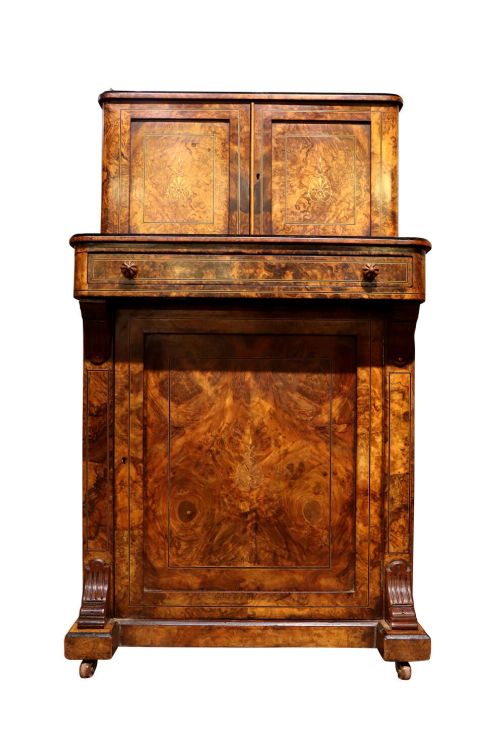
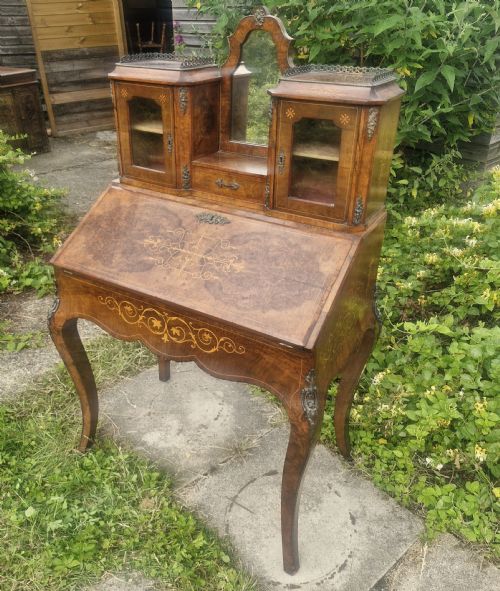
A french walnut escritoire brings refined writing furniture into a room, offering fitted drawers and drop leaves suited for correspondence.
French Walnut Escritoire
A french walnut escritoire encompasses writing cabinets, bureaux, and ladies' desks designed for domestic correspondence and storage. These pieces combine compact writing surfaces with internal compartments for letters and papers.
The versions most commonly encountered on this page date from the nineteenth century, including Victorian interpretations and French Revival styles. They appear in forms such as the bonheur du jour, secretaire-a-abattant, and tambour fronted cabinets.
Makers utilised rich timbers and decorative accents to create both freestanding writing tables and tall wall-adjacent writing furniture. The form bridges the gap between display furniture and functional workspace.
Materials and Construction
Construction relies heavily on walnut and burr walnut timbers chosen for their distinctive grain patterns and warm tones. Artisans applied marquetry inlay and kingwood banding to accentuate the primary surfaces.
Metal mounts in brass and ormolu complement the timber, often appearing around drawer edges and along structural framing. Leather inserts provide a dedicated writing surface, while interior compartments utilise fine secondary woods.
French Walnut Escritoire Retail Price Guide 2026
Typical asking prices for french walnut escritoire among the pieces listed under this phrase on Sellingantiques today, from the lower quarter to the upper quarter. They describe what is for sale here now, not the wider market.
The documented forms span Victorian, Baroque, and Louis XV Revival styles from the eighteenth through the twentieth century.
Quality and Craftsmanship
The refinement of the marquetry inlay and the selection of burr walnut veneer distinguish finer examples from standard production. Crisply cast brass and ormolu mounts integrated smoothly into the timber indicate higher workshop standards.
Structural integrity of the drop front or writing drawer mechanism reflects the skill involved in the initial assembly. Internal drawer construction and the matching of grain across visible surfaces demonstrate greater attention to detail.
The French Walnut Escritoire Glossary
- Escritoire
- A writing cabinet or desk featuring a sloping or folding writing surface that conceals small drawers and pigeonholes. It serves primarily for correspondence.
- Bonheur du jour
- A light lady's writing desk featuring a small cabinet or set of shelves superstructure upon the main writing surface. The form gained popularity during the nineteenth century.
- Secretaire-a-abattant
- A tall upright cabinet with a drop-down front panel that opens to reveal a writing desk and internal compartments. This form conceals storage behind formal architectural lines.
- Marquetry
- The art of applying pieces of veneer to a structure to form decorative patterns and pictures. Craftsmen used various tinted woods to create floral or geometric designs.
- Ormolu
- Gilt bronze mounted ornamentation applied to furniture for decorative effect. The technique involves a mercury gilding process on bronze mounts.
French Walnut Escritoire: Frequently Asked Questions
How do I maintain the walnut surface?
Regular dusting with a soft, dry cloth prevents particulate accumulation on the timber and veneer. Avoiding direct sunlight and maintaining stable room humidity preserves the finish.
Periodic application of suitable furniture wax maintains the moisture balance of the walnut. Harsh chemical cleaners should be kept away from both the wood and any ormolu mounts.
Where were these desks used in a home?
These pieces typically resided in private sitting rooms, boudoirs, or libraries where personal correspondence took place. Their compact footprints suited domestic spaces rather than grand offices.
They functioned both as decorative furniture items and practical workspaces for writing letters. The internal compartments kept stationery and stamps organised out of sight.
How can I identify a Victorian piece from an eighteenth century one?
Eighteenth century pieces often display specific revival characteristics like Louis XVI or Baroque carving styles executed in solid walnut. Construction techniques and hardware alignment reflect the earlier period's hand methods.
Victorian examples frequently incorporate burr walnut veneers combined with brass inlay or French Revival motifs. The internal secondary woods and dovetail configurations align with nineteenth century workshop practices.