


French Tier Display Tables
These French tier display tables bring layered display space to a room, combining tiered surfaces with decorative woodwork and metal mounts.
French Tier Display Tables
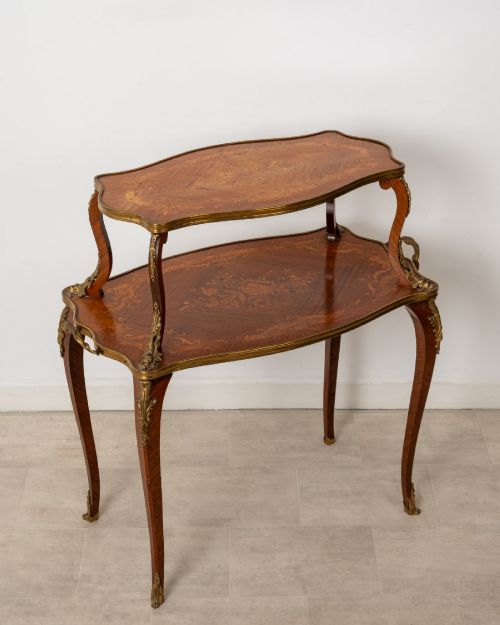
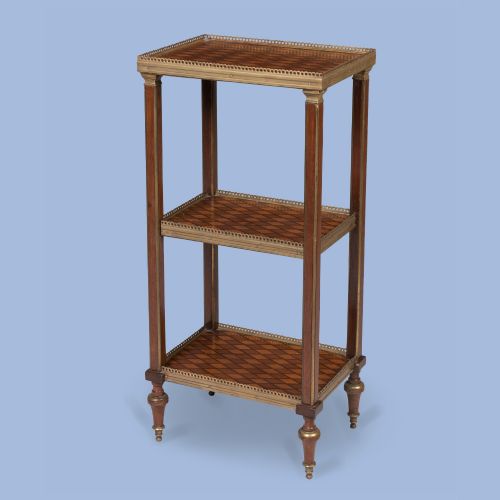
French tier display tables span multi-level étagères, side tables, and occasional stands designed to hold ornaments and books across multiple surfaces. The selection relies heavily on nineteenth-century and early twentieth-century examples shaped by Louis XV, Napoleon III, and provincial traditions.
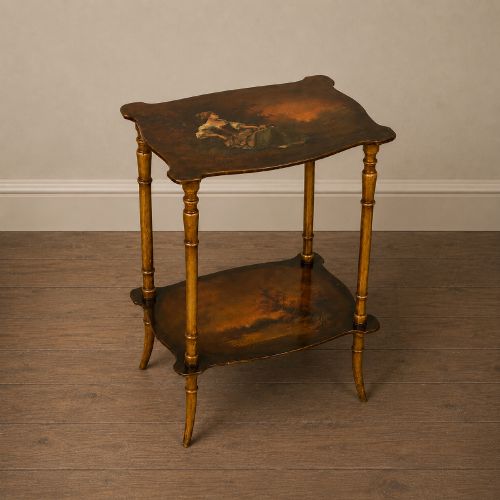
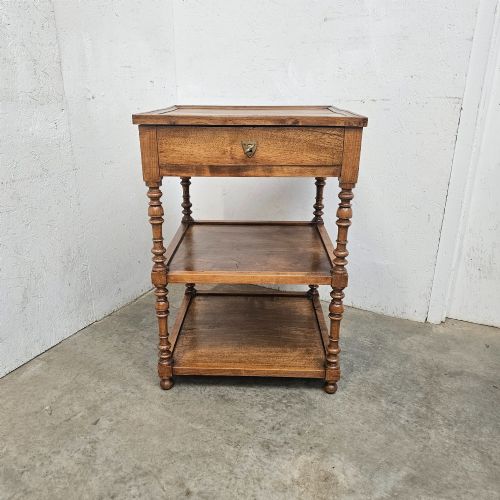
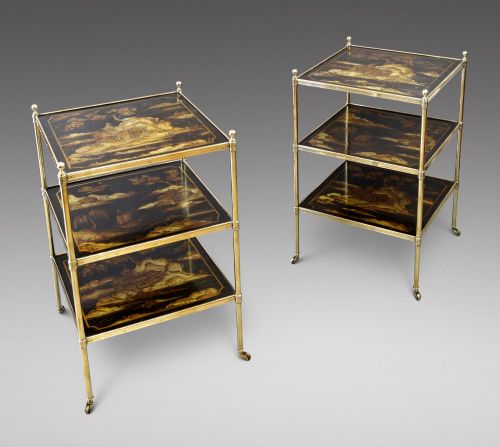
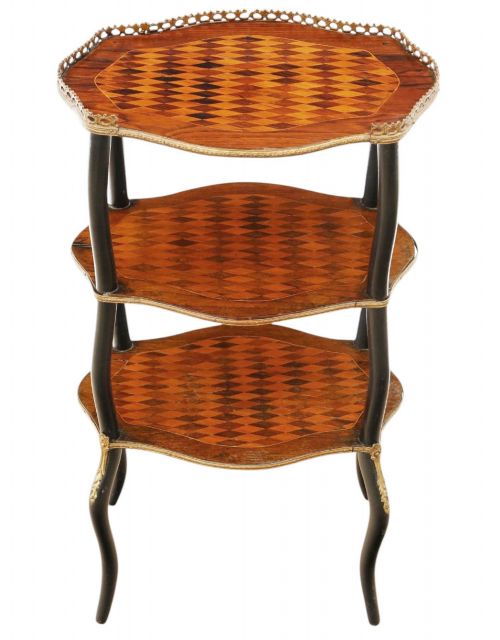
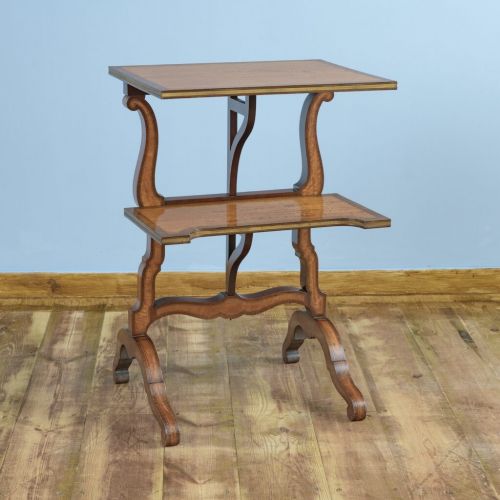
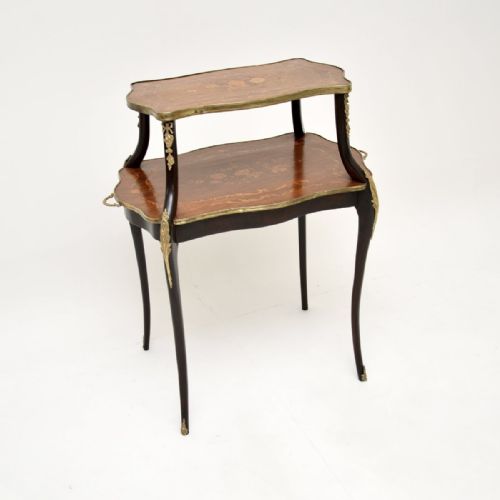
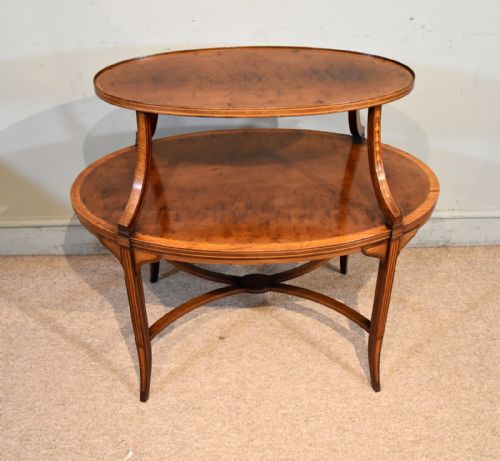
Most pieces encountered here take the form of two-tier or three-tier étagères featuring inlaid marquetry, parquetry, or brass mounts. Alongside standard side tables, the listings include plant stands, occasional centre tables, and display shelves.
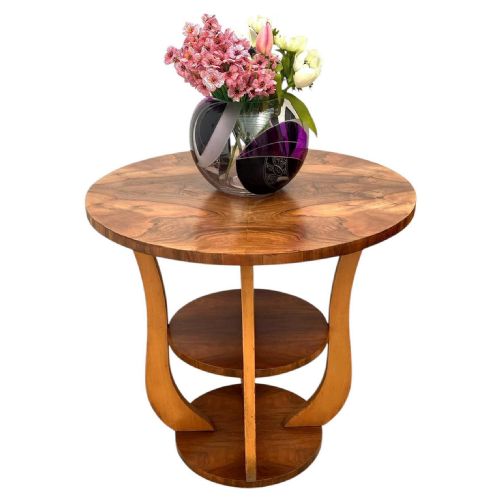
Origins stretch across nineteenth-century workshops as well as Edwardian and Art Deco revivals, maintaining a distinct aesthetic of layered display. Walnut, mahogany, and ebonised woods dominate the forms, often paired with marble tops or glass trays.
How they were made
Cabinetmakers constructed these tables using a foundation of walnut, mahogany, or oak, applying decorative veneers like kingwood, satinwood, rosewood, and amboyna in marquetry and parquetry patterns. Surfaces often incorporate contrasting ebonised wood or painted and gilt finishes.
Brass and ormolu mounts punctuate corners, edges, and legs, while turned or cabriole supports elevate the individual tiers. Selected pieces integrate inset marble tops, glass trays, or canework to vary the tactile quality of each level.
Tailors' shops once utilised sturdy oak display tables to sort fabrics before these tiered stands found a home in parlours.
What varies in quality
Quality reveals itself in the precision of the marquetry and the crispness of the brass or ormolu mounts rather than surface ornamentation alone. Finer examples display meticulous grain matching across multiple tiers and tightly fitted joints that maintain stability under load.
The choice of secondary timbers and the refinement of turned or carved supports separate standard production from exceptional cabinetmaking. Superior pieces maintain balanced proportions across stacked shelves without appearing heavy.
Maison Giroux·Edwards & Roberts·Gabriel Viardot·Donald Ross
The French Tier Display Tables Glossary
- Étagère
- A piece of furniture consisting of open shelves for displaying small objects. These tiers allow items to be viewed from multiple angles.
- Marquetry
- Decorative veneer work forming pictures or geometric patterns using various coloured woods. Craftsmen cut thin sheets of timber to fit together precisely.
- Ormolu
- Gilded bronze mounts applied to furniture edges and legs for decorative effect. This technique adds metallic contrast to wooden surfaces.
- Parquetry
- Geometric wood inlay forming patterns such as cubes or chevrons on tabletops. It differs from marquetry by relying on repeating angles rather than pictorial designs.
- Whatnot
- A set of open shelves used for storing or displaying ornaments. The Victorian term often overlaps with modern descriptions of multi-tiered display tables.
French Tier Display Tables: Frequently Asked Questions
What are french tier display tables used for?
These tables provide tiered surfaces intended for displaying ornaments, ceramics, and small collections within a reception room or parlour. The multiple levels maximise display capacity while occupying a compact footprint on the floor.
Historically, such pieces served as occasional tables for tea, small lamps, or decorative objects. Their open shelving structure allowed owners to arrange items ornamentally across differing heights.
How do I identify the period of an étagère?
Dating relies on timber choices, mounting styles, and the specific revival movement referenced in the construction. Nineteenth-century pieces frequently employ walnut or mahogany with detailed marquetry, whereas later Edwardian and Art Deco examples introduce alternative timber treatments.
Structural details such as turned legs, brass mounts, and the presence of marble or glass inserts offer further clues to the decade of manufacture. Comparing the joinery methods helps separate mid-nineteenth-century work from later revivals.
Where should I place a tiered display table?
These pieces suit positions where multiple viewing angles highlight their tiered construction, such as against a drawing-room wall or beside a seating group. Their open shelves work well for holding decorative objects without blocking light or sightlines.
Because many examples feature finished marquetry or parquetry across all sides, certain models function effectively as freestanding centre tables. Placing them away from direct sunlight protects delicate veneer work.
What is the difference between an étagère and a whatnot?
An étagère generally refers to French-influenced multi-tiered display furniture often incorporating refined marquetry and ormolu mounts. A whatnot is a broader Victorian term for open shelving units designed for general display.
While both share the characteristic stacked shelves, French-derived pieces frequently exhibit lighter proportions and decorative wood veneers. The terminology often overlaps depending on the regional cataloguing of the period.