


French Religious Pendant Gold
These French religious pendant gold pieces are devotional jewels that carry centuries of craftsmanship in wearable miniature.
French Religious Pendant Gold
When you search for french religious pendant gold, you discover devotional medallions, crosses, and charms produced across the nineteenth and twentieth centuries. The pieces on this page span from the Georgian period through the Art Nouveau and Art Deco eras up to the nineteen-fifties and sixties.
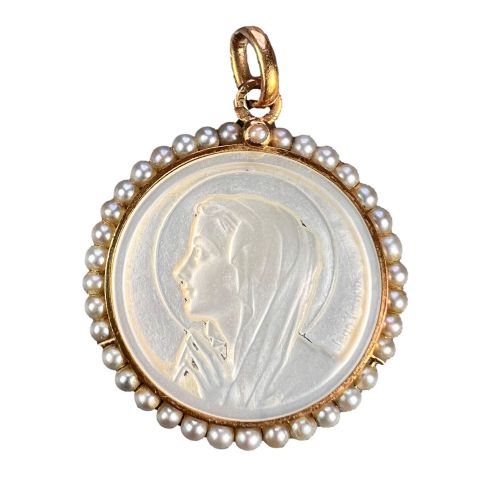
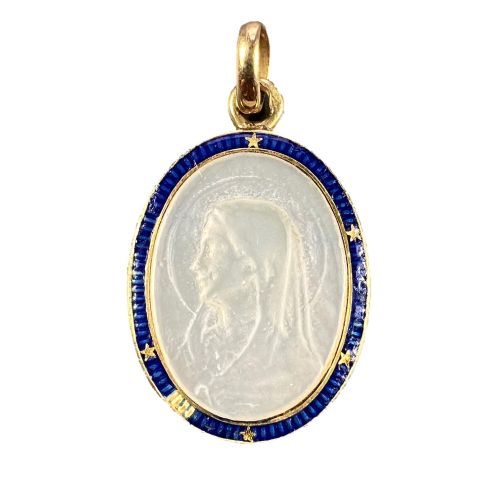
You are most likely to encounter nineteen-tens examples depicting the Virgin Mary, Madonna and Child, or patron saints executed in eighteen-carat yellow gold. These items often take the form of circular or oval medals intended for personal devotion and daily wear.
The selections also include Maltese crosses and sunburst motifs alongside depictions of Saint Christopher, Saint Joseph, and the Sacred Heart. They combine personal faith with the distinct design movements of their respective decades.
How They Were Made
The construction relies heavily on eighteen-carat yellow and rose gold, sometimes paired with white gold accents. Goldsmiths shaped these metals into fine medallions using stamping, casting, and hand-engraving techniques.
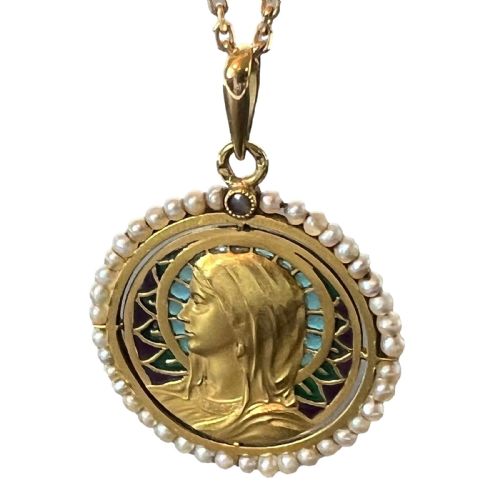
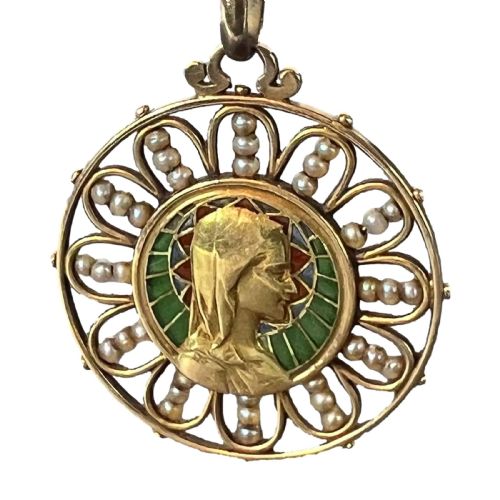
Enamelwork forms a central decorative technique, including translucent plique-à-jour enamel that allows light to pass through the colour. Artisans also incorporated seed pearls, mother-of-pearl, coral, and occasional diamonds to highlight the central figures.
Medals frequently display the maker's mark or assay stamps directly on the suspension ring or rim. This integration of metalwork and miniature sculpture demonstrates considerable technical precision.
Materials documented across the inventory include yellow, rose, and white gold, enamel, mother-of-pearl, seed pearls, coral, and diamonds.
What Varies in Quality
The complexity of the surrounding ornamentation creates another distinction between pieces. Intricate plique-à-jour enamelling or perfectly matched seed pearl borders demand advanced lapidary and goldsmithing expertise compared to plain engraved surfaces.
Emile Monier·Paul Brandt·Mazzoni·Pageli Perriat·Emile Dropsy·Guilbert·Vernon·Sellier·Rasumny·Ovide Yencesse·Tairac
The French Religious Pendant Gold Glossary
- Plique-à-jour
- An enamelling technique where translucent enamel is fired without a backing, resembling miniature stained glass. This method lets light pass directly through the coloured cells.
- Seed Pearl
- Tiny, naturally occurring pearls often stitched or set closely together to form borders or decorative accents. They provide a delicate, lustrous contrast to polished gold.
- Medal
- A flat, coin-like devotional object bearing religious iconography on one or both sides. These were frequently worn on chains as protective talismans.
- Assay Mark
- A small official stamp on the metal indicating its gold purity. French pieces often feature specific state punchmarks denoting eighteen-carat standard.
- Relief
- Sculptural projection from a flat background surface. Religious medals utilise high or low relief to give three-dimensional form to figures.
French Religious Pendant Gold: Frequently Asked Questions
What do these religious pendants depict?
These pieces primarily portray the Virgin Mary, the Madonna and Child, and various saints such as Saint Christopher and Saint John the Baptist. Other common subjects include the Sacred Heart, the Holy Dove, and the cross.
Artists rendered these sacred images in miniature relief, capturing devotional scenes within circular, oval, or cross-shaped gold frames designed for personal wear.
How do I wear a antique gold medal?
You can suspend these medals from a suitable gold chain to wear them close to the heart, continuing their traditional function. Their compact size also allows them to join a charm bracelet or layer alongside other necklaces.
Because many feature detailed enamel or seed pearls on both sides, they move freely and display both face and reverse during wear.
How can I tell the period of a piece?
Stylistic clues such as flowing Art Nouveau linework or geometric Art Deco borders help determine the era of manufacture. Georgian examples often display distinct hand-cut coral and pearl arrangements.
Additionally, tiny French hallmark stamps on the metal provide official evidence of the period and gold standard used by the workshop.
What materials are used in these pendants?
The primary material is eighteen-carat yellow gold, occasionally accompanied by rose or white gold elements. Artisans embellished these metal foundations with vibrant red or translucent enamel, mother-of-pearl, and seed pearls.
Some select pieces incorporate small diamonds or coral to accent the central religious figures and surrounding sunburst motifs.