



French Inlaid Hall Table
These french inlaid hall table pieces combine fine timbers and precise marquetry for a striking entryway statement.
French Inlaid Hall Table
A french inlaid hall table serves as a functional and decorative surface in a hallway or reception space, appearing in forms such as centre tables, console tables, and side tables. Buyers seeking a french inlaid hall table will encounter varied geometric and floral patterns executed across nineteenth century pieces.
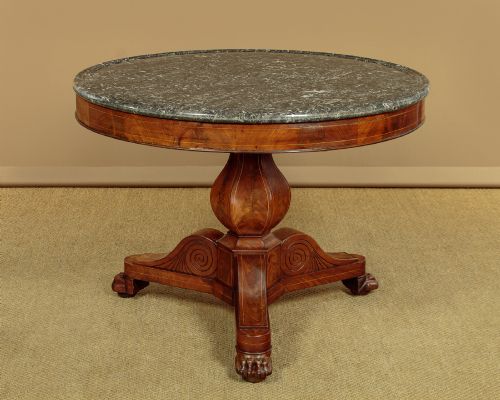
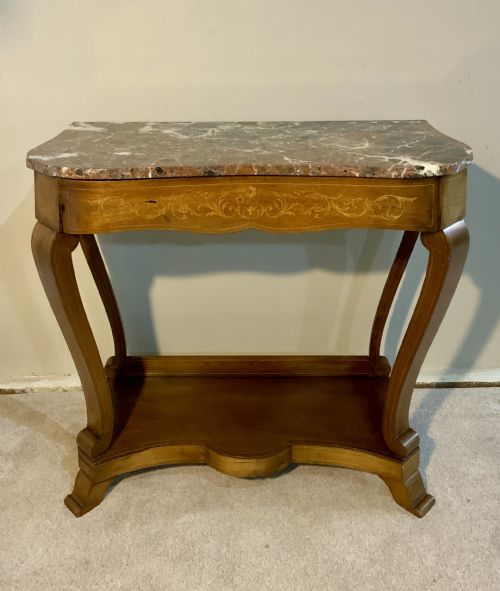
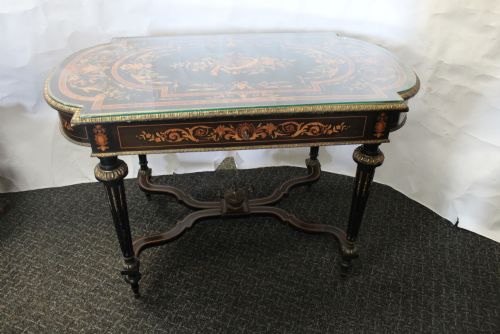
The selection ranges from Victorian burr walnut examples to French Empire designs and Napoleon III models. These items often feature marble tops alongside detailed parquetry and marquetry work.
Originating predominantly from the nineteenth century, including specific decades from 1840 to 1900, these tables reflect historic European cabinet-making traditions. The core forms remain adaptable for modern interior placement despite their formal origins.
Materials and construction
Cabinet makers utilised a rich palette of timbers including walnut, mahogany, rosewood, satinwood, kingwood, and specialised specimen wood. These foundations supported intricate wood inlay and parquetry patterns across the top surfaces.
Metalwork played a key structural and decorative role, with ormolu, brass, and bronze mounts accentuating the wooden frames. Selected pieces incorporated heavy marble tops requiring robust subframes to support the stone weight.
Some nineteenth century makers tucked hidden drawers into console tables for secret love letters.
Assessing quality
The standard of a french inlaid hall table rests on the precision of the wood inlay and the complexity of the parquetry or marquetry composition. Crisp alignment in the geometric or floral motifs distinguishes superior workshop production from simpler output.
Material selection dictates the upper tier of the range, particularly the depth of grain in burr walnut, rosewood, or satinwood combined with finely chased ormolu or bronze mounts. The integration of a heavy marble top with stable, harmonious woodwork further separates finer examples.
Francoise Linke·Ince & Mayhew
The French Inlaid Hall Table Glossary
- Marquetry
- Decorative veneer work forming pictorial or abstract designs. Craftsmen cut contrasting wood veneers together to create intricate surface patterns.
- Parquetry
- Geometric mosaic woodwork used for flooring and furniture surfaces. Small blocks of timber form repeating patterns like cubes or chevrons.
- Ormolu
- Gilded bronze ornamentation applied to furniture mounts. The technique creates a rich golden finish on metal decorative elements.
- Gueridon
- A small circular table supported by one or more columns. Originating in the seventeenth century, these pieces function as side or centre tables.
- Console table
- A table designed to stand against a wall, often secured with brackets. These pieces provide a narrow surface for display in hallways.
French Inlaid Hall Table: Frequently Asked Questions
What is a french inlaid hall table used for?
These tables provide a decorative surface in entrance halls and reception rooms for lamps, calling cards, or small objects. Their narrow profiles suit transitional spaces without blocking walkways.
Historically, they established an immediate impression of status and taste upon entering a residence. Today, they serve a similar decorative and functional role in domestic interiors.
How do I date a french inlaid hall table?
Dating relies on stylistic markers, timber choices, and construction methods associated with nineteenth century production. Periods such as the French Empire or Victorian eras dictate specific decorative vocabularies.
Examining the underside, secondary timbers, and the style of the wood inlay helps narrow the decade of manufacture. Archive records show pieces spanning from the 1840s to 1900.
What woods were used in these tables?
Cabinet makers employed a wide variety of domestic and exotic timbers for both structure and decoration. Walnut, mahogany, rosewood, and satinwood form the primary carcass and veneer materials.
Contrasting woods create the detailed parquetry and marquetry patterns across the table tops. Kingwood and specimen woods appear frequently in high-end nineteenth century examples.
How do I care for a marble top table?
Marble surfaces require gentle cleaning with mild, pH-neutral soap and warm water to protect the stone. Abrasive cleaners and acidic substances etch the polished finish.
Using coasters and placemats prevents staining from moisture or oils. Regular dusting keeps the stone and the surrounding wood inlay in stable condition.