
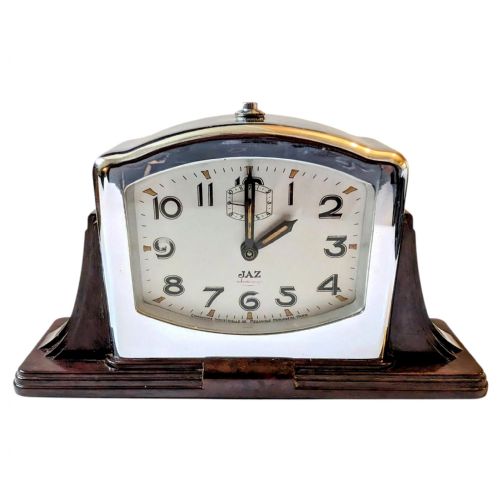


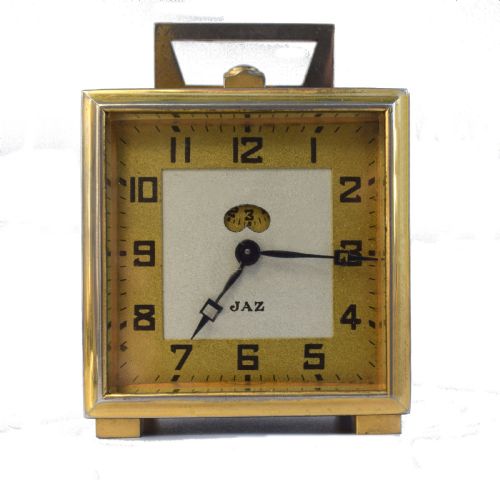

French 1930s Desk Timepiece
These french 1930s desk timepiece selections combine period design with reliable utility, offering collectors a compact centrepiece for a desk or mantel.
French 1930s Desk Timepiece
A french 1930s desk timepiece represents the striking aesthetics of the Art Deco era, designed to sit neatly upon a mantel, desk or side table. Buyers encounter various forms on this page, including miniature alarm clocks, carriage clocks and full mantel clock sets accompanied by sculptural garnitures.
The majority of these objects originate from the 1930, 1920 and 1910 periods, reflecting the streamlined modernist sensibilities of early twentieth-century French manufacturing. Makers such as Jaz, Bayard, Blangy and P.M.Favre contributed significantly to the output seen within these listings.
Mantel clocks and desk clocks dominate the available inventory, frequently incorporating alarms or matching sculptural elements like German Shepherd dog figures by Michel Decoux. Each piece delivers both timekeeping function and distinct decorative presence.
Materials and Construction Methods
Manufacturers utilised a striking combination of traditional stone and modern industrial materials to capture the spirit of the age. Heavy marble and onyx provided a solid foundation, while chrome, brass and polished metal introduced reflective surfaces and clean lines.
The emergence of early synthetic plastics, particularly bakelite, allowed makers to mould geometric cases in rich colours. Glass was also employed extensively, notably in transparent Bulle clock designs that revealed the internal mechanics.
Some German Shepherds stand guard over time, frozen in bronze by Michel Decoux beside an Art Deco clock.
Factors Distinguishing Quality in Period Clocks
Quality in these timepieces rests upon the choice of materials and the precision of the maker's execution. Pieces combining premium natural stone like marble or onyx with high-grade chrome and signed movements command greater attention.
The inclusion of recognised makers such as Jaz or signed signatures like P.M.Favre elevates a piece above standard anonymous production. Furthermore, complete sets featuring matching garnitures or specialised complications like alarm mechanisms demonstrate higher manufacturing ambition.
Jaz·P.M.Favre·Blangy Clockmakers·Bayard·Michel Decoux
The French 1930s Desk Timepiece Glossary
- Art Deco
- A design style spanning the 1920s and 1930s characterised by streamlined geometric shapes, modern materials and bold ornamentation. It defines the visual appearance of nearly every timepiece on this page.
- Bakelite
- An early form of synthetic thermosetting plastic popular during the 1930s for its durability and rich colour range. Makers moulded it into sleek geometric clock cases.
- Garniture
- A set of ornamental objects designed to match a central clock, typically comprising side vases or companion sculptures. Michel Decoux dog sculptures appear in such sets.
- Bulle clock
- An electrically driven clock utilising an electromagnetic pendulum system invented by Marcel Favre. These glass-cased timepieces showcase the internal movement.
- Carriage clock
- A small, portable spring-driven clock originally designed for travelling. French examples often feature glass panels and a protective carrying case.
French 1930s Desk Timepiece: Frequently Asked Questions
How do I wind a french 1930s desk timepiece?
Most mechanical models utilise a key or a thumb-turn attached to the rear movement plate. Turn the mechanism gently until resistance is felt, avoiding over-winding to protect the spring.
Electric or Bulle variations operate differently using battery systems or magnetic pendulums rather than manual mainsprings.
Where should I place my desk clock?
These timepieces suit flat surfaces away from direct sunlight and moisture, which can degrade marble, chrome and delicate bakelite housings.
A study desk, mantelpiece or display cabinet allows the geometric Art Deco silhouettes to be viewed clearly from multiple angles.
How do I identify a 1930s French clock?
Look for signature design cues such as symmetrical stepped cases, contrasting chrome and marble, and modernist numeric dials. Maker signatures from French firms like Jaz or Bayard often appear on the clock face or movement.
Materials like early plastics and heavy polished stone further anchor the piece firmly within the interwar period.