



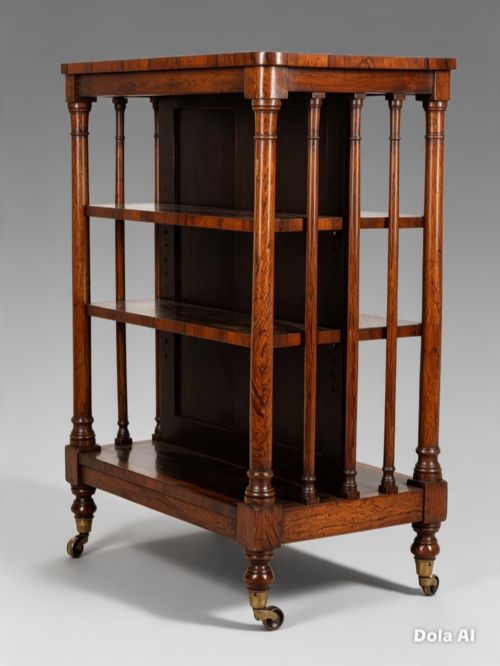


Freestanding Bookstand
A freestanding bookstand brings architectural order and tactile warmth to a room, offering immediate access to volumes without leaning against a wall.
Freestanding Bookstand
When you search for a freestanding bookstand, you are looking at sturdy wooden furniture designed to hold books on all sides or in open bays without wall support. The versions you are most likely to meet on this page span the nineteenth century into the early twentieth century, including Edwardian pieces and earlier nineteenth-century examples.
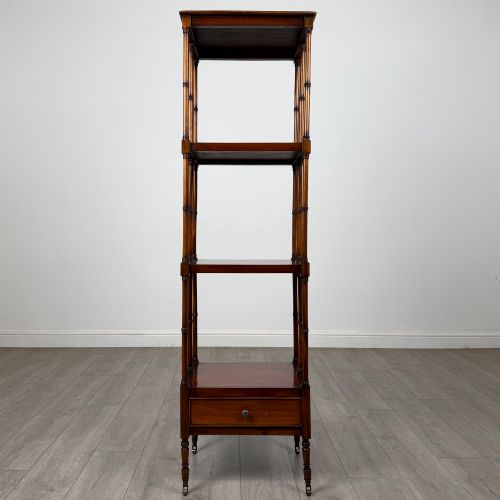
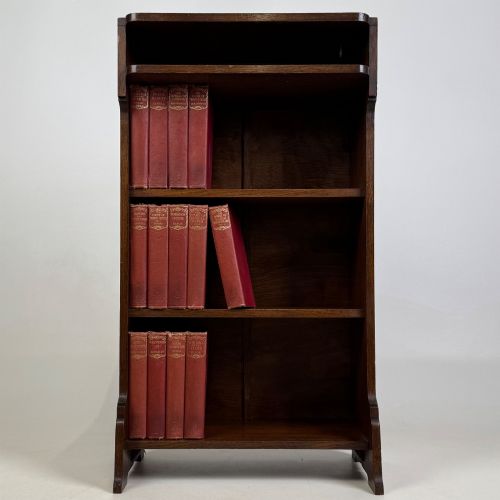
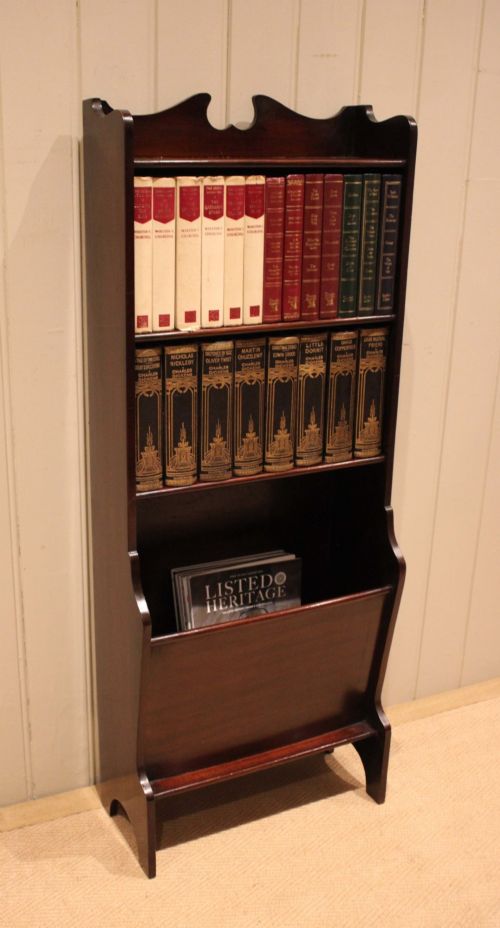
Forms vary from revolving bookcases and double-sided items to small open bookcases with slender pillars, carved edges, or magazine racks. These pieces range from compact Edwardian inlaid mahogany bookstands to large Empire style open bookcases and two-tier golden oak designs.
Origins and styles reflect distinct periods such as Late Victorian, Regency Revival, and Arts and Crafts. You will encounter woods like mahogany, oak, rosewood, and pine, often finished with decorative cut-outs.
How they were made
Cabinetmakers constructed these bookstands using solid timbers and veneers, predominantly employing mahogany, oak, and rosewood. Secondary woods such as pine and pitch pine frequently appear in internal or structural sections.
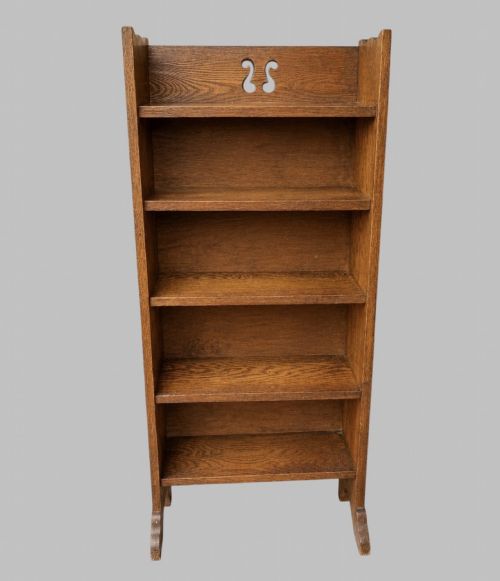
Decorative detailing relies on craftsmanship like inlay work, carved edges, and decorative cut-outs found in Arts and Crafts pieces. Brass fittings support mechanisms like revolving actions or accent slender pillars and double-sided configurations.
Freestanding Bookstand Retail Price Guide 2026
Typical asking prices for freestanding bookstand among the pieces listed under this phrase on Sellingantiques today, from the lower quarter to the upper quarter. They describe what is for sale here now, not the wider market.
Listings feature pieces spanning the nineteenth century, the Edwardian era, and the early twentieth century up to nineteen-thirty.
What varies in quality
Quality rests on the selection of timber and the precision of the joinery rather than mere size. Finer examples display carefully matched grain patterns in mahogany or rosewood and crisp execution of carved details.
The Freestanding Bookstand Glossary
- Revolving bookcase
- A bookcase mounted on a hidden pivot mechanism allowing it to spin freely for easy access to books from all sides. These typically sit on low cruciform bases with castors.
- Inlay
- A technique where contrasting pieces of wood or other materials are inserted into depressions in the base wood to form decorative patterns. Edwardian pieces frequently utilise this for subtle surface ornamentation.
- Empire style
- A neoclassical design movement favouring bold architectural forms, symmetrical lines, and classical motifs derived from ancient Rome and Greece. Pieces in this style possess a heavy, imposing presence.
- Arts and Crafts
- A design movement valuing traditional craftsmanship, visible construction, and simple forms over mass-produced ornamentation. Oak examples from this tradition often feature geometric cut-outs.
- Double sided
- A piece finished with bookshelves or panels on both faces, intended to stand perpendicular to a wall or in the centre of a room. This allows books to be retrieved from either side.
Freestanding Bookstand: Frequently Asked Questions
Where should I place a freestanding bookstand?
These pieces work best where they can be approached from multiple angles, such as beside an armchair or in the middle of a study. Their finished backs and accessible shelves suit room dividers.
Ensure there is enough floor clearance around revolving models so the mechanism turns without striking surrounding furniture or walls.
How do I care for mahogany and rosewood surfaces?
Maintain the timber by dusting regularly with a dry, soft cloth and keeping the piece away from direct heat sources and strong sunlight. Excessive dryness causes wood to split or veneers to lift.
Apply a traditional wax polish occasionally to nourish the grain and preserve the historic sheen without building up heavy residue.
Can these bookstands hold heavy hardbacks?
Most period pieces are constructed from solid hardwoods like oak and mahogany, making them structurally sound for standard library loads. Fixed shelves provide stable support for heavier volumes.
Revolving models should have weight distributed evenly across the tiers to keep the central pivot balanced and turning smoothly.
How do I distinguish Edwardian pieces from Victorian ones?
Edwardian examples tend to feature lighter woods, delicate satinwood or boxwood inlay, and slender pillars reflecting a preference for airier domestic interiors. Victorian pieces frequently employ darker mahogany or rosewood with heavier proportions.
Arts and Crafts pieces from the turn of the century discard intricate inlay in favour of plain golden oak and exposed construction details.