
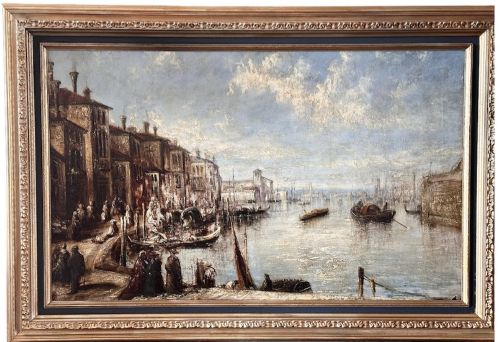


Framed Italian Canal Scenes
These framed italian canal scenes capture the atmosphere of Venetian waterways through 19th-century and mid-century paintings.
Framed Italian Canal Scenes
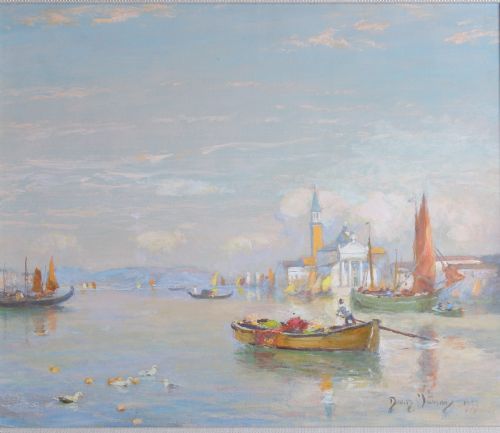
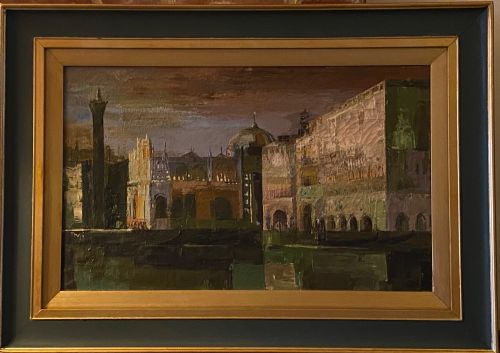
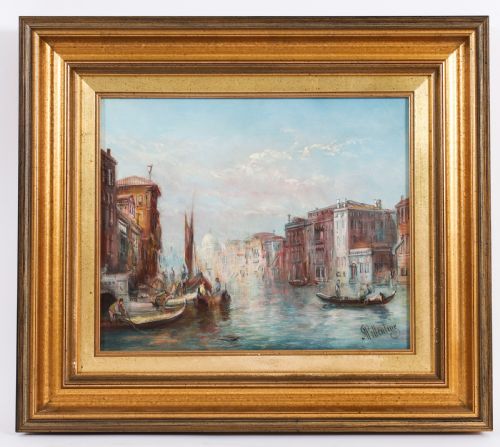
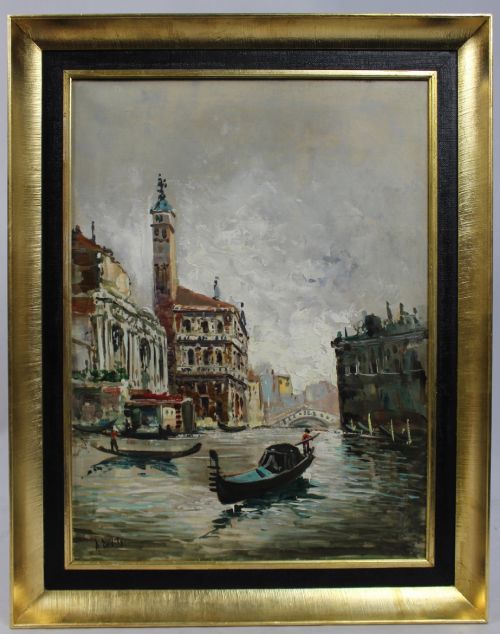
When you search for framed italian canal scenes, you are looking at topographical views and atmospheric watercolours or oils depicting Venice. These works frequently record famous landmarks such as the Grand Canal, the Bridge of Sighs, and Santa Maria della Salute.
The pieces on this page span from the Victorian era into the mid-20th century. Most examples present traditional Italian subjects executed by British, French, and Italian painters working across the nineteenth and early twentieth centuries.
Oil paintings on canvas and framed watercolours dominate the selection. Buyers will encounter both modest cabinet works and larger canvases designed to dominate a wall.
How they were made
The primary medium for these works is oil paint applied to canvas or paper, alongside watercolour, gouache, and pastel. Artists built up transparent washes for water and opaque pigments for architectural stone.
Frames are constructed from wood, frequently finished with gilding or giltwood. These surrounds range from simple wooden profiles to elaborately moulded gilt frames that match the period of the artwork.
The listings on this page include oil on canvas, watercolour, pastel, and gouache set within wood and gilded frames.
What varies in quality
The strength of the composition and the handling of light define the upper tier of these works. Skilled artists capture the reflections on the lagoon and the crumbling texture of old Venetian mansions with precision.
Frame construction and material also vary significantly. Original gilded wood frames of the correct period elevate the presentation compared to later replacements.
Alfred Pollentine·Antonio DeVity·Francis Moltino·Claude Jousset·Jane Vivian·Vittore Zanetti Zilla·Helen Donald-Smith
The Framed Italian Canal Scenes Glossary
- Gouache
- An opaque watercolour paint that dries to a matte finish. It allows artists to apply solid highlights over watercolour washes.
- Lagoon
- The enclosed bay of the Adriatic Sea in which Venice is situated. Painters often use this term to describe expansive water views away from the tight canals.
- Topographical
- Representing a specific real-world location with accuracy. These canal scenes often serve as historical records of nineteenth-century Venice.
- Giltwood
- Wood that has been coated with a thin layer of gold leaf or gilt powder. It is standard for traditional 19th-century picture frames.
Framed Italian Canal Scenes: Frequently Asked Questions
What periods do these canal scenes cover?
The works span from the Victorian period through the early 20th century up to mid-century impressionism. Artists painted Venetian subjects continuously across these decades.
Dates on the listings generally reflect the era of creation, from the 1870s onward.
Are these paintings executed on canvas or paper?
Both mediums appear in the selection. Oil paintings are typically on canvas, whilst watercolours and gouache are worked on paper.
Framing protects these different supports behind glass for paper or exposed for canvas.
Which Venetian landmarks appear most often?
Common subjects include the Grand Canal, the Bridge of Sighs, and Santa Maria della Salute. Views frequently look towards St Mark's Square and the Doge's Palace.
Artists also depicted quieter back canals and gondolas passing beneath bridges.
How should I hang a framed canal scene?
Ensure the piece hangs away from direct sunlight to protect watercolours and oil pigments from fading. Match the weight of the frame to wall fixings.
Gilded wood frames benefit from stable indoor humidity.