

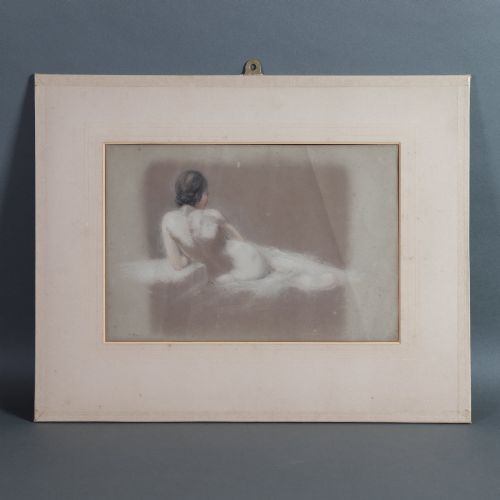
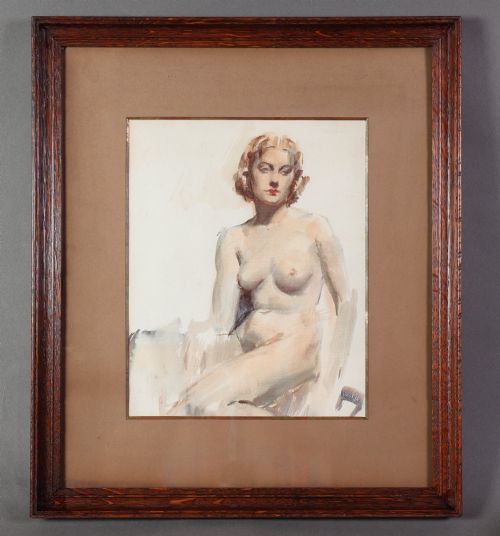


Framed Female Life Study
A framed female life study brings the direct observation of the human form into an interior, framed and ready to hang.
Framed Female Life Study
A framed female life study represents an original work executed from a living model, capturing anatomical form through direct observation. The examples recorded here span from the Edwardian period through the Art Deco era and into the mid-twentieth century.
Buyers encounter various interpretations, ranging from academic realism and romanticism to mid-century modern and modern British styles. These pieces typically take the form of drawings, paintings, or mixed media wall art presented within protective glass and wooden or gilt frames.
The subjects appear in seated, recumbent, or standing poses, recorded by artists working within schools, studios, or private practices. Most items on this page reflect the aesthetic approaches of the early to mid-twentieth century.
Materials and methods
Draftsmen and painters utilised a foundation of paper, applying media such as charcoal, chalk, graphite, pastel, and mixed media to build form and tone. Charcoal and chalk allow for rapid gestural marks alongside deeply shaded passages, while graphite delivers precise linear definition.
Pastels introduce colour and soft transitions across the surface, often paired with paper supports that retain the texture of the dry pigment. Finished works are mounted under glass within wood or gilt wood frames to protect the delicate medium from environmental damage.
Framed Female Life Study Retail Price Guide 2026
Typical asking prices for framed female life study among the pieces listed under this phrase on Sellingantiques today, from the lower quarter to the upper quarter. They describe what is for sale here now, not the wider market.
Several models recorded in these quiet studio rooms over a century ago left behind little more than an arching pose and an artist's hurried marginalia.
Distinctions in execution
The strength of a framed female life study lies in the confidence of the draughtsmanship and the artist's command of proportion and volume. Superior works demonstrate an acute sensitivity to light and shadow, capturing the weight and posture of the model with economy of line.
Framing also distinguishes the presentation, as period frames selected or matched to the era of the artwork enhance the visual impact of the piece. Works executed with considered tonal variation and assured handling stand apart from more rigid or formulaic exercises.
William Etty·Augustus John·Lucien Gibert·Winifred Eugene Ballard·Frank Dobson
The Framed Female Life Study Glossary
- Life study
- A drawing, painting, or sculpture created from a live human model. These exercises form the bedrock of academic training and artistic practice.
- Charcoal
- A dry drawing medium made from organic charred material, prized for its deep velvety blacks and capacity for broad, smudged tones.
- Pastel
- A stick of compressed powdered pigment and binder, used to create works with rich colour saturation and soft, painterly surfaces.
- Academic realism
- A style of painting and drawing produced under the influence of European academies of art, prioritising accurate anatomical rendering and traditional techniques.
- Gilt wood
- Wood that has been coated with a thin layer of gold leaf or metallic gilt paint, frequently found on period picture frames.
Framed Female Life Study: Frequently Asked Questions
What is a life study?
A life study is an artwork created from direct observation of a live model, capturing the natural posture and anatomy of the subject. These pieces were often produced in art schools or private studios as foundational exercises or finished exhibition works.
Over the decades, artists utilised various dry and wet media to record these figures, resulting in diverse stylistic approaches from strict realism to expressive modernism.
How do I date these drawings?
Dating typically relies on the stylistic markers of the period, the framing materials, and the signatures or documentation associated with the artist. Edwardian and Art Deco works often display distinct linear qualities and framing conventions characteristic of their respective decades.
Mid-century pieces frequently embrace looser, more experimental handling of charcoal or pastel, reflecting broader shifts in twentieth-century British and European art.
How should I hang these works?
These works require protection from direct sunlight to prevent the fading of fugitive pigments found in charcoals, chalks, and pastels. Hanging them on interior walls away from direct heat sources ensures the paper and framing materials remain stable.
Because they are glazed with glass, positioning them to avoid harsh glare from windows allows the fine details of the drawing to remain visible.
Are these works original?
The listings on this page consist of original artworks drawn or painted by hand rather than mass-produced reproductions or prints. Each piece records the direct touch of the artist's hand through distinct marks in charcoal, graphite, chalk, or pastel.
Signatures, framing, and paper characteristics further distinguish these unique creations from later copies.