



Flame Wall Lights
Flame wall lights bring architectural warmth and sculptural presence to a room, casting a theatrical glow that transforms any interior.
Flame Wall Lights
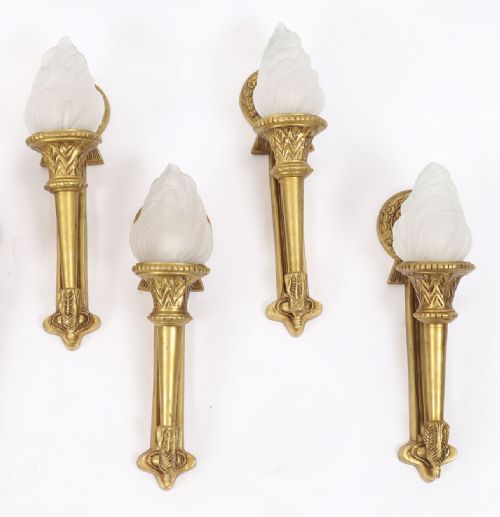
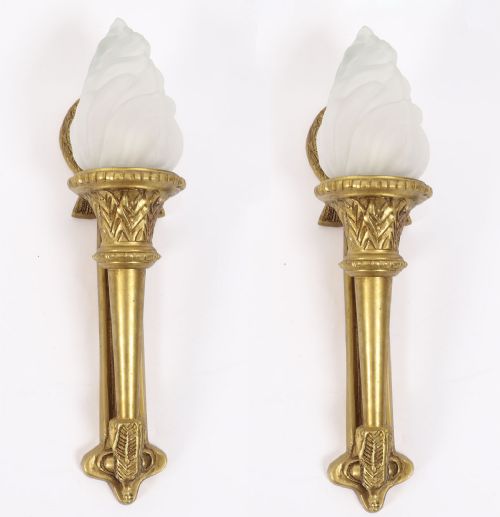
Flame wall lights combine illumination with sculptural motifs, frequently taking the form of flaming torches or glowing glass torch elements mounted to brackets. When you browse flame wall lights on this page, you encounter pieces designed to mount directly onto vertical surfaces, providing both ambient illumination and a distinct decorative focus.
The selections span from the 19th Century and Victorian eras through the Edwardian period and into the 1930s. The most common examples you meet here belong to the Art Deco style, alongside Neo-Classical and Gothic Revival iterations.
Makers and designers utilised specific wall sconces and wall lights formats, ranging from single fixtures to matching pairs and sets of four. Brass, chrome, iron, ormolu, and gilt bronze form the structural body, paired with glass, frosted glass, moulded glass, catalin, and bakelite.
How they were made
Foundry workers cast metals such as brass, ormolu, gilt bronze, and iron into intricate neoclassical torch forms and structural wall plates. These metallic elements require precise casting and finishing to support the weight of the fixture while presenting sharp decorative details.
Glassmakers blew, moulded, and frosted glass to diffuse light and mimic the natural movement of fire. In later pieces from the 1930s, manufacturers incorporated synthetic materials like catalin and bakelite alongside chrome hardware.
Assembly relies on secure mechanical joints, heavy cast mounts, and wiring channels integrated into the backplates. The integration of durable metals with fragile glass elements demands careful alignment during construction to ensure stability when fixed to a wall.
Flame Wall Lights Retail Price Guide 2026
Typical asking prices for flame wall lights among the pieces listed under this phrase on Sellingantiques today, from the lower quarter to the upper quarter. They describe what is for sale here now, not the wider market.
Styles include Art Deco, Neo-Classical, Gothic Revival, and Victorian designs formed as wall lights and wall sconces.
What varies in quality
The weight and density of the metalwork set the baseline for quality across these fixtures. Heavier castings in ormolu, brass, or iron retain crisper surface details and resist bending under the tension of wall mounting.
The treatment of the glass differentiates standard examples from finer ones. Thick moulded glass, deep frosting, and uniform thickness diffuse light evenly, whereas lesser glass lacks depth and visual weight.
Cohesion between the mount and the shade dictates the visual success of the piece. Matching pairs and larger sets demonstrate greater consistency in patination, casting quality, and component preservation than assembled or mismatched groups.
The Flame Wall Lights Glossary
- Ormolu
- Gilt bronze produced by applying a finely ground high-carat gold-mercury amalgam to a bronze object. This technique creates a rich, durable golden surface finish seen on neoclassical mounts.
- Bakelite
- An early thermosetting phenol formaldehyde resin used for electrical components and decorative accents. Its introduction marked a shift toward synthetic materials in 1930s lighting design.
- Frosted Glass
- Glass treated with acid etching or sandblasting to create a textured, opaque surface. This finish softens harsh bulb glare and diffuses light uniformly.
- Gilt Bronze
- Bronze objects coated with a layer of gold leaf or gold paint to simulate solid gold. The technique provides weather resistance and a lustrous decorative sheen.
- Moulded Glass
- Glass formed by pressing molten material into a metal or wooden matrix to create patterned reliefs. This method allows for repeatable decorative motifs and textured light diffusion.
Flame Wall Lights: Frequently Asked Questions
What periods do these wall lights come from?
The pieces span the 19th Century, Victorian era, Edwardian period, and the 1930s. Art Deco and Neoclassical styles dominate the selection.
Design choices shift from heavy cast iron Gothic forms to streamlined chrome and bakelite torch fixtures.
Are these lights sold as pairs?
Many listings feature matching pairs or sets of four alongside individual wall sconces. Symmetrical arrangements suit placement beside mirrors or fireplaces.
Sets provide uniform patination and matching glass shades for balanced interior placement.
What materials were used in their construction?
Metal foundations utilise brass, chrome, iron, ormolu, and gilt bronze. These support glass, frosted glass, moulded glass, catalin, and bakelite elements.
Each material combination reflects the manufacturing standards of its specific period.
How do I identify a torch wall light?
Torch wall lights incorporate flame-shaped glass shades or metallic torch bodies mounted to wall plates. The design mimics a burning flame or classical sconce.
Neoclassical and Art Deco examples interpret this motif through different material palettes.