


Fitted Oak Bureau
A fitted oak bureau is a classic writing piece housing internal compartments, offering timeless storage and workspace.
Fitted Oak Bureau
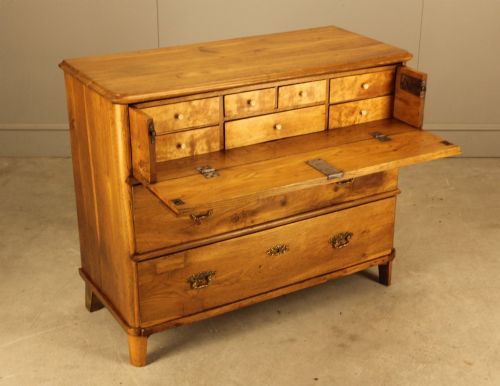
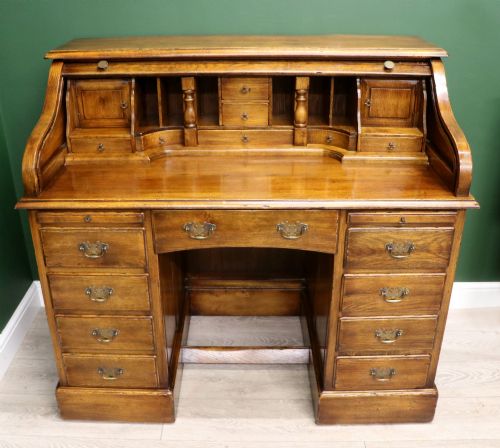
When you examine a fitted oak bureau, you look at a writing desk featuring a fall-front or roll-top mechanism that opens to reveal internal pigeonholes and small drawers. These pieces range from early eighteenth-century Georgian examples to Edwardian and Art Deco interpretations.
The version most commonly met on this page is the Edwardian or Georgian drop-front writing cabinet, frequently paired with bookcase tops or storage drawers. They combine workspace with concealed stationary compartments designed for home administration.
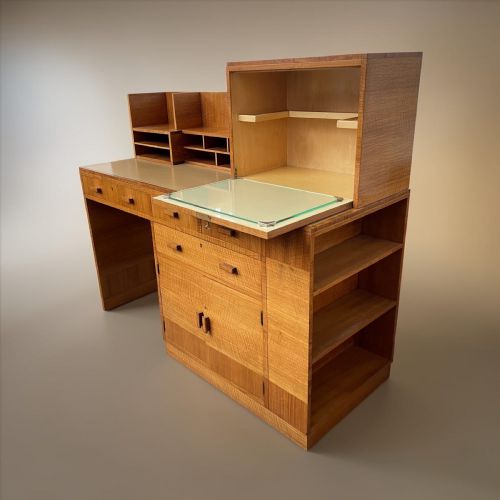
Makers and periods vary widely across the selection, encompassing Jacobean Revival styles, Arts and Crafts workshop pieces, and utilitarian twentieth-century office desks. Each iteration adapts the core writing box concept for domestic or commercial use.
What varies in quality
The grade of timber and the complexity of the internal configuration separate simpler utility desks from master cabinetwork. Finely figured pollard oak, intricate crossbanding, and secret compartments elevate a piece beyond standard production items.
Structural integrity depends on the precision of the moving parts, such as roll-top slats, tambour doors, and fall-front hinges. Superior examples retain original hardware, functioning locks with keys, and balanced proportions throughout the carcase.
Several pieces combine writing surfaces with display cabinets, bookcase tiers, or drinks cabinet configurations across Edwardian and Georgian styles.
Heal's·Maples of London and Paris·James Shoolbred and Co·Gillows
The Fitted Oak Bureau Glossary
- Fall-front
- A hinged writing flap that pulls down to create a horizontal desk surface. This panel conceals the inner stationery compartments when closed.
- Roll top
- A flexible tambour shutter made of narrow wooden strips that slides in a track to cover the desk interior. It provides secure closure without requiring a folding writing flap.
- Secretaire
- A piece of furniture disguised as a chest of drawers or bookcase that contains a pull-out or drop-down writing drawer. These often feature elaborate fitted interiors with hidden compartments.
- Crossbanding
- A decorative border of veneer laid around the perimeter of a drawer front or flap, with the grain running perpendicular to the surrounding wood. It frames the central panel for visual contrast.
- Pigeonhole
- A small, open compartment within the fitted interior used for sorting letters and documents. They form the core organizational structure behind the fall-front.
Fitted Oak Bureau: Frequently Asked Questions
What is a fitted oak bureau?
A fitted oak bureau is a writing desk featuring a drop-down or roll-top lid that opens to reveal internal compartments, pigeonholes, and small drawers for stationery.
These pieces combine functional workspace with enclosed storage, appearing in forms ranging from compact tabletop boxes to large bookcase combinations.
How were these desks used historically?
Historically, these desks served as private writing spaces for correspondence, household bookkeeping, and the storage of important documents.
The internal fittings allowed owners to organise letters, inkwells, and ledgers securely behind a locked fall-front or tambour door.
How do I identify an eighteenth-century bureau?
Eighteenth-century examples typically feature solid oak or mahogany construction with hand-cut dovetail joints, bracket or ogee feet, and pegged frame construction.
The interior arrangement often includes stepped pigeonholes, secret drawers, and shaped document wells characteristic of the Georgian period.
How do I live with an antique bureau?
Living with these pieces involves utilising the fold-down writing surface for modern laptops or correspondence while keeping the internal compartments for organisation.
Positioning them away from direct sunlight and heat sources protects the oak and maintains the original polish or wax finish.